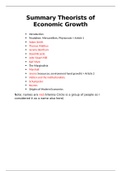
Summary Theorists of
Economic Growth
Introducton
Feudalism, Mercantlism, Physiocrats + Artcle 1
Adam Smith
Thomas Malthus
Jeremy Bentham
David Ricardo
John Stuart Mill
Karl Marx
The Marginalists
Marshall
Jevons (resources, environment hand growth) + Artcle
Veblen and the insttutonalists
Schumpeter
Keynes
Origins of Modern Economics
Note: names are red (Vienna Circle is a group of people so I
considered it as a name also here)
,Introduction
Chapter 1
The evolution of methodological thought (1900-2000)
Logical positiiss (19 0s – 1930s):
Group: Vienna Circle
Idea: scientsts develop a deductive structure (= logical theory), that leads to empirically
testable propositioos. The deductve theory is accepted as true, afer it has been empirically
tested and verifed.
Possibility of ierifcatoi
Role of scientsts: 1. Develop the theories . Test them
Formalized the distncton between normatve and positve economics normatve
economics (art of decision-making, advice to policy-makers etc) was neglected.
Purpose of science: establish truth
Falsifcatoi
Karl Propper’s critque (190 -1994):
Possibility of falsifcatiooo Empirical theories cannot be verifed, because one cannot
perform all possible tests of the theory. Science should develop theories with empirically
testable hypothesis and then try to falsify them.
Progress in Science: although theories can never be qualifed as true, they approach a higher
degree of “truth-likeliness”, when the theory will be the one that explains the widest range
of empirical observatons that have not yet been falsifed.
Consequence: many ecooometric models have been developed to test economic theories.
Paradigss
Thomas Kuhn (19 - 1996):
Problems with falsifcaton:
1) some empirical predictons cannot be tested, because the technology to test them doesn’t
exist
) It’s difcult to determine when a theory has (not) been falsifed, because exogenous
factors can also explain the failure if an empirical test doesn’t produce the expected results.
(how many tests?)
3) Researches do not try to falsify theories, because of their mindset about the theory to be
true.
Kuhn: chaiges occur by (quick) reiolutois
Paradigm = given approach and body of knowledge built into researchers’ analysis that
conforms to the accepted presentaton of mainstream scientfc thought at a given tme.
Normal science = solving puzzles posed within the existng paradigm, and so broaden the
applicaton of theories.
leads to aoomalies that the paradigm fails to account for anomalies trigger search for
alternatie theories competng theories alternatve paradigm found shift to a iew
paradigs (=scientic reioluton)
Reiolutoiary scieice = 1. Existng paradigm reeected by part of the scientfc community .
Old and new paradigms compete; communicaton difcult 3. If revoluton successful: new
questons will be posed in the new paradigm oew oormal scieoce
, Propper: higher truth-likeliness wins; Kuhn: a superior paradigm can win: a superior, more
truth-likely theory can exist, but won’t be adopted if it doesn’t ft the existng paradigm.
Research prograss
Imre Lakatos (1960-1970)
Non-tested and non-testable hard core of a theory; normal science will never be able to
falsify the hardcore;
Procedures scientsts: development competng research programmes (aoalysiog data,
attemptiog to falsify data, acceptiog hardcocore logical postulatesぅ
only peripheral implicatons can be falsifed :
Falsify a single peripheral implicaton: no reeecton of the theory
reconsideraton of the logical structure
degeneratve (deterioratve) research programmes
Falsify sufcient peripheral implicatons: reconsideraton of the hard-core assumptons
progressive research programs
signifcant features of Lakatos:
1) recognizes complexity of the process of falsifying a theory
) geliektedig bestaan van meerdere bruikbare theorieën, waarbie relateve voordelen niet
makkeliek te zien zien. (ENG: recognized that more useful theories can exist at the same tme,
and it’s hard to see which theory has more advantages)
Sociological aid rhetorical approaches to sethod
Deidre Mac Closkey (194 - …): The rhetoric of economics
Economics is “story-telling”
Economic science is social, interest-laden, situated contextual and contngent
Methodological pluralism
Cliometrics: an approach to history using economic and econometric methods
Colander: distncton between orthodox and mainstream (see ARTICLE 1)
Feyerabend (1975): the acceptance of any method limits creatvity in problem-solving.
First: difculty discovering the truth with methodologies
Now: no existence of absolute truth rethorical/sociological approaches.
Rhetorical approach to methodology = theory accepted because of persuasive rhetoric
Sociological approach to methodology=social and insttutonal constraints infuence the
acceptability of a theory
So a theory/methodological thought can evolve for various reasons, e.g. when the social and
insttutonal constraints change.
Post-rhetorical sethodology
Combinaton of “everything goes” (Feyerabend) and “more workable approaches”.
Abductoi: observaton most likely explanaton
Certain elements of logical positvism and falsifcatonism methodology
Rhetorical and sociological argument accepted by post-rhetorical economists.
More sceptcal of their own knowledge
Less likely to dismiss an argument as false before close consideraton
Scrutnize (onderzoeken) incentves of researchers to study partcular theories & are sceptc
about own interest
More likely to follow Bayesian: no ultmate truth, but higher degrees of truth & statstsche
testen minder exact, minder rhetorisch en afankeliek representatef voor een bepaald
betrouwbaarheidsniveau (ENG: statstcal methods are less exact, less rhetoric and
dependently representatve for a certain level of credibility).
, Two scieitfc reiolutois ii ecoiosics
1. The sargiialist reiolutoi (early 1870s)
[wiki: the development of economic theory in the late 19th century which explained
economic behaviour in terms of marginal utility and related concepts]
Revoluton in the theory of ialue
Important marginalist revolutonists:
- Jevons (England)
- Menger (Austria)
- Walras (France)
Voorloper: Heinrich Herman Gossen (1810 – 1858): “the development of the laws of human
intercourse and the consequent rules of human acton” (book 1854)
Law 1: diminishing marginal utlity of consumpton
Law : in an optmum, marginal utlity of all consumpton is equal
Introduced: measurability of marginal utlity; possibility of interpersonal comparisons;
implicatons of utlitarianism for distributon
. The ordiialist reiolutoi (1930s)
[idea of indiference curies and ranking preferences]
The ideas of measurability and interpersonal comparability seen as impossible, you can only
rank preferences for an individual, but not between individuals.
L. Robbins (193 ): “an essay on the Nature and signifcance of economic science”
J. Hicks and R. Allen (1934): “a reconsideraton of the theory of value”
Article 1:
David Colander, Richard Holt & Barkley Rosser Jr. ( 004): The changing face of mainstream
economics, Review of Politcal Economy, 16:4, 485-499
Maiistreas ecoiosics = ideas that are held by those individuals who are dominant and
leading (elite = academic insttutons, organizatons, eournals at a given tme etc)
Neoclassical orthodoxy = fully ratonal and well-informed individuals in a statc context and
the equilibria that result from that optmizaton; marginalist revoluton; methodological
approach = axiomatc deducton (logica)
Heterodox = against orthodox = outside of the mainstream & more social aspects: refuse to
work within the mainstream economics because of the nature of modelling process used, or
because of the assumptons made
Heterodox economists critcize the mainstream economics for being the same as the
neoclassical economics (1950). This paper: the saiistreas ecoiosic thiikiig has chaiged.
Orthodox: ratonality, selfshness, equilibrium
Now: purposeful behaviour, enlightened self-interest, sustainability.
Nature of this chaige:
Economics is a complex system/dynamic entty (self-reproducing, evolving system of
interactng ideas). Just to convey the message of economics to others, we use statc
classifcatons and organize it in distnct periods (classical, neoclassical etc.), to provide
structure. But underneath any statc classifcaton hides a dynamic change. Economics is not
a single set of ideas, but a diverse evolving set of ideas.”
“saiistreas ecoiosics is a cosplex systes of eioliiig ideas”
Process of this chaige:
Acceptance of new ideas by a proporton of the elite of the profession; organisators
(intellectual) of the ideas must atract the atenton of infuental individuals (social).
Heterodox economists get fundings not through normal channels, because they consider
themselves outside the mainstream. An enormous lag before disseminated in the
Economic Growth
Introducton
Feudalism, Mercantlism, Physiocrats + Artcle 1
Adam Smith
Thomas Malthus
Jeremy Bentham
David Ricardo
John Stuart Mill
Karl Marx
The Marginalists
Marshall
Jevons (resources, environment hand growth) + Artcle
Veblen and the insttutonalists
Schumpeter
Keynes
Origins of Modern Economics
Note: names are red (Vienna Circle is a group of people so I
considered it as a name also here)
,Introduction
Chapter 1
The evolution of methodological thought (1900-2000)
Logical positiiss (19 0s – 1930s):
Group: Vienna Circle
Idea: scientsts develop a deductive structure (= logical theory), that leads to empirically
testable propositioos. The deductve theory is accepted as true, afer it has been empirically
tested and verifed.
Possibility of ierifcatoi
Role of scientsts: 1. Develop the theories . Test them
Formalized the distncton between normatve and positve economics normatve
economics (art of decision-making, advice to policy-makers etc) was neglected.
Purpose of science: establish truth
Falsifcatoi
Karl Propper’s critque (190 -1994):
Possibility of falsifcatiooo Empirical theories cannot be verifed, because one cannot
perform all possible tests of the theory. Science should develop theories with empirically
testable hypothesis and then try to falsify them.
Progress in Science: although theories can never be qualifed as true, they approach a higher
degree of “truth-likeliness”, when the theory will be the one that explains the widest range
of empirical observatons that have not yet been falsifed.
Consequence: many ecooometric models have been developed to test economic theories.
Paradigss
Thomas Kuhn (19 - 1996):
Problems with falsifcaton:
1) some empirical predictons cannot be tested, because the technology to test them doesn’t
exist
) It’s difcult to determine when a theory has (not) been falsifed, because exogenous
factors can also explain the failure if an empirical test doesn’t produce the expected results.
(how many tests?)
3) Researches do not try to falsify theories, because of their mindset about the theory to be
true.
Kuhn: chaiges occur by (quick) reiolutois
Paradigm = given approach and body of knowledge built into researchers’ analysis that
conforms to the accepted presentaton of mainstream scientfc thought at a given tme.
Normal science = solving puzzles posed within the existng paradigm, and so broaden the
applicaton of theories.
leads to aoomalies that the paradigm fails to account for anomalies trigger search for
alternatie theories competng theories alternatve paradigm found shift to a iew
paradigs (=scientic reioluton)
Reiolutoiary scieice = 1. Existng paradigm reeected by part of the scientfc community .
Old and new paradigms compete; communicaton difcult 3. If revoluton successful: new
questons will be posed in the new paradigm oew oormal scieoce
, Propper: higher truth-likeliness wins; Kuhn: a superior paradigm can win: a superior, more
truth-likely theory can exist, but won’t be adopted if it doesn’t ft the existng paradigm.
Research prograss
Imre Lakatos (1960-1970)
Non-tested and non-testable hard core of a theory; normal science will never be able to
falsify the hardcore;
Procedures scientsts: development competng research programmes (aoalysiog data,
attemptiog to falsify data, acceptiog hardcocore logical postulatesぅ
only peripheral implicatons can be falsifed :
Falsify a single peripheral implicaton: no reeecton of the theory
reconsideraton of the logical structure
degeneratve (deterioratve) research programmes
Falsify sufcient peripheral implicatons: reconsideraton of the hard-core assumptons
progressive research programs
signifcant features of Lakatos:
1) recognizes complexity of the process of falsifying a theory
) geliektedig bestaan van meerdere bruikbare theorieën, waarbie relateve voordelen niet
makkeliek te zien zien. (ENG: recognized that more useful theories can exist at the same tme,
and it’s hard to see which theory has more advantages)
Sociological aid rhetorical approaches to sethod
Deidre Mac Closkey (194 - …): The rhetoric of economics
Economics is “story-telling”
Economic science is social, interest-laden, situated contextual and contngent
Methodological pluralism
Cliometrics: an approach to history using economic and econometric methods
Colander: distncton between orthodox and mainstream (see ARTICLE 1)
Feyerabend (1975): the acceptance of any method limits creatvity in problem-solving.
First: difculty discovering the truth with methodologies
Now: no existence of absolute truth rethorical/sociological approaches.
Rhetorical approach to methodology = theory accepted because of persuasive rhetoric
Sociological approach to methodology=social and insttutonal constraints infuence the
acceptability of a theory
So a theory/methodological thought can evolve for various reasons, e.g. when the social and
insttutonal constraints change.
Post-rhetorical sethodology
Combinaton of “everything goes” (Feyerabend) and “more workable approaches”.
Abductoi: observaton most likely explanaton
Certain elements of logical positvism and falsifcatonism methodology
Rhetorical and sociological argument accepted by post-rhetorical economists.
More sceptcal of their own knowledge
Less likely to dismiss an argument as false before close consideraton
Scrutnize (onderzoeken) incentves of researchers to study partcular theories & are sceptc
about own interest
More likely to follow Bayesian: no ultmate truth, but higher degrees of truth & statstsche
testen minder exact, minder rhetorisch en afankeliek representatef voor een bepaald
betrouwbaarheidsniveau (ENG: statstcal methods are less exact, less rhetoric and
dependently representatve for a certain level of credibility).
, Two scieitfc reiolutois ii ecoiosics
1. The sargiialist reiolutoi (early 1870s)
[wiki: the development of economic theory in the late 19th century which explained
economic behaviour in terms of marginal utility and related concepts]
Revoluton in the theory of ialue
Important marginalist revolutonists:
- Jevons (England)
- Menger (Austria)
- Walras (France)
Voorloper: Heinrich Herman Gossen (1810 – 1858): “the development of the laws of human
intercourse and the consequent rules of human acton” (book 1854)
Law 1: diminishing marginal utlity of consumpton
Law : in an optmum, marginal utlity of all consumpton is equal
Introduced: measurability of marginal utlity; possibility of interpersonal comparisons;
implicatons of utlitarianism for distributon
. The ordiialist reiolutoi (1930s)
[idea of indiference curies and ranking preferences]
The ideas of measurability and interpersonal comparability seen as impossible, you can only
rank preferences for an individual, but not between individuals.
L. Robbins (193 ): “an essay on the Nature and signifcance of economic science”
J. Hicks and R. Allen (1934): “a reconsideraton of the theory of value”
Article 1:
David Colander, Richard Holt & Barkley Rosser Jr. ( 004): The changing face of mainstream
economics, Review of Politcal Economy, 16:4, 485-499
Maiistreas ecoiosics = ideas that are held by those individuals who are dominant and
leading (elite = academic insttutons, organizatons, eournals at a given tme etc)
Neoclassical orthodoxy = fully ratonal and well-informed individuals in a statc context and
the equilibria that result from that optmizaton; marginalist revoluton; methodological
approach = axiomatc deducton (logica)
Heterodox = against orthodox = outside of the mainstream & more social aspects: refuse to
work within the mainstream economics because of the nature of modelling process used, or
because of the assumptons made
Heterodox economists critcize the mainstream economics for being the same as the
neoclassical economics (1950). This paper: the saiistreas ecoiosic thiikiig has chaiged.
Orthodox: ratonality, selfshness, equilibrium
Now: purposeful behaviour, enlightened self-interest, sustainability.
Nature of this chaige:
Economics is a complex system/dynamic entty (self-reproducing, evolving system of
interactng ideas). Just to convey the message of economics to others, we use statc
classifcatons and organize it in distnct periods (classical, neoclassical etc.), to provide
structure. But underneath any statc classifcaton hides a dynamic change. Economics is not
a single set of ideas, but a diverse evolving set of ideas.”
“saiistreas ecoiosics is a cosplex systes of eioliiig ideas”
Process of this chaige:
Acceptance of new ideas by a proporton of the elite of the profession; organisators
(intellectual) of the ideas must atract the atenton of infuental individuals (social).
Heterodox economists get fundings not through normal channels, because they consider
themselves outside the mainstream. An enormous lag before disseminated in the