Margeaux Vorster ENG1501 56938233
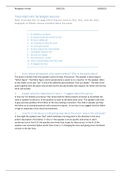
‘From Not Him’ by Wopko Jensma
Read ‘From No t H im ’ on pa ge 228 o f Seasons Com e to Pass. Also , rea d the shor t
b io graphy of Wopko Jensma provided abo ve th e p oem.
1. he forbids us to dance
2. he always leads the church service
3. he has a stable job
4. he is always on time for work
5. he never gets drunk
6. he has respects for most people
7. everybody respects him
8. we love our daddy
9. but sometimes i notice
10. when a kwela blasts from the radio
11. he wiggles his toes
1. From whose perspective is this poem written? Who is the poem about?
The poem is written from the speaker’s point of view, first person. The speaker is observing his
“father figure". The father figure can be presented as a priest or as a mentor. Or the speaker refers
to this father as he says “we” in line 8 (his different personalities) “love our daddy”. The title of the
poem signifies that the poem was written by the one personality that respects his father and not the
other personality.
2. Explain what the statements in lines 1 -7 suggest about this person.
In line one “he forbids us to dance” this shows that the father position of power as he forbids the
child or speaker to dance or in the position to want to tell them what to do. The speaker tries hard
to give positive qualities of his father as the tone lacking in emotion. The child or speaker portrays
the father as an exemplary person who everyone respects. In line two it can suggest that the father
is high or important in the church environment.
3. Lines 9-11 introduce a contrasting view about the poem. How is this achieved?
In line eight the speaker uses “but” which indicates a turning point in the direction in the tone
and/or description of his father. In line 1-7 the speaker is more specific and writes in short
sentences, but in line 8-11 the speaker uses three lines to get his ideas across. In line 8-11 the
speaker uses more descriptive words than in line 1-7, changing the tone and giving more emotional
context in the last lines.
‘From Not Him’ by Wopko Jensma
Read ‘From No t H im ’ on pa ge 228 o f Seasons Com e to Pass. Also , rea d the shor t
b io graphy of Wopko Jensma provided abo ve th e p oem.
1. he forbids us to dance
2. he always leads the church service
3. he has a stable job
4. he is always on time for work
5. he never gets drunk
6. he has respects for most people
7. everybody respects him
8. we love our daddy
9. but sometimes i notice
10. when a kwela blasts from the radio
11. he wiggles his toes
1. From whose perspective is this poem written? Who is the poem about?
The poem is written from the speaker’s point of view, first person. The speaker is observing his
“father figure". The father figure can be presented as a priest or as a mentor. Or the speaker refers
to this father as he says “we” in line 8 (his different personalities) “love our daddy”. The title of the
poem signifies that the poem was written by the one personality that respects his father and not the
other personality.
2. Explain what the statements in lines 1 -7 suggest about this person.
In line one “he forbids us to dance” this shows that the father position of power as he forbids the
child or speaker to dance or in the position to want to tell them what to do. The speaker tries hard
to give positive qualities of his father as the tone lacking in emotion. The child or speaker portrays
the father as an exemplary person who everyone respects. In line two it can suggest that the father
is high or important in the church environment.
3. Lines 9-11 introduce a contrasting view about the poem. How is this achieved?
In line eight the speaker uses “but” which indicates a turning point in the direction in the tone
and/or description of his father. In line 1-7 the speaker is more specific and writes in short
sentences, but in line 8-11 the speaker uses three lines to get his ideas across. In line 8-11 the
speaker uses more descriptive words than in line 1-7, changing the tone and giving more emotional
context in the last lines.