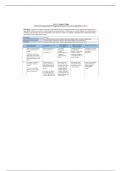
What constitutes a theoretical contribution? Whetten, 1999
What are the building blocks of theory development?
- What: factors (variables, constructs, concepts) that logically should be considered as
part of the explanation of the social or individual phenomena of interest
o Right factors: comprehensiveness (are all relevant factors included) and
parsimony (should some factors be deleted because they add little additional
value to our understanding)
- How: How are the factors related (arrows to connect the boxes)
o Together, what and how are the elements that constitute the domain or
subject of the theory
- Why: underlying psychological, economic or social dynamics that justify the selection
of factors and the proposed causal relationships
o During the theory-development process, logic replaces data as the basis for
evaluation.
o The mission of a theory-development journal is to challenge and extend
existing knowledge, not simply to rewrite it. Therefore, authors should push
back the boundaries of our knowledge by providing compelling and logical
justifications for altered views. This requires explaining the Whys underlying
the reconstituted Whats and Hows
o Combining the whats and Hows produces the typical model
- What and How describe; only Why explains. What and How provide a framework for
interpreting patterns, or discrepancies, in our empirical observations
- Essential ingredients of a simple theory: description and explanation
- Who, Where, When. These conditions place limitations on the propositions
generated from a theoretical model. These temporal and contextual factors set the
boundaries of generalizability, and as such constitute the range of the theory.
o Sensitivity to context is especially important for theories based on experience.
o -> authors of inductively generated theories have a particular responsibility
for discussing limits of generalizability
What is a legitimate, value-added contribution to theory development?
- What: authors of inductively generated theories have a particular responsibility for
discussing limits of generalizability
- How: demonstrate the value of a proposed change in a list of factors is to identify
how this change affects the accepted relationships between the variables
o theoretical insights come from demonstrating how the addition of a new
variable significantly alters our understanding of the phenomena by
reorganizing our causal maps.
o Important changes in a theory's What and How are frequently stimulated by
surprising research results
- Why: commonly involves borrowing a perspective from other fields, which
encourages altering our metaphors and gestalts in ways that challenge the
underlying rationales supporting accepted theories
- Who, when, Where: insufficient to point out limitations in. current conceptions of a
theory’s range of application?
, o is preferable to investigate qualitative changes in the boundaries of a theory
(applications under qualitatively different conditions)
o Theoretical feedback loop: common element in advancing theory
development
o new applications should improve the tool, not merely reaffirm its utility
- three broad themes:
o proposed improvements addressing only a single element of an existing
theory are seldom judged to be sufficient
o theoretical critiques should marshal compelling evidence.
o Theoretical critiques should propose remedies or alternatives.
What factors are considered in judging conceptual papers?
- Clarity of expression, impact on research, timeliness, and relevance
- 7 questions: what constitutes a publishable theory paper?
1. What is new? (value-added contribution?)
2. So what (will it change anything?)
3. Why so? (Is underlying logic and supporting evidence compelling?)
4. Well done? (elements what, how etc. ?)
5. Done well (well written, flow logically?)
6. Why now? (contemporary interest in area?)
7. Who cares? (what percentage is really interested in this topic?)
In conclusion, the theory-development process and criteria for judging theoretical
contributions need to be broadly understood and accepted so that editors and contributors
can communicate effectively.
What are the building blocks of theory development?
- What: factors (variables, constructs, concepts) that logically should be considered as
part of the explanation of the social or individual phenomena of interest
o Right factors: comprehensiveness (are all relevant factors included) and
parsimony (should some factors be deleted because they add little additional
value to our understanding)
- How: How are the factors related (arrows to connect the boxes)
o Together, what and how are the elements that constitute the domain or
subject of the theory
- Why: underlying psychological, economic or social dynamics that justify the selection
of factors and the proposed causal relationships
o During the theory-development process, logic replaces data as the basis for
evaluation.
o The mission of a theory-development journal is to challenge and extend
existing knowledge, not simply to rewrite it. Therefore, authors should push
back the boundaries of our knowledge by providing compelling and logical
justifications for altered views. This requires explaining the Whys underlying
the reconstituted Whats and Hows
o Combining the whats and Hows produces the typical model
- What and How describe; only Why explains. What and How provide a framework for
interpreting patterns, or discrepancies, in our empirical observations
- Essential ingredients of a simple theory: description and explanation
- Who, Where, When. These conditions place limitations on the propositions
generated from a theoretical model. These temporal and contextual factors set the
boundaries of generalizability, and as such constitute the range of the theory.
o Sensitivity to context is especially important for theories based on experience.
o -> authors of inductively generated theories have a particular responsibility
for discussing limits of generalizability
What is a legitimate, value-added contribution to theory development?
- What: authors of inductively generated theories have a particular responsibility for
discussing limits of generalizability
- How: demonstrate the value of a proposed change in a list of factors is to identify
how this change affects the accepted relationships between the variables
o theoretical insights come from demonstrating how the addition of a new
variable significantly alters our understanding of the phenomena by
reorganizing our causal maps.
o Important changes in a theory's What and How are frequently stimulated by
surprising research results
- Why: commonly involves borrowing a perspective from other fields, which
encourages altering our metaphors and gestalts in ways that challenge the
underlying rationales supporting accepted theories
- Who, when, Where: insufficient to point out limitations in. current conceptions of a
theory’s range of application?
, o is preferable to investigate qualitative changes in the boundaries of a theory
(applications under qualitatively different conditions)
o Theoretical feedback loop: common element in advancing theory
development
o new applications should improve the tool, not merely reaffirm its utility
- three broad themes:
o proposed improvements addressing only a single element of an existing
theory are seldom judged to be sufficient
o theoretical critiques should marshal compelling evidence.
o Theoretical critiques should propose remedies or alternatives.
What factors are considered in judging conceptual papers?
- Clarity of expression, impact on research, timeliness, and relevance
- 7 questions: what constitutes a publishable theory paper?
1. What is new? (value-added contribution?)
2. So what (will it change anything?)
3. Why so? (Is underlying logic and supporting evidence compelling?)
4. Well done? (elements what, how etc. ?)
5. Done well (well written, flow logically?)
6. Why now? (contemporary interest in area?)
7. Who cares? (what percentage is really interested in this topic?)
In conclusion, the theory-development process and criteria for judging theoretical
contributions need to be broadly understood and accepted so that editors and contributors
can communicate effectively.