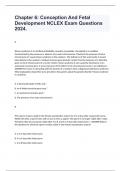
Chapter 6: Conception And Fetal Development NCLEX Study Questions 2024.
Chapter 6: Conception And Fetal Development NCLEX Study Questions 2024. D (Down syndrome is an intellectual disability caused by aneuploidy. Aneuploidy is a condition characterized by the presence or absence of an extra chromosome. Therefore the presence of extra chromosome 21 causes Down syndrome in the newborn. The deficiency of folic acid results in neural tube defects in the newborn. X-linked recessive gene disorder results from the presence of a defective gene on the X-chromosome of a carrier mother. Down syndrome is not caused by inheritance of an autosomal recessive gene. It occurs because of the defect in the chromosomal count in an individual.) - ANSWER The nurse is interacting with the parents of a newborn who is diagnosed with Down syndrome. What explanation should the nurse provide to the parents about the genetic disorder? Down syndrome is caused by: A. A decreased intake of folic acid." B. An X-linked recessive gene issue." C. An autosomal recessive gene." D. The presence of an extra chromosome." B (The sperm remains viable in the female reproductive system for 3 to 5 days after sexual intercourse. Within this time a sperm fuses with an ova to form a zygote. The sperm is no longer viable after 5 days. Therefore they do not remain viable after 4 to 8, and 5 to 9 days after intercourse.) - ANSWER What is the duration for which the sperm remains viable in the female reproductive system? A. 2 to 4 days after intercourse B. 3 to 5 days after intercourse C. 4 to 8 days after intercourse D. 5 to 9 days after intercourse C (The detection of the presence of pulmonary surfactants (surface-active phospholipids) in amniotic fluid has been used to determine fetal lung maturity, or the ability of the lungs to function after birth. This occurs at approximately 35 weeks of gestation. The presence of surface-active phospholipids is not an indication of Down syndrome. This result reveals the fetal lungs are mature and in no way indicates risk for preterm labor. Meconium should not be present in the amniotic fluid.) - ANSWER A woman at 35 weeks of gestation has had an amniocentesis. The results reveal that surface-active phospholipids are present in the amniotic fluid. The nurse is aware that this finding indicates: A. The fetus is at risk for Down syndrome. B. The woman is at high risk for developing preterm labor. C. Lung maturity. D. Meconium is present in the amniotic fluid. A (The risk for Down syndrome increases in the fetus as the age of the pregnant mother gets older. Because the patient is older than 35 years of age, the fetus is at an increased risk for having Down syndrome. The development of sickle cell anemia is not related to the age of the mother. It is caused by inheriting the defective genes from the parents. Neural tube defect in the fetus results from insufficient intake of folic acid during pregnancy. HD is an autosomal dominant disorder caused by a mutation on the normal gene and is not related to the age of the patient.) - ANSWER The nurse is assessing a 40-year-old patient who is 12 weeks pregnant. What should the nurse anticipate based on the patient's age? A. The fetus is at a risk for Down syndrome. B. The patient is at a risk for sickle cell anemia. C. The fetus is at a risk for neural tube defects. D. The patient is at a risk for Huntington's disease (HD).
Written for
- Institution
- MNB
- Course
- MNB
Document information
- Uploaded on
- April 24, 2024
- Number of pages
- 19
- Written in
- 2023/2024
- Type
- Exam (elaborations)
- Contains
- Questions & answers
Subjects
-
chapter 6 conception and fetal development nclex
-
chapter 6 conception and fetal development ncl

Also available in package deal