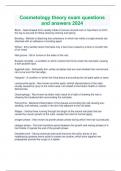
Cosmetology theory exam questions and answers 2024
Block - Head shaped form usually made of canvas covered cork or Styrofoam on hitch the wig is secured for fitting cleaning coloring and styling Bonding - Method of attaching hair extensions in which hair wefts or single strands are attached with an adhesive or bonding agent Wheel - Itchy swollen lesion that lasts only a few hours cased by a blow or scratch bite of an insect Nail groove - Slit or furrow on the sides of the nail. Bruised nail beds - a condition in which a blood clot forms under the nail plate, causing a dark purplish spot. Eggshell nails - Noticeably thin, white nail plates that are more flexible than normal and can curve over the free edge. Hangnail - A condition in which the living tissue surrounding the nail plate splits or tears. Leukonychia spots - Also known as white spots; whitish discolorations of the nails, usually caused by injury to the matrix area; not related to the body's health or vitamin deficiencies. Onychophagy - Also known as bitten nails; result of a habit of chewing the nail or chewing the hardened skin surrounding the nail plate. Paronychia - Bacterial inflammation of the tissues surrounding the nail causing pus, swelling, and redness, usually in the skin fold adjacent to the nail plate. Ridges - Vertical lines running through the length of the natural nail plate that are caused by uneven growth of the nails, usually the result of normal aging. anagen phase - Also known as growth phase; phase during which new hair is produced. catagen phase - The brief transition period between the growth and resting phases of a hair follicle. It signals the end of the growth phase. Disulfide bond - Strong chemical side bond that joins the sulfur atoms of two neighboring cysteine amino acids to create one cystine, which joins together two polypeptide strands like rungs on a ladder. Eumelanin - Produces brown to black pigments in the hair hair bulb - Lowest part of a hair strand; the thickened, club-shaped structure that forms the lower part of the hair root. hair density - The number of individual hair strands on 1 square inch of scalp. Hair elasticity - Ability of the hair to stretch and return to its original length without breaking. hair follicle - The tube-like depression or pocket in the skin or scalp that contains the hair root. hair texture - Thickness or diameter of the individual hair strand hydrogen bond - A week physical cross link side bond that is easily broken by water or heat Keratin - A fibrous protein that grows from cells originating within the hair follicle peptide bond - Also known as an end bond; chemical bond that joins amino acids to each other, end to end, to form a polypeptide chain. oxidizing agent - substance that releases oxygen Ph - The abbreviation used for potential hydrogen. Ph represents the quantity of hydrogen ions pH scale - A measure of the acidity and alkalinity of a substance; the pH scale has a range of 0 to 14, with 7 being neutral. A pH below 7 is an acidic solution; a pH above 7 is an alkaline solution. Physical change - A change in the form or physical properties of a substance without a chemical reaction or the creation of a new substance Thioglycolic acid - A colorless liquid or white crystals with a strong unpleasant odor that is used in permanent waving solutions. Pimple - Also known as papule; small elevation on the skin that contains no fluid but may develop pus. sebaceous glands - Also known as oil glands; glands connected to hair follicles. Sebum is the fatty or oily secretion of the sebaceous glands.
Written for
- Institution
- Cosmetology theory.
- Course
- Cosmetology theory.
Document information
- Uploaded on
- April 24, 2024
- Number of pages
- 17
- Written in
- 2023/2024
- Type
- Exam (elaborations)
- Contains
- Questions & answers
Subjects
- cosmetology theory exam
- cosmetology theory
-
cosmetology theory exam questions and answers 2024
-
cosmetology theory exam questions
-
cosmetology theory exam questions and answers

Also available in package deal