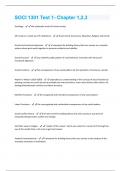
SOCI 1301 Test 1- Chapter 1,2,3 Questions With Complete Solutions Rated A+
Sociology - the systematic study of human society All if science is made up of 5 institutions - Government, Economics, Education, Religion and Family Structural-Functional Approach - a framework for building theory that sees society as a complex system whose parts work together to promote solidarity and stability. Social Structure - any relatively stable pattern of social behavior. Coincides with StructuralFunctional Approach. Social Functions - the consequences of any social pattern for the operation of society as a whole. Robert K. Merton () - expanded our understanding of the concept of social function by pointing out that any social structure probably has many functions, some more obvious than others. He distinguished between manifest and latent functions. Manifest Functions - the recognized and intended consequences of any social pattern Latent Functions - the unrecognized and unintended consequences of any social pattern Social-Conflict theory - the frame work for building theory that sees society as any arena of inequality that generates conflict and change. Karl Marx view of religion - "opiate of the masses" said it was easier for a camel to fit through the eye of the needle than a rich man to get into heaven. Symbolic-Interactionism - framework for building theory that sees society as the product of the everyday interaction of individualsLooking-glass Self - social psychological concept created by Charles Horton Cooley in 1902. It states that a person's self grows out of society's interpersonal interactions and the perceptions of others C.H Cooley - created the concept of the "looking-glass self" Social marginality - being excluded from social activity as an "outsider" Objectivity - personal neutrality in conduction research Levels of Science (Kung and Deloria) - Micro-science is studying the minute (the virtually invisible). Atomic/Subatomic level. All variable can be controlled and experiments can prove cause-and-effect. Macro-science is examining phenomena on a mass scale (astronomy/astrophysics). From total control of variables to no control. We can only observe and measure from afar/. Meso-Science is human size. Hawthorne Effect - a change in a subject's behavior caused simply by the awareness of being studied Androcentircity - "focus on the male" refers to approaching an issue from a males perspective. Random sample - is when researchers draw a sample from the population at random so every person in the population has an equal chance of being selected; whereas, a sample is a part of a population that represents the whole. Independent Variables - a variable that an experimenter manipulates Dependent Variables - a variable that an experimenter predicts will be affected by manipulations of the independent variableCorrelations - statistical relationship between two variables. Short of cause-and-effect. Cant say A causes B, but can measure a change that takes place in A and B at the same time. Ex: Shark attacks in Florida and ice cream sales in New York City. Positive Correlations - increases in one variable are associated with increases in the other. Negative Correlations - Increases in one variable are associated with decreases in the other.
Written for
- Institution
- SOCI 1301
- Course
- SOCI 1301
Document information
- Uploaded on
- April 23, 2024
- Number of pages
- 6
- Written in
- 2023/2024
- Type
- Exam (elaborations)
- Contains
- Questions & answers
Subjects

Also available in package deal