Chapter 4 Probative Fallacies
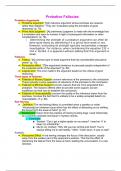
Probative argument is an inductive argument evaluated using the principles of good reasoning, as it uses reasons rather than statistics. The strength of a probative argument can be easily determined as weak or not based on prima facie judgment, which is a preliminary judgement made with the knowledge that it is tentative and open to revision. Determining the strength typically requires a deeper investigation. Probative fallacies are common types of weak arguments that have considerable persuasive power. They include fallacies of illusory support, minimal support, and unacceptability. One common probative fallacy is the red herring fallacy where the speaker introduces an irrelevant issue, distracting from the original topic. This changes the focus of the discussion, usually away from the weaker part of the opponent’s position. Another is the guilt by association fallacy, where a claim is rejected based on the people who hold the position. The straw person fallacy attributes a false view to a proponent and pretends to refute it while appealing to an irrelevant standard undermines acceptance of a policy by highlighting its inability to achieve irrelevant goals. Two wrongs fallacy is when a wrong is justified by the fact that others have gotten away with it. An ad hominem attack discredits an argument by attacking the proponent's background or behavior, shifting the argument away from the issues at hand. Appeal to popularity is an attempt to justify a belief or action on the basis that most people believe it. Hasty generalization occurs when a generalization is drawn from limited evidence, exploiting the tendency to generalize from limited experiences. Anecdotal evidence uses an anecdote as if it were adequate evidence for a broad generalization. The argument from absence of evidence concludes that a position is correct on the basis of a lack of evidence refuting it. The slippery slope argues against an action on the grounds that the long-run consequences of such an action will be disastrous without supplying sufficient evidence. Equivocation uses a word in two different senses while the problematic premise introduces a premise that is neither credible nor acceptable. Begging the question uses a premise that is identical to the conclusion or assumes the truth of the claim central to the controversy. False dilemma attempts to force people to consider only two choices, one of which is typically repugnant. Sufficient and necessary conditions refer to antecedent and consequent in an argument, where the antecedent is often referred to as the sufficient condition, and the consequent is called the necessary condition.
Written for
- Institution
-
Sam Houston State University
- Course
-
PHIL 2303
Document information
- Uploaded on
- April 23, 2024
- Number of pages
- 9
- Written in
- 2023/2024
- Type
- Class notes
- Professor(s)
- Brommage
- Contains
- All classes
Subjects
- fallacy
- persuasive
- argument
- analysis
- false dilemma
- begging the question
- problematic premise
-
equivocation
-
slippery slope
-
sufficient and necessary conditions
-
argument from absence of evidence

Also available in package deal