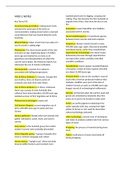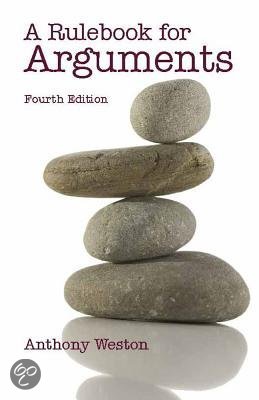
A rulebook for arguments
By Anthony Weston
Chapter 2 – develop your ideas in a natural order
1. Make sure your idea is set in the right order:
o List of ideas, then conclusion
o First conclusion, then list of ideas
o Use words as however, therefore, in addition etc.
Chapter 3 – start from reliable premises
o If premises/conclusions are weak, the whole statement is weak
Chapter 4 – be concrete and concise
o Be concrete and concise (short and clear) in your claims (or something else)
Chapters 5 – build on substance not overtone
o overtone = something that is suggested, but not clearly stated
o actual and concrete evidence should be given, not an overtone.
o Try to figure out what their view is, try to understand the reasons, even if you disagree.
E.g. a person who believes in evolution is not claiming that her grandparents were monkey (so what
does she think)
Chapter 6 – use consistent terms
o Repeat your key terms in your argument
e.g. when you learn about cultures, you start to realize the variety of human customs. When you start to
realize the variety of human customs, you tend to become more tolerant. Therefore, when you learn about
other cultures, you tend to become more tolerant.
o Make a clear connection between premises and between premises and conclusions
Chapter 7 – use more than one example
o Don’t use a single example to support for a generalization
o Use more examples to proof your claim
o A generalization about a small set of things needs, the argument should considers all of the examples
o A generalization about a larger set of things require picking out a sample
Chapter 8 – use representative examples
o Show different sides of the argument you make
o For example, the Romans do not represent all of the women in ancient times, pick more
groups!
o Make sure the representatives includes every party of a country etc.
Chapter 9 – background rates may be crucial
o Don’t look at one case that supports the argument! Look at other sides of the argumente.g. how
many times did he miss instead of hit the bulls-eye?
o A rate is needede.g. how many times did he failed, how many times did he passed?
o Ask yourself if the featured examples are how many out of what number?
Chapter 10 – statistics need a critical eye
o Be careful in giving numbers, they might think critical about your number.
o Don’t be too precise with your numbers, as it might seem unbelievable sometimes
o Using extrapolation (what happens next based on certain information), sometimes an argument is
useless (e.g. if kids keep watching more TV at current rates, by 2025 they’ll have no time left to sleep)
Appendix I – some common fallacies
Fallacy many people think it is true, but it is not (e.g.
women are worse drivers than men)
Ad hominem (to the man) attacking the person of a source rather than his or
her qualifications or reliability or the actual argument
he/she made
By Anthony Weston
Chapter 2 – develop your ideas in a natural order
1. Make sure your idea is set in the right order:
o List of ideas, then conclusion
o First conclusion, then list of ideas
o Use words as however, therefore, in addition etc.
Chapter 3 – start from reliable premises
o If premises/conclusions are weak, the whole statement is weak
Chapter 4 – be concrete and concise
o Be concrete and concise (short and clear) in your claims (or something else)
Chapters 5 – build on substance not overtone
o overtone = something that is suggested, but not clearly stated
o actual and concrete evidence should be given, not an overtone.
o Try to figure out what their view is, try to understand the reasons, even if you disagree.
E.g. a person who believes in evolution is not claiming that her grandparents were monkey (so what
does she think)
Chapter 6 – use consistent terms
o Repeat your key terms in your argument
e.g. when you learn about cultures, you start to realize the variety of human customs. When you start to
realize the variety of human customs, you tend to become more tolerant. Therefore, when you learn about
other cultures, you tend to become more tolerant.
o Make a clear connection between premises and between premises and conclusions
Chapter 7 – use more than one example
o Don’t use a single example to support for a generalization
o Use more examples to proof your claim
o A generalization about a small set of things needs, the argument should considers all of the examples
o A generalization about a larger set of things require picking out a sample
Chapter 8 – use representative examples
o Show different sides of the argument you make
o For example, the Romans do not represent all of the women in ancient times, pick more
groups!
o Make sure the representatives includes every party of a country etc.
Chapter 9 – background rates may be crucial
o Don’t look at one case that supports the argument! Look at other sides of the argumente.g. how
many times did he miss instead of hit the bulls-eye?
o A rate is needede.g. how many times did he failed, how many times did he passed?
o Ask yourself if the featured examples are how many out of what number?
Chapter 10 – statistics need a critical eye
o Be careful in giving numbers, they might think critical about your number.
o Don’t be too precise with your numbers, as it might seem unbelievable sometimes
o Using extrapolation (what happens next based on certain information), sometimes an argument is
useless (e.g. if kids keep watching more TV at current rates, by 2025 they’ll have no time left to sleep)
Appendix I – some common fallacies
Fallacy many people think it is true, but it is not (e.g.
women are worse drivers than men)
Ad hominem (to the man) attacking the person of a source rather than his or
her qualifications or reliability or the actual argument
he/she made