
BOSR DCF Study Guide Exam All Questions And Correct Answers What are the three main reasons child care programs observe and screen chil dren? - Answer -1. Facilitate growth and development of every child 2. Detect early signs of developmental delay or disability 3. Identify signs of child abuse or neglect Define: Assessment - Answer -Assessment is a process whereby an agency or organizati on gathers and reviews multiple sources of information about a child's suspected or confirmed developmental delay or disability, and uses that information to improve a child's outcomes. Define: Evidence - Answer -Documented evidence refers to written data collected by the program. For example, there may be a file note stating when a child could stand on one foot. Define: Developmental Domains - Answer -Categorize children's skills and ab ilities. They include Physical Development, Cognitive Development and General Knowledge, Language and Communication, Social and Emotional, and Approaches to Learning. Define: Evaluation - Answer -Evaluation is a process that determines a child's eligibili ty for federal, state, and local programs and services. Define: Natural Environment - Answer -Refers to places the child would typically be, such as home, the child care program, school, a place of worship, or the homes of family and friends rather than a director's office, doctor/therapist's office, or similar places. Define: Observation - Answer -An ongoing process in which child care professionals recognize and document identifiable developmental milestones as they appear, using tools such as checklist s, anecdotal records, and running records. Define: Screening - Answer -Is an ongoing process in which child care professionals use specialized observation and documentation tools to identify, document, and monitor typical development or possible developme ntal delay. Give examples of professional groups that perform each of these four activities: observation, screening, assessment, and evaluation. - Answer -Observation: child care professionals monitor a child as he or she demonstrates identified skills or abilities within a developmental domain or domains. Assessment: child care professionals refer families to the Florida Diagnostic and Learning Resource System's Child Find for assessment, which may result in them being referred to Children's Medical Ser vices for evaluation of a delay or disability. Evaluation:Children's Medical Services performs assessment and evaluation processes to determine eligibility for programs and services under the Individuals with Disabilities Education Act (IDEA). Screening: child care professionals or other medical professionals Relate the four guidelines for observations and screenings that take place in child care settings. - Answer -1. Be informed 2. Be objective and accurate 3. Be honest and fair 4. Be focused Name cha racteristics seen in effective child care professionals who observe and screen children. - Answer -Objective, follow directions, accurate/relevant documentation, ethical, honest, fair, information seeker Describe best practices used by skilled practitioners to obtain valid and usable results. - Answer -Review appropriate general information immediately prior to an observation or screening session. This includes: 1. Developmental domains and milestones 2. Information about the child's abilities and unique needs 3. Study the child's file 4. Know how to use the observation or screening tool before attempting to use it. 5. Ensure observation and screening results do not reflect personal feelings. Set aside personal beliefs and consider only facts. 6. Document all relevant information 7. Ensure documentation is correct and complete. 8. Document children's development over time. 9. Observe and screen when children are at their best. 10. Conduct sessions in the child's natural setting with familiar staff 11. Never observe or screen with the intent of confirming a suspicion of delay, disability, abuse, or neglect. 12. Allow enough time. 13. Observe or screen one child at a time. 14. Pay attention to small differen ces and details, because it is in those one can see emerging trends and patterns of growth and development, the earliest signs of delay or disability, and subtle signs of abuse or neglect. If signs of child abuse or neglect are observed, you must, by law, report them to the Abuse Hotline. 15. Work methodically and thoughtfully. To work methodically, professionals are organized, systematic, and deliberate List characteristics shared by quality screening instruments. - Answer -1. Easy to use.
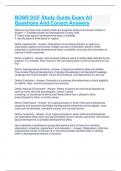
Preview 2 out of 6 pages
Exam (elaborations)
BOSR DCF Study Guide Exam All Questions And Correct Answers
Preview 2 out of 6 pages
BOSR DCF Study Guide Exam All Questions And Correct Answers What are the three main reasons child care programs observe and screen children? - Answer -1. Facilitate growth and development of every child 2. Detect early signs of developmental delay or disability 3. Identify signs of child abuse or neglect Define: Assessment - Answer -Assessment is a process whereby an agency or organization gathers and reviews multiple sources of information about a child's suspected or confirmed developmental delay or disability, and uses that information to improve a child's outcomes. Define: Evidence - Answer -Documented evidence refers to written data collected by the program. For example, there may be a file note stating when a child could stand on one foot. Define: Developmental Domains - Answer -Categorize children's skills and abilities. They include Physical Development, Cognitive Development and General Knowledge, Language and Communication, Social and Emotional, and Approaches to Learning. Define: Evaluation - Answer -Evaluation is a process that determines a child's eligibility for federal, state, and local programs and services. Define: Natural Environment - Answer -Refers to places the child would typically be, such as home, the child care program, school, a place of worship, or the homes of family and friends rather than a director's office, doctor/therapist's office, or similar places. Define: Observation - Answer -An ongoing process in which child care professionals recognize and document identifiable developmental milestones as they appear, using tools such as checklists, anecdotal records, and running records. Define: Screening - Answer -Is an ongoing process in which child care professionals use specialized observation and documentation tools to identify, document, and monitor typical development or possible developmental delay. Give examples of professional groups that perform each of these four activities: observation, screening, assessment, and evaluation. - Answer -Observation: child care professionals monitor a child as he or she demonstrates identified skills or abilities within a developmental domain or domains.
Content preview
Document information
- Uploaded on
- April 21, 2024
- Number of pages
- 6
- Written in
- 2023/2024
- Type
- Exam (elaborations)
- Contains
- Questions & answers
$12.49
Wrong document? Swap it for free
Within 14 days of purchase and before downloading, you can choose a different document. You can simply spend the amount again.
Written by students who passed
Immediately available after payment
Read online or as PDF

Reputation scores are based on the amount of documents a seller has sold for a fee and the reviews they have received for those documents. There are three levels: Bronze, Silver and Gold. The better the reputation, the more your can rely on the quality of the sellers work.
Available in package deal
Package deal
Bundle For BOSR DCF Exam Questions Answers

