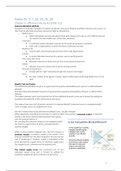
Parkin Ch. 5, 7, 22, 23, 25, 29
Chapter 5 – Efficiency and Equity (p103-111)
Resource Allocation Methods
The goal is to evaluate the ability of markets to allocate resources efficiently and fairly. Resources are scarce, so
they must be allocated somehow. Resources might by allocated by:
- Market price
• Works with goods and services where those who choose not to buy or can’t afford to buy do
not matter (not with health care, school fees, pensions)
- Command
• A command system allocates resources by the order of someone in authority
• Work well in organisations in which the lines of authority are clear
- Majority rule
• Used to elect representative governments that make big decisions
- Contest
• A contest allocates resources to a winner, used in sporting events
- First-come, first-serve
• Allocates resources to those who are first in the queue (restaurants)
- Lottery
• Allocate resources to those who pick the winning number
- Personal characteristics
• People with the ‘right’ characteristics get the resource (marriage)
- Force
• Ill in war, military force against a nation. Good in effectively transferring wealth from rich to
poor.
Benefit, Cost and Surplus
The relationship between the price of a good and the quantity demanded by one person is called individual
demand.
And the relationship between the price of a good and the quantity demanded by all buyers is called market
demand.
The market demand curve: the horizontal sum of the individual demand curves and is formed by adding the
quantities demanded by all the individuals at each price.
The value of one more unit of good or service is its marginal benefit. A demand curve is a marginal benefit
curve. A supply curve is a marginal cost curve.
We don’t always have to pay what we are willing to pay – we get a bargain.
When people buy something for less than it is worth to them, they receive a consumer surplus. A consumer
surplus is the excess of the benefit received from a good
over the amount paid for it.
We calculate the consumer surplus as the marginal benefit
(or value) of a good minus its price, summed over the
quantity bought.
When a price exceeds marginal cost, the firm receives a
producer surplus. A producer surplus is the excess if the
amount received from the sale of a good or service over the
cost of producing it. Producer surplus is calculated as the
price received for a good minus its minimum supply-price
(or marginal cost), summed over the quantity sold.
The market supply curve: the horizontal sum of the
individual supply curve and is formed by adding the
quantities supplied by all the producers at each price.
1
, Chapter 7 – Global Markets in Action
How Global Markets Work
The goods and services that we buy from other countries are our imports; the goods and services that we sell to
people in other countries are our exports
What Drives International Trade?
The fundamental force that generates trade between nations is comparative advantage.
The basis for comparative trade is divergent opportunity costs between countries.
National comparative advantage is the ability of a nation to perform an activity or produce a good or service at a
lower opportunity cost than any other nation.
EXAMPLE: the opportunity cost of producing a car is lower in Japan than in the UK, so Japan has a comparative
advantage in producing cars.
Why the UK Imports Cars and Exports Chemicals
International trade lowers the price of an imported good and raises the price of an exported good.
Buyers of imported goods benefit from lower prices and sellers of exported goods benefit from higher prices.
With cars, the rest of the world has a comparative advantage.
With chemicals, the UK has a comparative advantage
Winners, Losers and the Net Gain from Trade
Gains and losses from imports are measured by examining their effect on consumer surplus, producer surplus
and total surplus. In the importing country, the winners are those whose surplus increases and losers are those
whose surplus decreases.
Consumers gain because they pay less, buy
more cars and receive a larger consumer
surplus.
Producers lose because they receive a
lower price, produce fewer cars and
receive a smaller producer surplus.
Consumers’ gain exceeds producers’ loss,
so total surplus increases.
Producers gain because they
receive a higher price, produce a
larger quantity and receive a larger
producer surplus.
Consumers lose because they pay a
higher price, buy a smaller quantity
and receive a smaller consumer
surplus.
The gains exceed the losses and
total surplus increases.
2
Chapter 5 – Efficiency and Equity (p103-111)
Resource Allocation Methods
The goal is to evaluate the ability of markets to allocate resources efficiently and fairly. Resources are scarce, so
they must be allocated somehow. Resources might by allocated by:
- Market price
• Works with goods and services where those who choose not to buy or can’t afford to buy do
not matter (not with health care, school fees, pensions)
- Command
• A command system allocates resources by the order of someone in authority
• Work well in organisations in which the lines of authority are clear
- Majority rule
• Used to elect representative governments that make big decisions
- Contest
• A contest allocates resources to a winner, used in sporting events
- First-come, first-serve
• Allocates resources to those who are first in the queue (restaurants)
- Lottery
• Allocate resources to those who pick the winning number
- Personal characteristics
• People with the ‘right’ characteristics get the resource (marriage)
- Force
• Ill in war, military force against a nation. Good in effectively transferring wealth from rich to
poor.
Benefit, Cost and Surplus
The relationship between the price of a good and the quantity demanded by one person is called individual
demand.
And the relationship between the price of a good and the quantity demanded by all buyers is called market
demand.
The market demand curve: the horizontal sum of the individual demand curves and is formed by adding the
quantities demanded by all the individuals at each price.
The value of one more unit of good or service is its marginal benefit. A demand curve is a marginal benefit
curve. A supply curve is a marginal cost curve.
We don’t always have to pay what we are willing to pay – we get a bargain.
When people buy something for less than it is worth to them, they receive a consumer surplus. A consumer
surplus is the excess of the benefit received from a good
over the amount paid for it.
We calculate the consumer surplus as the marginal benefit
(or value) of a good minus its price, summed over the
quantity bought.
When a price exceeds marginal cost, the firm receives a
producer surplus. A producer surplus is the excess if the
amount received from the sale of a good or service over the
cost of producing it. Producer surplus is calculated as the
price received for a good minus its minimum supply-price
(or marginal cost), summed over the quantity sold.
The market supply curve: the horizontal sum of the
individual supply curve and is formed by adding the
quantities supplied by all the producers at each price.
1
, Chapter 7 – Global Markets in Action
How Global Markets Work
The goods and services that we buy from other countries are our imports; the goods and services that we sell to
people in other countries are our exports
What Drives International Trade?
The fundamental force that generates trade between nations is comparative advantage.
The basis for comparative trade is divergent opportunity costs between countries.
National comparative advantage is the ability of a nation to perform an activity or produce a good or service at a
lower opportunity cost than any other nation.
EXAMPLE: the opportunity cost of producing a car is lower in Japan than in the UK, so Japan has a comparative
advantage in producing cars.
Why the UK Imports Cars and Exports Chemicals
International trade lowers the price of an imported good and raises the price of an exported good.
Buyers of imported goods benefit from lower prices and sellers of exported goods benefit from higher prices.
With cars, the rest of the world has a comparative advantage.
With chemicals, the UK has a comparative advantage
Winners, Losers and the Net Gain from Trade
Gains and losses from imports are measured by examining their effect on consumer surplus, producer surplus
and total surplus. In the importing country, the winners are those whose surplus increases and losers are those
whose surplus decreases.
Consumers gain because they pay less, buy
more cars and receive a larger consumer
surplus.
Producers lose because they receive a
lower price, produce fewer cars and
receive a smaller producer surplus.
Consumers’ gain exceeds producers’ loss,
so total surplus increases.
Producers gain because they
receive a higher price, produce a
larger quantity and receive a larger
producer surplus.
Consumers lose because they pay a
higher price, buy a smaller quantity
and receive a smaller consumer
surplus.
The gains exceed the losses and
total surplus increases.
2