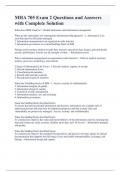
MHA 705 Exam 2 Questions and Answers with Complete Solution
MHA 705 Exam 2 Questions and Answers with Complete Solution What does HIIM stand for? - Health informatics and information management What are the 3 principles of Contemporary Information Management? - 1. Information is an asset that must be efficiently managed 2. Information management is an organization-wide function 3. Information governance is a crucial building block of EIM Primary and secondary medical records data, business operations data, images, personal health records, performance reviews are all example of what... - Information assets Why is information management an organization-wide function? - Calls for explicit structure, policies, processes, technology, and controls 5 Stages of Information Life Cycle - 1. Record creation, capture, or receipt 2. Record maintenance & use 3. Classification & metadata 4. Record audit and data controls 5. Record preservation & retention Name the 5 building blocks of EIM - 1. Access, security & confidentiality 2. Information integrity & quality 3. Information design & capture 4. Content & records management 5. Information analysis, use, and exchange 6. Information governance Name the building block described below: To ensure that personal health information and business information are available only to authorized persons and used only for authorized purposes and that security risks and vulnerability are proactively managed - Access, security, and confidentiality Name the building block described below: To continuously improve the value and trustworthiness of the information asset by ensuring that data and content are valid, accurate, reliable, up-to-date, and "fit for use" - Information integrity and quality Name the building block described below: To continuously improve the standards-based policies and practices for data capture & clinical documentation that supports the full range of uses and enable interoperability, exchange, and linkage. - Information design and capture Name the building block described below: To align data and content requirements and availability to the needs of those who rely on information for a range of clinical and business uses and ensure that those who must act on information have the requisite tools and skills to use it effectively. - Information analysis, use, and exchange Name the building block described below: To ensure leadership and organizational practices, resources, and controls for effective, compliant, and ethical stewardship of information assets to enable best clinical and business practices and serve patients, stakeholders, and the public good. - Information governance Name the building block described below: t To continuously improve the methods whereby corporate and health records and data content are maintained across their life cycle and regardless of media, to ensure compliance with regulatory, accreditation, and legal best practices. - Content and records management • Compliance focused • Gaps in policy framework • Focus on threats of punishment for noncompliance • Vulnerabilities in planning for disruptions • Limited connections between related functions, for example, privacy and security have limited crossover ... explains what building block Pre-EIM? - Access, security, and confidentiality • Stewardship focused • Policy planning integral to process, system changes • Incentives for sound stewardship • Business continuity planning and plan • Safeguards against accidental or deliberate information corruption due to accidental failures or deliberate fraud • Routine audits of compliance leading to improvement ... explains what building block in EIM culture? - Access, security, and confidentiality • Limited systematic data quality assessment • Reactive response to data quality problems • Lack of trust in data • Lack of standard protocols for error correction • Data scrubbing and cleansing in the creation of data warehouses • Modification of existing systems to accommodate changes such as new regulations ...explains what building block Pre-EIM? - Information integrity and quality • Standards- and definitions-based data capture • Knowledge of data provenance and lineage • Protocols for monitoring end-to-end impact of conversions and upgrades • Systematic data quality monitoring based on assessed risks • Error correction and amendment processes ...explains what building block in EIM culture? - Information integrity and quality • Adapted work process to technology constraints • Highly customized solutions with wide personal preference latitude • Documentation improvement as an overlay to the process of data capture • Productivity barriers leading to poor morale • User interface issues impeding safe and effective care ...explains what building block Pre-EIM? - Information design and capture • Process for assessing data needs and improving data capture and documentation over time • Knowledgeable and proactive users behind coordinated efforts to improve the design of technology and the tools used for data capture • Understood and addressed impact on productivity and user acceptability of how structured and unstructured data are captured and available ...explains what building block in EIM culture? - Information design and capture • Records management not addressed in specifications for technology acquisition • Permanent retention of all the data • Data silos and data owners unaware of rules for records management • Unmanaged content accumulates in an increasing number of files and applications • The official health record has information holes because valuable unstructured data are inaccessible • Data redundancy expands ...explains what building block Pre-EIM? - Content and records management • Policies expanded to include the range of record types • Policies linked to business strategy • Retention policies and planning • Audit practices to ensure that policies and practices are being carried out • Records management issues considered as part of technology acquisition ...explains what building block in EIM culture? - Content and records management • Users maintain the information they need • Tools and products are purchased without scrutiny of data properties and information integrity capabilities • Information changes in one system are not replicated in others • New error is introduced because upgrades and interfaces are not consistently tested using standard test databases and test scripts
Written for
- Institution
- MHA 705
- Course
- MHA 705
Document information
- Uploaded on
- April 20, 2024
- Number of pages
- 7
- Written in
- 2023/2024
- Type
- Exam (elaborations)
- Contains
- Questions & answers
Subjects
-
mha 705 exam 2 questions and answers with complete
-
what does hiim stand for health informatics and
-
3 information governance is a crucial building bl
-
2 information management is an organization wide

Also available in package deal