PCA STUDY EXAM LAWS AND REGULATIONS ACTUAL EXAM QUESTIONS AND ANSWERS
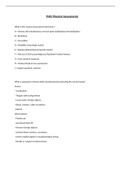
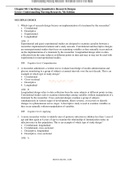
The difference between California laws and DPR regulations is that laws are A. Passed by County Agricultural Commissioners and regulations are passed by the California legislature B. Passed by the California legislature and regulations are adopted by DPR to carry out the laws C. Supplements to federal regulations D. Adopted by DPR to carry out regulations signed by the Governor b Which of the following is not one of the purposes of California's pesticide and pest control laws and regulations? A. Protecting workers from pesticide exposure B. Providing proper, safe, and effective use of pesticides C. Encouraging people to use more pesticides D. Protecting public health and safety c A cooperating agency that helps DPR enforce pesticide use laws and regulations in California is the A. County Department of Health B. State Department of Water Resources C. State Department of Labor D. County Agricultural Commissioner D County Agricultural Commissioners may adopt supplemental pesticide regulations with the approval of the A. Department of Pesticide Regulation B. Office of the Governor C. County Board of Supervisors D. California State Legislature A Which of the following is considered to be pesticide labeling? A. Spray nozzle catalog B. A printed pesticide advertisement C. The federal Worker Protection Standard D. A written recommendation c When a pesticide registrant allows a pesticide product registration to lapse, pest control dealers A. Must immediately return all unsold stock B. Can sell and deliver the pesticide product for two years C. Must retrieve all previously sold stock D. Can indefinitely sell and deliver the pesticide product B When a pesticide product registration is cancelled, the sale and use of this product A. Is automatically prohibited under all circumstances B. May continue under conditions imposed by the regulatory agency responsible for the cancellation C. Will be allowed for two years from the cancellation date D. Is not affected as long as detailed sales records are kept current B A Special Local Need Registration (SLN) allows A. Growers to apply the pesticide to any crop as long as the SLN is valid in the grower's state B. Supplemental uses of the pesticide uniformly throughout the U.S. C. Uses of pesticides for crops or sites not listed on the label D. Any feasible use of the pesticide in the specified local area C Which of the following is considered a supplemental label? A. Sales literature distributed by the pesticide registrant B. A sample of a pesticide label produced by the registrant C. Literature containing use and maintenance directions for application equipment D. A pamphlet containing use directions and restrictions that is attached to the container D On a pesticide label the signal word A. Signifies the relative acute toxicity of the pesticide product B. Identifies the formulation of pesticide product C. Warns of the potential crop damage level D. Identifies relative effectiveness or control level A The precautionary statements section of the label contains information about the A. Application rate B. Crops on which the product can be applied C. Relative toxicity of the product D. Hazards to people and domestic animals D Plant-back restrictions are found in the _________ section of the pesticide label A. Precautionary statements B. Statement of practical treatment C. Contents D. Directions for use D Making an application of a pesticide product at a rate less than specified in its label directions is A. Always allowed. B. Illegal. C. Allowed only if you obtain written authorization from the County Agricultural Commissioner. D. Allowed only if the product is tank mixed. A Exceeding the maximum application rate of a pesticide product as per its label is A. Always allowed. B. Illegal. C. Allowed only if you obtain written authorization from the County Agricultural Commissioner. D. Allowed only if the product is tank mixed with another similar product. B U.S. EPA may classify a pesticide as a restricted use pesticide if it A. Is ineffective unless used at twice the label-recommended rate. B. Presents a significant dermal hazard to applicators. C. Leaves visible residues on treated surfaces. D. Does not break down within 7 days. B
Written for
- Institution
- PCA
- Course
- PCA
Document information
- Uploaded on
- April 18, 2024
- Number of pages
- 44
- Written in
- 2023/2024
- Type
- Exam (elaborations)
- Contains
- Questions & answers
Subjects
-
pca study exam laws and regulations actual exam

Also available in package deal