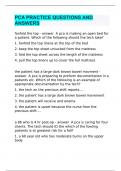
PCA PRACTICE QUESTIONS AND ANSWERS
Definition of Pain SUBJECTIVE Pain is whatever the person experiencing the pain says it is, existing whenever the person says it does (Pasero & McCaffery, 2011) Unpleasant, subjective sensory and/or emotional experience associated with actual or potential tissue damage. (IASP, 2010) Assessing Pain Location Intensity Quality Onset, duration & recurrence Precipitating factors Alleviating factors Evolution of new/different pain What is Patient Controlled Analgesia? Technology that allows patients to control and self-administer their own IV pain medication Programmable syringe pump allows with safety limits set. Common Indications for PCA: Goal: pain management - minimal sedation Post-operative pain Severe acute pain Acute exacerbations of chronic pain Cancer pain Patients unable to take oral medications Advantages of PCA Patients can titrate medication to their pain Patients are in "control" Reduces patient anxiety Quick response time to patient pain medication need Routes I.V. (most common) Epidural (PCEA) Intrathecal Surgical incisional (On-Q pumps) Safety Concerns Patient is the only person to depress the pain button Patient education and family education is critical High Alert: The PCA must be set up and then verified by 2 RNs Equipment PCA pump Key PCA tubing Medication Syringe Patent IV access Running IV Fluids Alaris PCA Handset Handset is an electronic switch with a Green button Green when dose is available Flashing when delivering dose Dims during timeout Parts of PCA order Medication Concentration (mg/ml) of drug Possible loading dose Mode Continuous infusion PCA (patient activated dose) Continuous infusion with PCA PCA dose Lockout interval Hour limit (1 or 4 hour limit) Bolus Dose When the patient presses the button, the PCA delivers the programmed demand dose In cases of severe pain or in patients with opioid tolerance the demand dose may be larger higher than the usual PRN dose Lockout time Lockout time reduces the risk of overdose Lockout time is set by the ordering MD Usually 5-20 minutes The PCA will not deliver a dose during lockout time, even if the patient presses the button This allows each bolus to reach peak effect before the patient has another bolus Bolus Dose Duration Dose duration is normally set as 'stat' Alaris PCA 'stat' is less than 70 seconds The dose duration may be increased to prevent problems such as light-headedness or nausea associated with a rapid peak of onset of analgesia Continuous Infusion Background infusion (continuous infusion) may be added to PCA dose Generally background infusion is only required for patients with high opioid requirements Background infusions may increase the risk of the side effects associated with opioids: sedation, respiratory depression, itching, nausea Demands / Delivery Demand dosing fixed-size dose is self-administered intermittently (pt. pushes button) Continuous infusion Combination of demand & continuous doses Attempts How many times the pt. pushes the button to receive the medication Knowing the proportion of attempts over ordered doses allows MD to adjust the PCA settings to meet the patient's needs or whether further patient education is required Is a PCA appropriate? PCA is suitable for treatment of most types of acute pain: surgical, burn, trauma, etc NPO with high pain needs Supplement to PO medication for severe pain Goal is to transition to PO medication Patient must be: Alert Able to understand instructions Physically able to push button Contraindications to PCA Inability to understand PCA instructions Patients not wishing to control their own analgesia Unable to push the button. Pediatric Patients? The child needs to understand the concept of pressing a button to self-administer analgesia
Written for
- Institution
- PCA
- Course
- PCA
Document information
- Uploaded on
- April 18, 2024
- Number of pages
- 39
- Written in
- 2023/2024
- Type
- Exam (elaborations)
- Contains
- Questions & answers
Subjects
-
pca practice questions and answers

Also available in package deal