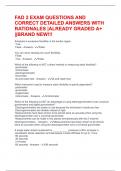
WGU D278 - Scripting and Programming Foundations Latest Update Graded A+ Program ✔✔Consists of instructions executing one at a time. Input ✔✔A program gets data, perhaps from a file, keyboard, touchscreen, network, etc. Process ✔✔A programs performs computations on that data, such as adding two values like x + y. Output ✔✔A programs puts that data somewhere, such as to a file, screen, network, etc. Computational thinking ✔✔Creating a sequence of instructions to solve a problem. Algorithm ✔✔A sequence of instructions that solves a problem. Statement ✔✔Carries out some action and executing one at a time. String literal ✔✔Consists of text (characters) within double quotes, as in "Go #57!". Cursor ✔✔Indicates where the next output item will be placed in the output. Newline ✔✔A special two -character sequence \n whose appearance in an output string literal causes the cursor to move to the next output line. The newline exists invisibly in the o utput. Comment ✔✔Text added to a program, read by humans to understand the code, but ignored by the program when executed. Whitespace ✔✔Refers to blank spaces (space and tab characters) between items within a statement, and to newlines. Whitespace helps improve readability for humans, but for execution purposes is mostly ignored. Pseudocode ✔✔Text that resembles a program in a real programming language but is simplified to aid human understanding.
Exam (elaborations)
WGU D278 - Scripting and Programming Foundations Latest Update Graded A+
Rating
Sold
-
Pages
14
Grade
A
Uploaded on
18-04-2024
Written in
2023/2024
WGU D278 - Scripting and Programming Foundations Latest Update Graded A+ Program Consists of instructions executing one at a time. Input A program gets data, perhaps from a file, keyboard, touchscreen, network, etc. Process A programs performs computations on that data, such as adding two values like x + y. Output A programs puts that data somewhere, such as to a file, screen, network, etc. Computational thinking Creating a sequence of instructions to solve a problem. Algorithm A sequence of instructions that solves a problem. Statement Carries out some action and executing one at a time. String literal Consists of text (characters) within double quotes, as in "Go #57!". Cursor Indicates where the next output item will be placed in the output. Newline A special two-character sequence n whose appearance in an output string literal causes the cursor to move to the next output line. The newline exists invisibly in the output. Comment Text added to a program, read by humans to understand the code, but ignored by the program when executed. Whitespace Refers to blank spaces (space and tab characters) between items within a statement, and to newlines. Whitespace helps improve readability for humans, but for execution purposes is mostly ignored. Pseudocode Text that resembles a program in a real programming language but is simplified to aid human understanding. Assignment statement Assigns a variable with a value, such as x = 5. An assignment statement's left side must be a variable. The right side is an expression.Examples: x = 5, y = a, or z = w + 2. = In programming, = is an assignment of a left-side variable with a right-side value. It does not represent equality like in mathematics. Variable declaration Declares a new variable, specifying the variable's name and type. Identifier A name created by a programmer for an item like a variable or function. An identifier must: be a sequence of letters (a-z, A-Z), underscores (_), and digits (0-9), AND start with a letter or underscore. Reserved word or keyword A word that is part of the language, like integer, Get, or Put. A programmer cannot use a reserved word as an identifier. Lower camel case Abuts multiple words, capitalizing each word except the first, such as numApples.
Show more
Read less
Institution
WGU D278 - Scripting And Programming Foundations
Course
WGU D278 - Scripting and Programming Foundations
Whoops! We can’t load your doc right now. Try again or contact support.
Written for
- Institution
- WGU D278 - Scripting and Programming Foundations
- Course
- WGU D278 - Scripting and Programming Foundations
Document information
- Uploaded on
- April 18, 2024
- Number of pages
- 14
- Written in
- 2023/2024
- Type
- Exam (elaborations)
- Contains
- Questions & answers
Subjects
-
wgu d278 scripting and programming foundations l
Content preview
$9.99
Get access to the full document:
100% satisfaction guarantee
Immediately available after payment
Both online and in PDF
No strings attached

Also available in package deal
Package deal
WGU D278 - Scripting and Programming Foundations Bundled Exams Questions and Answers Latest Versions (2024/2025) (Complete and Accurate)
1
10
2024
$ 104.40
More info