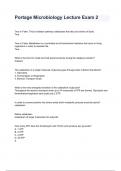
Portage
Microbiology
Lecture
Exam
2
True
or
False.
The
β-
oxidation
pathway
catabolizes
the
fatty
acid
chains
of
lipids.
True
True
or
False.
Metabolism
is
a
controlled
set
of
biochemical
reactions
that
occur
in
living
organisms
in
order
to
maintain
life.
True
What
is
the
term
for
metal
ions
that
assist
enzymes
during
the
catalysis
reaction?
Cofactor
The
catabolism
of
a
single
molecule
of
glucose
goes
through
what
3
distinct
transitions?
1.
Glycolysis
2.
Fermentation
or
Respiration
3.
Electron
Transport
Chain
What
is
the
most
energetic
transition
in
the
catabolism
of
glucose?
Throughout
the
electron
transport
chain
up
to
34
molecules
of
ATP
are
formed.
Glycolysis
and
fermentation/respiration
each
yield
only
2
STP.
In
order
to
convert
proteins
into
amino
acids
which
metabolic
process
would
be
active?
catabolism
Define
catabolism
breakdown
of
larger
molecules
into
subunits
How
many
ATP
does
the
tricarboxylic
acid
(TCA)
cycle
produce
per
pyruvate?
A.
1
ATP
B.
2
ATP
C.
4
ATP
D.
34
ATP
A True
or
False:
The
Calvin
cycle
must
occur
in
the
absence
of
light.
false
Describe
the
energy
transfer
process
relative
to
both
ATP
and
ADP.
ADP
undergoes
phosphorylation
to
become
energy-rich
ATP.
A
phosphoryl
group
is
added
to
ADP
by
way
of
photophosphorylation,
substrate-level
phosphorylation,
or
oxidative-level
phosphorylation.
ATP
is
hydrolyzed
in
order
to
become
ADP.
Identify
the
reactants
of
the
following
chemical
equation:
Glucose
+
2NAD+
→
2
NADH
+
2
Pyruvate
+
2
ATP
Glucose,
2NAD+
True
or
False.
The
reactants
of
the
TCA
cycle
directly
enter
and
fuel
the
electron
transport
system.
False
The
process
of
carbon
fixation
begins
with
which
of
the
following
reactants:
select
all
that
apply.
A.
ATP
B.
Glyceraldehyde-3-phosphate
C.
CO2
D.
NADPH
E.
H2O
A,
B,
C,
D,
E
In
phosphorylation,
the
light
reactions
always
occur
where?
The
process
of
converting
light
energy
into
chemical
energy
(photophosphorylation)
always
occurs
in
the
membrane.
In
the
absence
of
glucose,
which
of
the
following
can
be
used
as
alternative
energy
sources?
Select
all
that
apply.
A.
Lactose
B.
Nucleic
acids
C.
Carbohydrates
D.
Lipids
A,
C,
D
Microbiology
Lecture
Exam
2
True
or
False.
The
β-
oxidation
pathway
catabolizes
the
fatty
acid
chains
of
lipids.
True
True
or
False.
Metabolism
is
a
controlled
set
of
biochemical
reactions
that
occur
in
living
organisms
in
order
to
maintain
life.
True
What
is
the
term
for
metal
ions
that
assist
enzymes
during
the
catalysis
reaction?
Cofactor
The
catabolism
of
a
single
molecule
of
glucose
goes
through
what
3
distinct
transitions?
1.
Glycolysis
2.
Fermentation
or
Respiration
3.
Electron
Transport
Chain
What
is
the
most
energetic
transition
in
the
catabolism
of
glucose?
Throughout
the
electron
transport
chain
up
to
34
molecules
of
ATP
are
formed.
Glycolysis
and
fermentation/respiration
each
yield
only
2
STP.
In
order
to
convert
proteins
into
amino
acids
which
metabolic
process
would
be
active?
catabolism
Define
catabolism
breakdown
of
larger
molecules
into
subunits
How
many
ATP
does
the
tricarboxylic
acid
(TCA)
cycle
produce
per
pyruvate?
A.
1
ATP
B.
2
ATP
C.
4
ATP
D.
34
ATP
A True
or
False:
The
Calvin
cycle
must
occur
in
the
absence
of
light.
false
Describe
the
energy
transfer
process
relative
to
both
ATP
and
ADP.
ADP
undergoes
phosphorylation
to
become
energy-rich
ATP.
A
phosphoryl
group
is
added
to
ADP
by
way
of
photophosphorylation,
substrate-level
phosphorylation,
or
oxidative-level
phosphorylation.
ATP
is
hydrolyzed
in
order
to
become
ADP.
Identify
the
reactants
of
the
following
chemical
equation:
Glucose
+
2NAD+
→
2
NADH
+
2
Pyruvate
+
2
ATP
Glucose,
2NAD+
True
or
False.
The
reactants
of
the
TCA
cycle
directly
enter
and
fuel
the
electron
transport
system.
False
The
process
of
carbon
fixation
begins
with
which
of
the
following
reactants:
select
all
that
apply.
A.
ATP
B.
Glyceraldehyde-3-phosphate
C.
CO2
D.
NADPH
E.
H2O
A,
B,
C,
D,
E
In
phosphorylation,
the
light
reactions
always
occur
where?
The
process
of
converting
light
energy
into
chemical
energy
(photophosphorylation)
always
occurs
in
the
membrane.
In
the
absence
of
glucose,
which
of
the
following
can
be
used
as
alternative
energy
sources?
Select
all
that
apply.
A.
Lactose
B.
Nucleic
acids
C.
Carbohydrates
D.
Lipids
A,
C,
D