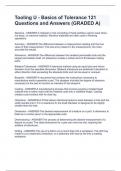
Tooling U - Basics of Tolerance 121 Questions and Answers (GRADED A)
Abrasive - ANSWER-A material or tool consisting of hard particles used to wear down, rub away, or machine material. Abrasive materials are often used in finishing operations. Accuracy - ANSWER-The difference between a measurement reading and the true value of that measurement. The less error present in the measurement, the more accurate the results. Allowance - ANSWER-The difference between the smallest permissible hole and the largest permissible shaft. An allowance creates a certain kind of fit between mating parts. Bilateral Tolerances - ANSWER-A tolerance method using an equal plus and minus deviation from the specified dimension. Bilateral tolerances are preferred if deviation in either direction risks exceeding the absolute limits and can be equal or unequal. Blueprint - ANSWER-A document that contains the instructions necessary to manufacture and/or assemble a part. The designer includes the degree of tolerance necessary for the part to function as intended in the blueprint. Casting - ANSWER-A manufacturing process that involves pouring a heated liquid material into a hollow mold until the material cools into a solidified shape. Casting creates a part surface with no clear lay. Clearance - ANSWER-A fit that allows intentional space to exist between a hole and the shaft inserted into it. For a clearance fit, the shaft diameter is designed to be slightly smaller than the hole. Dimension - ANSWER-The desired measurement of a feature on a part. A dimension is listed as a number given in the appropriate units. Dimensioning - ANSWER-The process of determining the desired measurement of a feature on a part. The ideal dimensions for a part can never be met, requiring the addition of tolerances. Drilling - ANSWER-The use of a drill to cut a round hole into a workpiece. The drill may rotate to cut a stationary workpiece, or a stationary drill may be fed into a rotating workpiece. Flaw - ANSWER-An unintentional irregularity that may be random or repeating. In surface inspection, flaws are random surface defects that are generally not included in the measurement of the surface. Grinding - ANSWER-The use of an abrasive tool or wheel to wear away at the surface of a workpiece and change its shape. Grinding produces a finish that is smoother than both sawing and milling. Interference - ANSWER-A tight fit designed where the smallest permissible shaft is larger than the largest permissible hole. Force is required to assemble parts with an interference fit. Lapping - ANSWER-An abrasive process that removes the last bit of unwanted material. A lapping process sometimes uses an abrasive paste that is rubbed across the part to gradually smooth it. Lay - ANSWER-The overall direction of the pattern created by the production process. Lay cannot be measured because it indicates only a direction. Limit Dimensions - ANSWER-A tolerancing method using an absolute maximum and minimum allowable dimension. Limit dimensioning specifies a range of acceptable measurements instead of a target dimension.
Written for
- Institution
- Tooling U - Basics
- Course
- Tooling U - Basics
Document information
- Uploaded on
- April 18, 2024
- Number of pages
- 3
- Written in
- 2023/2024
- Type
- Exam (elaborations)
- Contains
- Questions & answers
Subjects
-
tooling u basics of tolerance 121 questions and
-
tooling u basics of tolerance 121 stuvia
-
abrasive answer a material or tool consisting of
-
accuracy answer the difference between a measure

Also available in package deal