RAMP ACTUAL EXAM QUESTIONS WITH CORRECT ANSWERS
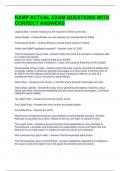
RAMP ACTUAL EXAM QUESTIONS WITH CORRECT ANSWERS Incident Documentation Form - Answer-Attempts to purchase by a minor Refusal of service Bar Fight Refusal of entry What helps to slow down the absorption of alcohol? - Answer-Any amount of food in the stomach helps. Absorption Rate Factors - Answer-Body Size Body Type Gender Amount Consumed / Time Gender - - Answer-Gender - Given equal variables, women generally will have higher concentrations of alcohol because they typically have higher percentages of body fat versus muscle mass than males. Also, women have less water content which helps dilute alcohol and less of the stomach enzyme alcohol dehydrogenase. Alcohol dehyrogenase is what helps metabolize and break down alcohol. Body Size - Answer-Larger people tend to have more volume of blood, water, muscle, etc., to dilute alcohol than a smaller person. Therefore, after consuming the same amount of alcohol, a smaller person will generally have a higher blood alcohol concentration. Body Type - People with high amounts of body fat will have more alcohol in their blood since fat does not absorb alcohol, whereas muscle does Body Type - - Answer-People with high amounts of body fat will have more alcohol in their blood since fat does not absorb alcohol, whereas muscle does Amount Consumed / Time - - Answer-The faster one drinks, the faster alcohol is absorbed, which speeds up the rate of intoxication. In one hour, an average liver can process or eliminate approximately 12 ounces of beer, 5 ounces of wine or 1.5 ounces of 80 proof liquor. So if the amount consumed exceeds the rate of elimination, higher levels of BAC and/or intoxication will occur. Concentration of Alcohol - The strength of a drink will determine the absorption rate. For example, a straight shot will be absorbed faster into the system than one mixed with juice. Alcohol is generally absorbed from fastest to slowest: Fastest being a straight shot followed by, carbonated mixer, water mixer and juice mixer. - Answer-The strength of a drink will determine the absorption rate. For example, a straight shot will be absorbed faster into the system than one mixed with juice. Alcohol is generally absorbed from fastest to slowest: Fastest being a straight shot followed by, carbonated mixer, water mixer and juice mixer.
Written for
- Institution
- RAMP
- Course
- RAMP
Document information
- Uploaded on
- April 17, 2024
- Number of pages
- 7
- Written in
- 2023/2024
- Type
- Exam (elaborations)
- Contains
- Questions & answers
Subjects
-
ramp actual exam questions with correct answers
-
a standard drink answer any drink that contains
-
five parts of ramp certification answer ownerma
-
liability concerns answer administrative liabili

Also available in package deal