ATI PEDS ATI 2024 B WITH NGN/ RATIONALES EXAM FULLY SOLVED & UPDATED
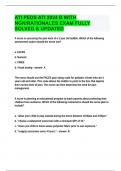
A nurse is assessing the pain level of a 3 year old toddler. Which of the following assessment scales should the nurse use? a. FACES b. Numeric c. CRIES d. Visual analog A The nurse should use the FACES pain rating scale for pediatric clients who are 3 years old and older. This scale allows the toddler to point to the face that depicts their current level of pain. The nurse can then determine the need for pain management. A nurse is planning an educational program to teach parents about protecting their children from sunburns. Which of the following instructions should the nurse plan to include? a. "allow your child to play outside during the hours between 10:00am and 2:00pm." b. "choose a waterproof sunscreen with a minimum SPF of 15." c. "dress you child in loose weave polyester fabric prior to sun exposure." d. "reapply sunscreen every 4 hours." B The nurse should instruct parents to avoid allowing their children to play outside during the hours between 1000 and 1400 because the child is at greatest risk for developing a sunburn during this time. The nurse should instruct parents to apply a waterproof sunscreen with a minimum SPF of 15 for children. The parents should apply the sunscreen prior to sun exposure to reduce the risk of sunburn. The nurse should instruct parents to dress their children in tight weave cotton fabric prior to sun exposure to protect the skin from the sun. The nurse should instruct parents to reapply sunscreen every 2 to 3 hr. A nurse is performing hearing screenings for children at a community health fair. Which of the following children should the nurse refer to a provider for a more extensive hearing evaluation? a. an 18 month old toddler who has unintelligible speech b. a 3 month old infant who has exaggerated startle response c. a 4 year old preschooler who prefers playing with others rather than alone d. an 8 month old infant who is not yet making babbling sounds D The nurse should refer a toddler who does not possess intelligible speech by the age of 24 months to a provider for a more extensive evaluation of hearing. The nurse should refer infants who are under the age of 4 months and lack a startle response to a provider for a more extensive evaluation of hearing. The nurse should refer a preschooler who prefers playing alone and avoids interaction with others to a provider for a more extensive evaluation of hearing. The nurse should refer an infant who is not making babbling sounds by the age of 7 months to a provider for a more extensive evaluation of hearing. A nurse in an emergency department is assessing a 3 month old infant who has rotavirus and is experiencing acute vomiting and diarrhea. Which of the following manifestations should the nurse identify as an indication that the infant has moderate to severe dehydration? a. HR 124 b. increased tear production c. sunken anterior fontanel d. capillary refill 2 seconds C A heart rate of 124/min is within the expected reference range of 106 to 186/min for a 3- to the 5-month-old infant. The nurse should expect the infant who has moderate to severe dehydration to have tachycardia. An infant who has moderate to severe dehydration is more likely to have an absence of tears rather than increased tear production. The nurse should recognize that a sunken anterior fontanel is an indication of moderate to severe dehydration due to the acute loss of fluid. A capillary refill of 2 seconds is within the expected reference range of 2 seconds or less for a 3-month-old infant. An infant who has moderate to severe dehydration is more likely to have a delayed capillary refill of greater than 2 seconds. A nurse is providing teaching to the family of a school-age child who has juvenile idiopathic arthrisis. Which of the following instructions should the nurse include in the teaching? a. "limit movement of the child's large joints" b. "encourage the child to perform independent self-care." c. "provide the child with a soft mattress for sleeping." d. "schedule a 2 hour daily nap for the child in the afternoon." B "Limit movement of the child's large joints."Large joints should be exercised regularly to maintain mobility and strengthen muscles. "Encourage the child to perform independent self-care."MY ANSWERThe nurse should teach the family the importance of encouraging the child to perform independent self-care. This will minimize the child's pain while maximizing mobility. Encouraging and praising the child's efforts for independence will also increase their self-esteem. "Provide the child with a soft mattress for sleeping."Children who have juvenile idiopathic arthritis should sleep on a firm mattress to provide support in maintaining joints in a functional position. "Schedule a 2-hour daily nap for the child in the afternoon."Daytime naps are discouraged because stiffness can occur quickly and easily with inactivity, and naps can interfere with nighttime sleeping. A nurse is planning care for a school age child who has a tunneled central venous access device. Which of the following interventions should the nurse include in the plan? a. use sterile scissors to remove the dressing from the site b. irrigate each lumen weekly with 10 ml of 0.9% sodium chloride solution when not in use c. access the site suing a noncoring angle needle d. use a semipermeable transparent depressing to cover the site D The nurse should avoid the use of scissors when performing dressing changes because this can result in the accidental cutting of the catheter. The nurse should flush each lumen of the catheter with a heparin solution daily when not in use. The nurse should use a non-coring angled or straight needle when accessing an implanted port. The nurse should cover the site with a semipermeable transparent dressing to reduce the risk of infection. A nurse is providing anticipatory guidance to the parent of a toddler. Which of the following expected behavior characteristics of toddlers should the nurse include? a. controls impulsive feelings b. understands right from wrong c. easily separates from parents for long periods of time d. expresses likes and dislikes D Controlling impulsive feelings is expected behavior of school-age children. Toddler is more likely to have difficulty controlling strong and impulsive feelings as they try to assert their independence and gain control of situations. Understanding right from wrong and modifying their behavior in response to others' expectations is the expected behavior of preschoolers. Toddlers tend to have a great deal of curiosity and ask many questions but are not able to fully understand what behaviors are right or wrong. A toddler might be able to separate from their parents for a short period of time, but toddlers are more likely to experience acute separation anxiety when separated from their parents for an extended period of time. The toddler might offer resistance if they are left with a new babysitter or at a new daycare center. Nurses should include that expressing likes and dislikes is an expected behavior of toddlers. This is the time in life when a toddler is developing autonomy and self-concept. They will try to assert themselves and frequently refuse to comply. The parent should allow the child to have some control, but also set limits for them so they learn from their behavior and learn to control their actions. A nurse is providing discharge teaching to the parent of a school age child who has moderate persistent asthma. Which of the following instructions should the nurse include? a. "you should give your child their salmeterol inhaler every 4 hours when they are having an acute episode of wheezing." b. "you should monitor your child's weight weekly while they are receiving inhaled corticosteroids therapy." c. "pulmonary function tests will be performed every 12-24 months to evaluate how your child is responding to therapy." d. "when using the peak expiratory flow meter, record your child's average of three readings." C "You should give your child their salmeterol inhaler every 4 hours when they are having an acute episode of wheezing."The nurse should inform the parent that long-acting beta2 agonists are to be used in conjunction with a low- or medium-dosage inhaled corticosteroid, and never used alone. Using this medication alone on an as-needed basis during an acute asthma attack is dangerous and can lead to worsening of the child's condition. "You should monitor your child's weight weekly while they are receiving inhaled corticosteroid therapy."The nurse should instruct the parent that the use of inhaled corticosteroids has not been shown to have any negative effects on growth. The provider might monitor the child's growth for systemic absorption; however, it is not necessary for the parent to weigh the child weekly. "Pulmonary function tests will be performed every 12 to 24 months to evaluate how your child is responding to therapy."MY ANSWERThe nurse should inform the parent that their child will need pulmonary function tests every 12 to 24 months to evaluate the presence of lung disease and how the child is responding to the current treatment regimen. As children grow, sometimes their manifestations can improve or decline, and treatment needs to change accordingly. "When using the peak expiratory flow meter, record your child's average of three readings."The nurse should instruct the parent to measure the child's airflow using a peak expiratory flow meter. This should be done twice daily, taking three measurements each time and waiting 30 seconds between each measurement. The parent should record the highest of the three readings, rather than the average. A nurse is assessing an adolescent who received a sodium polystyrene sulfonate enema. Which of the following findings indicates effectiveness of the medication? a. reports an absence of nausea and vomiting b. reports experiencing an onset of loose stools within 15 minutes of administration c. serum potassium level 4.1 mEq/L d. blood pressure 86/52 mm Hg C The absence of nausea and vomiting indicates the effectiveness of the antiemetic medication. Sodium polystyrene sulfonate is an antidote, which exchanges sodium ions in the intestine. Therefore, the absence of nausea and vomiting is not an indicator of the medication's effectiveness. The nurse should monitor the adolescent for diarrhea because it is an adverse effect of sodium polystyrene sulfonate. The nurse should monitor the adolescent's serum potassium level following the administration of sodium polystyrene sulfonate. This medication is used to treat hyperkalemia by exchanging sodium ions for potassium ions in the intestine. Therefore, a potassium level within the expected reference range of 3.4 to 4.7 mEq/L indicates the effectiveness of the medication. Blood pressure of 86/52 mm Hg is below the expected reference range of 90 to 110 mm Hg systolic and 60 to 80 mm Hg diastolic for an adolescent and does not indicate the effectiveness of the medication. The nurse should continue to monitor blood pressure as an indicator of fluid and electrolyte imbalance. A nurse is assessing an infant who has pneumonia. Which of the following findings is the priority for the nurse to report the provider? a. nasal flaring b. WBC count 11,300/mm^3 c. diarrhea d. abdominal distension A Nasal flaringMY ANSWERWhen using the airway, breathing, and circulation approach to client care, the nurse should determine that the priority finding to report to the provider is nasal flaring. Nasal flaring indicates the infant is experiencing acute respiratory distress. WBC count 11,300/mm3The nurse should report a WBC count of 11,300/mm3 because it is above the expected reference range of 5,000 to 10,000/mm3 and indicates infection. However, there is another finding that is the priority for the nurse to report. DiarrheaThe nurse should report diarrhea because it is a manifestation of pneumonia in infants and indicates the current treatment is not effective. However, there is another finding that is the priority for the nurse to report. Abdominal distensionThe nurse should report abdominal distension because it is a manifestation of pneumonia in infants and indicates the current treatment is not effective. However, there is another finding that is the priority for the nurse to report. A nurse is providing discharge teaching to the guardian of a school age child who has undergone a tonsillectomy. Which of the following statements by the guardian indicates an understanding the teaching? a. "my child can resume usual activities since this year just an outpatient surgery." b. "my child will be able to drink the chocolate milkshake I promised to get for them tonight." c. "I will notify the doctor if I notice that my child is swallowing frequently." d. "I will have my child gargle with warm salt water to relieve their sore throat." C "My child can resume usual activities since this was just an outpatient surgery."Activity should be limited following a tonsillectomy to decrease the risk of hemorrhage. "My child will be able to drink the chocolate milkshake I promised to get for them tonight."Milk products should be avoided because they coat the child's throat, which can initiate a cough response and increase the risk of bleeding. Brown and red foods should be avoided during the immediate postoperative period so that food and fresh or old blood are distinguishable in the child's emesis. "I will notify the doctor if I notice that my child is swallowing frequently."MY ANSWERThe nurse should instruct the parent that frequent swallowing is an indication of bleeding and, if it is observed, to notify the provider immediately. "I will have my child gargle with warm salt water to relieve their sore throat."Gargles are likely to cause irritation and discomfort and can increase the risk of bleeding following a tonsillectomy. The child should receive adequate pain medication following the procedure and can wear an ice collar if tolerated. A nurse is discussing organ donation with the parents of a school age child who has sustained brain death due to a bicycle crash. Which of the following actions should the nurse take first? a. inform the parents that written consent is required prior to organ donation b. provide written information to the parents about organ donation c. ask the provider to explain misconceptions of organ donation to the parents. d. explore the parents feelings and wishes regarding organ donation D The nurse should inform the parents that written consent is required prior to organ donation to document that the parents have consented to organ donation and that the provider has addressed any questions or concerns the parents might have. However, there is another action the nurse should take first. The nurse should provide written information to the parents to enhance their understanding of organ donation. However, there is another action the nurse should take first. The nurse should ask the provider to explain misconceptions of organ donation to the parents because it is important that they have accurate information before making a final decision. However, there is another action the nurse should take first. The first action the nurse should take when using the nursing process is assessment. The nurse should first explore the parents' feelings and wishes regarding organ donation to assist in determining if organ donation is the right choice for the family. A nurse is caring for a newly admitted school age child who has hypopituitarism. Which of the following medications should the nurse expect the provider to prescribe? a. Desmopressin b. Luteinizing hormone-releasing hormone c. Recombinant growth hormone d. Levothyroxine C Desmopressin is used to treat the hyposecretion of antidiuretic hormones. Luteinizing hormone-releasing hormone is used in the treatment of precocious puberty to slow prepubertal growth in children and in the treatment of advanced prostate cancer in adult clients. Recombinant growth hormone injections are used to treat hypopituitarism, which inhibits cell growth and results in growth failure. The nurse should expect the provider to prescribe this treatment. Levothyroxine is used to treat various hypothyroid conditions. A nurse is providing discharge teaching to he parents of a 3 month old infant following a cheiloplasty. Which of the following instructions should the nurse include? a. "clean your baby's sutures daily with a mixture of chlorhexidine and water." b. "expect your baby to swallow more than usual over the next few days." c. "inspect your baby's tongue for white patches using a tongue depressor every 8 hours." d. "apply a thin layer of antibiotic ointment on your baby's suture line daily for the next 3 days." D The nurse should instruct the parents to clean the infant's sutures with sterile water or diluted hydrogen peroxide. The nurse should instruct the parents to notify the provider of excessive swallowing because this can indicate bleeding and the infant's swallowing of blood. The nurse should instruct the parents to avoid placing objects, such as tongue depressors, in the infant's mouth to prevent injury to the suture line. The nurse should instruct the parents to apply a thin layer of antibiotic ointment on the infant's suture line daily for 3 days and then continue to apply petroleum jelly to the area for several weeks to promote healing. A nurse is caring for a school age child who has peripheral edema. The nurse should identify that which of the following assessments should be performed to confirm peripheral edema? a. palpate the dorsum of the child's feet b. weigh the child daily using the same scale c. assess the child's skin turgor d. observe the child for periorbital swelling A The nurse should palpate the dorsum of the feet by pressing the fingertip against a bony prominence for 5 seconds to assess for peripheral edema. Weighing the child daily might indicate that the child has retained fluid. However, this is not a method the nurse should use to assess for peripheral edema. Assessing the child's skin turgor measures the elasticity and mobility of the skin. However, this is not a method the nurse should use to assess for peripheral edema. Observing the child for periorbital swelling is a method used to assess for generalized edema. However, this is not a method the nurse should use to assess for peripheral edema. A nurse is caring for a 10 year old child following a head injury. Which of the following findings should the nurse identify as an indication that the child is developing diabetes insipidus? a. urine specific gravity 1.045 b. sodium 155 mEq/L c. blood glucose 45 mg/dL d. urine output 35 mL/hr B Urine-specific gravity of 1.045 is above the expected reference range of 1.005 to 1.030. A child who has diabetes insipidus is more likely to have diluted urine and a urine-specific gravity below the expected reference range. A child who has a head injury can develop diabetes insipidus as a result of pituitary hypofunction leading to a deficiency of the antidiuretic hormone. Underexcretion of the antidiuretic hormone leads to polyuria and polydipsia, and possibly dehydration. With the excessive loss of free water, sodium levels rise above the expected reference range of 136 to 145 mEq/L. Blood glucose of 45 mg/dL is below the expected reference range of 70 to 110 mg/dL. A child who has diabetes insipidus is expected to have a blood glucose level within the expected reference range. Urinary output of 35 mL/hr is within the expected reference range of 33 to 58 mL/hr for a 10-year-old child. A child who has diabetes insipidus is expected to have polyuria. A school nurse is providing an in service for faculty about improving education for students who have ADHD. Which of the following statements by a faculty member indicates an understanding of the teaching? a. "I will plan to increase the amount of homework I assign to students who have ADHD." b. "I will give students who have ADHD the same amount of time as other students to complete tests." c. "I will allow students who have ADHD one rest break throughout the day." d. "I will teach challenging academic subjects to students who have ADHD in the morning." D Faculty should plan to teach challenging academic subjects in the morning when students who have ADHD are most able to focus and their medication is most likely to be effective.
Written for
- Institution
- ATI NGN
- Course
- ATI NGN
Document information
- Uploaded on
- April 17, 2024
- Number of pages
- 57
- Written in
- 2023/2024
- Type
- Exam (elaborations)
- Contains
- Questions & answers
Subjects
-
ati peds ati 2024 b with ngn rationales exam

Also available in package deal