MRI safety guidelines questions with answers 2024/2025
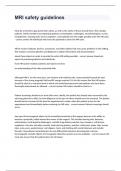
MRI safety guidelines Must be screened to guarantee their safety, as well as the safety of those around them. This includes patients, family members accompanying patients, technologists, radiologists, anesthesiologists, nurses, receptionists, cleaning staff, service engineers, and anybody else who might possibly enter the MR suite. - correct answer All individuals who have the potential to enter the MR suite: All the various implants, devices, accessories, and other objects that may cause problems in this setting. This requires constant attention and diligence to obtain information and documentation about these objects in order to provide the safest MR setting possible. - correct answer Important aspect of protecting patients and individuals from MR system-related accidents and injuries involves an understanding of the risks associated with: Although MRI is, for the most part, non-invasive and relatively safe, some potential hazards do exist because of the strong magnetic field and RF energy required. It is for this reason that the MR system should be sited in a restricted area in which only authorized personnel and patients who have been thoroughly interviewed are allowed. - correct answer MR system should be sited in a: Patient screenings should occur more than once. Ideally, the patient has already been screened by the referring physician's office, but this diligence on the part of others should never be assumed. The patient should also be screened at the time the appointment is made, when the patient arrives for the appointment,and immediately before entering the MR suite. - correct answer Patient screenings should occur: Any type of ferromagnetic object to the immediate proximity of the magnet because of its ability to become a projectile, pulled toward the center of the magnet. This includes hearing aids, dentures, partial plates, contraceptive diaphragms, metallic drug delivery patches, keys, beepers, cell phones, eyeglasses, hair pins, barrettes, jewelry, body piercing jewelry, watches, safety pins, paper clips, money clips, coins, pens, pocket knives, nail clippers, tools, and clothing with metal fasteners and metallic threads. Conventional metal detectors do not differentiate between ferromagnetic and non-ferromagnetic metallic objects. Ferromagnetic detection systems are now available. - correct answer We must also ensure that the patient does not introduce:
Written for
- Institution
- MRSO
- Course
- MRSO
Document information
- Uploaded on
- April 16, 2024
- Number of pages
- 3
- Written in
- 2023/2024
- Type
- Exam (elaborations)
- Contains
- Questions & answers
Subjects

Also available in package deal