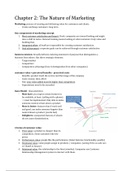
Chapter 2: The Nature of Marketing
Marketing: process of creating and delivering value for customers and clients.
- Create and keep customers: long term
Key components of marketing concept:
1. Meet customer satisfaction and keep it. Hard: companies are inward looking and might
miss a shift in tastes. Outward looking means looking at what customers truly value and
building that.
2. Integrated effort: all staff are responsible for creating customer satisfaction.
3. Goal achievement: corporate goals can be achieved through customer satisfaction
business mission: broadly defined, enduring statement of purpose that distinguishes a
business from others. Has three strategic elements:
- Target market
- Competitors
- Comparative advantage (how it distinguishes from other companies)
customer value = perceived benefits - perceived costs
- Benefits: product itself, the service and the image of the company
- Costs: money, time, effort
- Key: your value added must be higher than competitors.
- Expectations need to be exceeded.
Kano Model: Characteristics:
- Must have: you expect certain features to
be available, at least. (calling with a phone).
→ must be implemented. Only able to make
someone neutral at best about a product
- More is better: features that if work well
and good, can make someone happier than
neutral about a product. (works fast)
- Delighters: unexpected features, if absent
do not cause dissatisfaction.
4 forms of customer value:
1. Price value: a product is cheaper than its
competitors. Some customers like low
prices
2. Performance value: people like the performance. (latest features, functionality, quality)
3. Emotional value: value people assign to products / companies. (seeing Volvo as safe cars
or Chanel as luxury)
4. Relational value: the relationship to the firm (airmiles). Companies use Customer
Relationship Management system to interact with them.
,Customer value proposition: what value do you offer the customer? Firms often compete in
only one dimension (above), to avoid confusion (but may change over time).
Different orientations besides marketing:
- Production orientation: focus on solely production → might make something consumers
don’t want
- Sales orientation: try to use marketing to get people to buy things, but not necessarily
bring value to customers.
- Customer Orientation: understanding needs and wants from customers.
Societal marketing concept: sustainable marketing, deliver value to customers and society.
(reducing pollution)
Marketing planning: process of analysing business climate. Questions:
1. Where are we now?
2. Where would we like to be?
3. How do we get there?
Comparative advantages:
1. Differentiation: making just a slightly different product. Broad range of markets
2. Cost leadership: making products cheaper. Broad range of markets
3. Differentiation focus. Narrow range
4. Cost focus. Narrow range
Marketing Audit: analysis of firms current situation. Finding issues, problem areas,
opportunities.
- Internal audit: focus on areas under control of marketing management
- External audit: focus on areas where marketing management has no control
- Example: SWOT analysis
SWOT Analysis: Strengths, Weaknesses, Opportunities, Threats.
- Focus on relative strengths as opposed to absolute ones. (compared to other firms)
- Look objectively at strengths, as they may turn into weaknesses.
- Only include strengths that are valued by customers.
Marketing Objectives:
- Strategic thrust: how to grow a company. Ansoff matrix
- Existing products in existing markets: get people to use your brand more often
and to use more of it. Market penetration.
- New products / existing markets: additional products. Product development
- Existing products / new markets: expand to new countries, continents. Market
development.
- New products / new markets: risky but might be necessary. Diversification
- Strategic objectives: choosing to build, hold, harvest or divest products.
- Build: develop a new product
, - Holding: just keep selling your product
- Harvest: Maximize profit margins of products whose sales drop
- Divestment: drop or sell a product.
- Marketing objectives should be SMART: Specific, Measurable, Achievable, Realistic
and Timed.
Marketing actions: use of 4Ps: product, price, promotion and place.
- Product: what the product will be
- Price: decisions regarding pricing
- Place: where it is distributed
- Promotion: advertising, twitter, facebook etc
Marketing works: leads to higher sales and profits (proven). But effectiveness is difficult to
measure. → marketing budgets are the first to be cut in worse times.
Chapter 9: Value through Products and
Brands
Product (marketing definition): any form of value offered in exchange for money, votes or
time.
- Most are a mix of tangible and intangible. (iPhone + Apple store experience)
Brands: distinguish the offerings from one company of those of others.
3 levels of ‘product’: Product differentiation can happen at all three levels
1. Core product: this delivers the core benefit of the product (cars & transportation)
2. Actual product: certain features, styling etc (tangible)
3. Augmented product: extra bundles of benefits added to product (guarantees etc)
(Intangible)
Product differentiation:
- Core differentiation: changes to the core product, mostly technical breakthroughs. Also
strategic thinking: instead of focusing on extras, focus on core benefit.
- Actual differentiation: competing on quality, design, features etc.
- Quality: no defects and meet needs customer
- Packaging: kind of container wrapper for product.
- Slack packaging: extra big containers to make it seem like they contain
more than they do
- Augmented differentiation: new features (screen sizes, resolution)
, New product development
4 categories of new products:
1. Product replacements: revisions and improvements to existing products.
2. Additions to existing lines: new products added to an existing product
line.
3. New product lines: new product and move into a new market (Mars
icecream)
4. New-to-the-world products: products that create an entirely new market.
Product development process:
- Idea generation: Internal: brainstorming, using financial incentives for
good ideas of employees. External: examining competitors products,
distributors, customers
- Screening: evaluating commercial value (attractiveness of the market,
ability to make it etc)
- Concept testing: testing the concept with potential customers (verbally /
with pictures)
- Business analysis: estimating cost, profit. Marketing analysis identifies the
market, size and product acceptance.
- Break even analysis: when will we break even
- Sensitivity analysis: how do variations from previous assumptions
about market size etc influence profits
- Product Development: make the actual product. This stage should be
quick because you risk being too late to the market and being first in the market gives an
advantage. Products are tested in a lab / alongside competing products
- Market testing: measures customer acceptance by launching in a limited way. Simulated
market test: small, realistic market in which a sample of customers can buy goods
provided by the firm (groceries for example), they’ll see if the customers buy it on their
own. Test marketing: a few geographical areas are chosen to launch the product first.
(but may not be representative → inaccurate)
- Commercialization: actual launch of the product
Branding (Not midterm)
Benefits of brands to organizations:
1. Company value: branding creates intangible value for a company
2. Consumer preference/loyalty: satisfied customers are loyal to your brand
3. Barrier to competition: difficult for new brands to compete
4. High profits: brand equity means you can charge higher prices
5. Base for brand extensions: you can extend your brand and profit from the already strong
brand.
Marketing: process of creating and delivering value for customers and clients.
- Create and keep customers: long term
Key components of marketing concept:
1. Meet customer satisfaction and keep it. Hard: companies are inward looking and might
miss a shift in tastes. Outward looking means looking at what customers truly value and
building that.
2. Integrated effort: all staff are responsible for creating customer satisfaction.
3. Goal achievement: corporate goals can be achieved through customer satisfaction
business mission: broadly defined, enduring statement of purpose that distinguishes a
business from others. Has three strategic elements:
- Target market
- Competitors
- Comparative advantage (how it distinguishes from other companies)
customer value = perceived benefits - perceived costs
- Benefits: product itself, the service and the image of the company
- Costs: money, time, effort
- Key: your value added must be higher than competitors.
- Expectations need to be exceeded.
Kano Model: Characteristics:
- Must have: you expect certain features to
be available, at least. (calling with a phone).
→ must be implemented. Only able to make
someone neutral at best about a product
- More is better: features that if work well
and good, can make someone happier than
neutral about a product. (works fast)
- Delighters: unexpected features, if absent
do not cause dissatisfaction.
4 forms of customer value:
1. Price value: a product is cheaper than its
competitors. Some customers like low
prices
2. Performance value: people like the performance. (latest features, functionality, quality)
3. Emotional value: value people assign to products / companies. (seeing Volvo as safe cars
or Chanel as luxury)
4. Relational value: the relationship to the firm (airmiles). Companies use Customer
Relationship Management system to interact with them.
,Customer value proposition: what value do you offer the customer? Firms often compete in
only one dimension (above), to avoid confusion (but may change over time).
Different orientations besides marketing:
- Production orientation: focus on solely production → might make something consumers
don’t want
- Sales orientation: try to use marketing to get people to buy things, but not necessarily
bring value to customers.
- Customer Orientation: understanding needs and wants from customers.
Societal marketing concept: sustainable marketing, deliver value to customers and society.
(reducing pollution)
Marketing planning: process of analysing business climate. Questions:
1. Where are we now?
2. Where would we like to be?
3. How do we get there?
Comparative advantages:
1. Differentiation: making just a slightly different product. Broad range of markets
2. Cost leadership: making products cheaper. Broad range of markets
3. Differentiation focus. Narrow range
4. Cost focus. Narrow range
Marketing Audit: analysis of firms current situation. Finding issues, problem areas,
opportunities.
- Internal audit: focus on areas under control of marketing management
- External audit: focus on areas where marketing management has no control
- Example: SWOT analysis
SWOT Analysis: Strengths, Weaknesses, Opportunities, Threats.
- Focus on relative strengths as opposed to absolute ones. (compared to other firms)
- Look objectively at strengths, as they may turn into weaknesses.
- Only include strengths that are valued by customers.
Marketing Objectives:
- Strategic thrust: how to grow a company. Ansoff matrix
- Existing products in existing markets: get people to use your brand more often
and to use more of it. Market penetration.
- New products / existing markets: additional products. Product development
- Existing products / new markets: expand to new countries, continents. Market
development.
- New products / new markets: risky but might be necessary. Diversification
- Strategic objectives: choosing to build, hold, harvest or divest products.
- Build: develop a new product
, - Holding: just keep selling your product
- Harvest: Maximize profit margins of products whose sales drop
- Divestment: drop or sell a product.
- Marketing objectives should be SMART: Specific, Measurable, Achievable, Realistic
and Timed.
Marketing actions: use of 4Ps: product, price, promotion and place.
- Product: what the product will be
- Price: decisions regarding pricing
- Place: where it is distributed
- Promotion: advertising, twitter, facebook etc
Marketing works: leads to higher sales and profits (proven). But effectiveness is difficult to
measure. → marketing budgets are the first to be cut in worse times.
Chapter 9: Value through Products and
Brands
Product (marketing definition): any form of value offered in exchange for money, votes or
time.
- Most are a mix of tangible and intangible. (iPhone + Apple store experience)
Brands: distinguish the offerings from one company of those of others.
3 levels of ‘product’: Product differentiation can happen at all three levels
1. Core product: this delivers the core benefit of the product (cars & transportation)
2. Actual product: certain features, styling etc (tangible)
3. Augmented product: extra bundles of benefits added to product (guarantees etc)
(Intangible)
Product differentiation:
- Core differentiation: changes to the core product, mostly technical breakthroughs. Also
strategic thinking: instead of focusing on extras, focus on core benefit.
- Actual differentiation: competing on quality, design, features etc.
- Quality: no defects and meet needs customer
- Packaging: kind of container wrapper for product.
- Slack packaging: extra big containers to make it seem like they contain
more than they do
- Augmented differentiation: new features (screen sizes, resolution)
, New product development
4 categories of new products:
1. Product replacements: revisions and improvements to existing products.
2. Additions to existing lines: new products added to an existing product
line.
3. New product lines: new product and move into a new market (Mars
icecream)
4. New-to-the-world products: products that create an entirely new market.
Product development process:
- Idea generation: Internal: brainstorming, using financial incentives for
good ideas of employees. External: examining competitors products,
distributors, customers
- Screening: evaluating commercial value (attractiveness of the market,
ability to make it etc)
- Concept testing: testing the concept with potential customers (verbally /
with pictures)
- Business analysis: estimating cost, profit. Marketing analysis identifies the
market, size and product acceptance.
- Break even analysis: when will we break even
- Sensitivity analysis: how do variations from previous assumptions
about market size etc influence profits
- Product Development: make the actual product. This stage should be
quick because you risk being too late to the market and being first in the market gives an
advantage. Products are tested in a lab / alongside competing products
- Market testing: measures customer acceptance by launching in a limited way. Simulated
market test: small, realistic market in which a sample of customers can buy goods
provided by the firm (groceries for example), they’ll see if the customers buy it on their
own. Test marketing: a few geographical areas are chosen to launch the product first.
(but may not be representative → inaccurate)
- Commercialization: actual launch of the product
Branding (Not midterm)
Benefits of brands to organizations:
1. Company value: branding creates intangible value for a company
2. Consumer preference/loyalty: satisfied customers are loyal to your brand
3. Barrier to competition: difficult for new brands to compete
4. High profits: brand equity means you can charge higher prices
5. Base for brand extensions: you can extend your brand and profit from the already strong
brand.