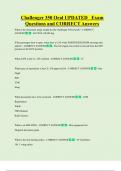
Chem 219 Unit 1 Exam Questions With 100% Correct Answers
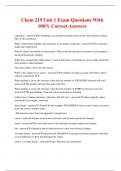
Chem 219 Unit 1 Exam Questions With 100% Correct Answers catenation - answerthe bonding of an element to another atom of the same element (carbon likes to do catenation) What controls the properties and reactivity of an organic molecule? - answerThe molecule's shape and composition Why do atoms form bonds to other atoms? What is the driving force for atoms to join together? - answerenergetic stability What does energetically stable mean? - answerAtoms of elements are more stable when they form bonds to other elements The more stable = the lower the energy What is the valence of an atom? - answerThe number of bonds an atom will form to fill its valence (outermost) shell When making a Lewis dot structure what does the number of UNPAIRED electrons tell you? - answerThe number of bonds the atom will form When making a Lewis dot structure what does the number of PAIRS of electrons tell you? - answerThe non-bonding / lone pairs don't participate in bonding Carbon has 4 valence electrons, what does that tell you? - answerCarbon typically makes four bonds in an organic molecule. Ionic bonds - answer-Formed by the complete TRANSFER of one or more valence electrons from one atom to another atom -The attractive force between oppositely charged ions cation - answerwhen an atom loses electrons and becomes positively charged anion - answerThe atom that receives the electrons becomes negatively charged ion - answera chemical species that possesses a non-zero electrical charge Covalent bonds - answerformed by the SHARING of electrons between elements with little (or no) difference in their electronegativity values ionic vs covalent bonds - answerIonic- Electrons are transferred Covalent- Electrons are shared From what type of bond are ions formed? - answerIonic bonds (not from covalent bonds) diatomic elements - answerElements that in their pure form exist in pairs (hydrogen is always found bound to another atom) What are the two key parameters of the covalent bond? - answerthe bond strength and the bond length bond strength - answerdetermined by measuring how much heat is released when a covalent bond forms, When atoms bond they release heat and gain stability. The more stable = the more heat released bond length - answera unit of distance that describes the perfect balance between attraction and repulsion between the atoms joined by the bond. At some equilibrium distance (which depends on which specific atoms are joining together) the atoms vibrate around each other, neither flying apart nor fusing together pure (or purely) covalent bond - answera covalent bond that forms between atoms of identical electronegativity values. Neither atom "wants" the bonding electron more than the other. Also a covalent bond between any two identical atoms is always a purely covalent bond. Polar covalent bonding - answercovalent bonding that occurs between elements with different electronegativity values but not enough of a difference that the bond becomes ionic (there is a sharing of electrons, but it is unequal) How is the dipole arrow used? - answerWhen showing a polar covalent bond the dipole arrow always points in the direction of the more negative element. What type of bonds form between atoms with large differences in electronegativity? - answerIonic bonds What type of bonds form between atoms with no differences in electronegativity? - answerPure (purely) covalent bonds What type of bonds form between atoms with small differences in electronegativity? - answerPolar covalent bonds bond order - answerthe number of bonds between a pair of atoms in a molecule Unsaturated compounds - answermolecules that possess one or more double or triple bonds (or a ring) as a part of their structure Isomers - answerTwo different molecules that have the same chemical formula but have different structures (the different structures can result in different types of reactions, melting
Written for
- Institution
- CHEM 219
- Course
- CHEM 219
Document information
- Uploaded on
- April 16, 2024
- Number of pages
- 8
- Written in
- 2023/2024
- Type
- Exam (elaborations)
- Contains
- Questions & answers
Subjects
-
chem 219 unit 1 exam questions with 100 correct a

Also available in package deal