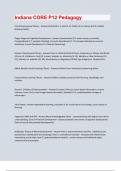
Indiana CORE P12 Pedagogy Questions and Answers with complete solution
Freud Psychosexual Theory - Answer-Oral (birth-1 ), Anal (2-3), Phallic (4-5), Latency (6-12), Genital (Puberty-Adult) Piaget Stages of Cognitive Development - Answer-Sensorimotor (0-2 motor sensory curiosity), Preoperational (2-7 symbolic thinking), Concrete Operational (7-11 Concepts attached to concrete situations), Formal Operations (11+ Abstract Reasoning) Erikson's Psychosocial Theory - Answer-Trust vs. Mistrust (birth-18 mo.), Autonomy vs. Shame and Doubt (18 mo.-3), Initiative vs. Guilt (3-5 years), Industry vs. Inferiority (5-13), Identity vs. Role Confusion (13- 21), Intimacy vs. Isolation (21-39), Generativity vs, Stagnation (40-65), Ego Integrity vs. Despair (65+) Albert Bandura Social Learning Theory - Answer-children learn indirectly by observing others. Constructivist Learning Theory - Answer-children actively construct their learning, knowledge, and realities. Bruner's 3 Modes of Representation - Answer-Enactive (infancy): action-based information, muscle memory, Iconic (1-6): visual image-based information, Symbolic (7+): coded/symbolic storage of information John Dewey - Answer-experiential learning, education is for social reform and change, social nature of learning Vygotsky's MKO and ZPD - Answer-More Knowledgeable Other - someone/thing with higher level skill or understanding, Zone of Proximal Development - distance between two levels of cognitive development (level of actual and potential development) Kohlberg's Theory of Moral Development - Answer-level 1: preconventional morality - obedience and punishment, individualism and exchange, level 2: conventional morality - interpersonal relationships, maintaining social order, level 3: postconventional morality - social contract and individual rights, universal ethical principlesBloom's Taxonomy - Answer-Remembering, Understanding, Applying, Analyzing, Evaluating, Creating Adolescent Cognitive Development - Answer-prefrontal cortex matures age of 18-25 years Typical vs. Atypical Child Development - Answer-slowly emerging skills indicate delays while skills differing in form, function, and quality often indicate disorders. Differentiating Instruction - Answer-tailor content, process, product, environment to each student Schemata - Answer-a mental construct Assimilate - Answer-fit new stimulus into existing schemata Accomodate - Answer-modify existing schemata or create new one Cognitive Information Processing Theory - Answer-person receives sensory input in sensory register or memory, attend to it through attention, chunk and rehearse it via working memory into short term memory, encode for transfer to long term memory, then retrieve as needed. Behaviorist Theory - Answer-individual will emit or repeat behavior for reward Reciprocal Determinism - Answer-learning involves individual, environment, and behavior Scaffolding - Answer-temporary, need support, gradually withdrawn as learner gains proficiency Classical Conditioning - Answer-Pavlov's dogs: manipulate unconscious behaviors with previously unrelated stimulus Operant Conditioning - Answer-Skinner found you can manipulate conscious behaviorsInternal Rewards - Answer-Originate within the individual. More powerful for increasing and maintaining behaviors External Rewards - Answer-Rewards provided by other people or the environment. Intellectual Disability - Answer-students function intellectually two standard deviations or more lower than peers, learn the same ways but at slower rates Autism Spectrum Disorders - Answer-emotional and cognitive disability, intelligence varies widely, impairs social understanding and interaction
Written for
- Institution
- Indiana CORE P12 Pedagogy
- Course
- Indiana CORE P12 Pedagogy
Document information
- Uploaded on
- April 15, 2024
- Number of pages
- 9
- Written in
- 2023/2024
- Type
- Exam (elaborations)
- Contains
- Questions & answers
Subjects

Also available in package deal