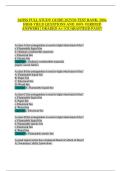
Test Bank for Earth Science 14th Edition, Complete All Chapters 1- 14, Newest Version.
Chapter 1 Introduction to Earth Science 1) What are the basic differences between the disciplines of physical and historical geology? A) Physical geology is the study of fossils and sequences of rock strata; historical geology is the study of how rocks and minerals were used in the past. B) Historical geology involves the study of rock strata, fossils, and geologic events, utilizing the geologic time scale as a reference; physical geology includes the study of how rocks form and of how erosion shapes the land surface. C) Physical geology involves the study of rock strata, fossils, and deposition in relation to plate movements in the geologic past; historical geology charts how and where the plates were moving in the past. D) none of the above—physical geology and historical geology are essentially the same. Answer: B Diff: 1 Topic: 1.1 What Is Earth Science Bloom's Taxonomy: 1 Remember 2) The study of Earth's atmosphere is known as ________. A) astronomy B) oceanography C) meteorology D) cosmology Answer: C Diff: 1 Topic: 1.1 What Is Earth Science Bloom's Taxonomy: 1 Remember 3) Which science is not used within the Earth sciences? A) Chemistry B) Physics C) Biology D) Mathematics E) None of the above; Earth Science makes use of all of these sciences. Answer: E Diff: 1 Topic: 1.1 What Is Earth Science Bloom's Taxonomy: 3 Apply 4) Oceanography is the study of the oceans and geology is the study of the earth, so what is meteorology? A) the study of meteors B) the study of the Sun's impact on the upper atmosphere C) the study of the atmosphere D) the study of how to be a TV newscaster Answer: C Diff: 1 Topic: 1.1 What Is Earth Science Bloom's Taxonomy: 1 Remember 5) Sedimentary rocks with marine fossils are exposed at the top of Mt. Everest. Which scientists would make most use of this observation in their study? A) Meteorologists, because they could use the fossils as a guide to ancient climates B) Geologists, because their elevation is related to physical geology and fossils are related to Earth history C) Oceanographers, because the fossils can tell us about periods when the earth was covered with water to the height of Mt. Everest D) Astronomers, because they can study how life came from outer space to Earth Answer: B Diff: 1 Topic: 1.1 What Is Earth Science Bloom's Taxonomy: 2 Understand 6) Hurricanes and tornados are natural disasters. What branch of the Earth sciences studies the origin of these phenomena? A) Meteorology B) Geology C) Oceanography D) Astronomy Answer: A Diff: 1 Topic: 1.1 What Is Earth Science Bloom's Taxonomy: 2 Understand 7) Hurricanes are natural disasters. Which branch of the Earth sciences studies the impact of this phenomenon on coastal environments? A) Meteorology B) Geology C) Oceanography D) Astronomy Answer: B Diff: 1 Topic: 1.1 What Is Earth Science Bloom's Taxonomy: 2 Understand 8) Tsunamis and earthquakes have killed millions of people during human history. What branch of the Earth sciences is the main group that studies these phenomena? A) Meteorology B) Geology C) Oceanography D) Astronomy Answer: B Diff: 1 Topic: 1.1 What Is Earth Science Bloom's Taxonomy: 2 Understand 9) If you want to buy a house in an area and you are worried there may be an earthquake hazard, who would be the best person to ask for advice on this hazard? A) a civil engineer B) a geologist C) a physicist D) an astrologer Answer: B Diff: 1 Topic: 1.1 What Is Earth Science Bloom's Taxonomy: 2 Understand 10) The earth is estimated to be approximately 4.6 billion years old. Life appeared early in the history of Earth, but metazoans (multicelled organisms) did not appear until about 600 million years ago. If the history of Earth were compressed into a single year, when would metazoans appear? A) late September B) late November Test Bank for Earth Science 14th Edition C) mid-December D) late January Answer: B Diff: 1 Topic: 1.1 What Is Earth Science Bloom's Taxonomy: 4 Analyze 11) Which of the following would not typically be considered an Earth Science study? A) studies of volcanic eruptions B) studies of impact craters on the moon C) studies of acid mine waters and the bacteria that live in those waters D) chemical refining of petroleum Answer: D Diff: 2 Topic: 1.1 What Is Earth Science Bloom's Taxonomy: 2 Understand / 3 Apply Test Bank for Earth Science 14th Edition 12) Climate change is a well-known human problem and remains controversial despite widespread scientific agreement on the issue. Although most scientists are familiar with the issues, if you were a congressman and wanted an informed analysis of the problem, which of the following would be most likely to give you the most complete analysis? A) an astronomer B) a meteorologist with knowledge of oceanography C) a geologist with knowledge of astronomy D) a physicist Answer: B Diff: 2 Topic: 1.1 What Is Earth Science Bloom's Taxonomy: 2 Understand 13) A ________ is a well-tested and widely accepted view that best explains certain scientific observations. A) hypothesis B) generalization C) law D) theory Answer: D Diff: 1 Topic: 1.2 The Nature of Scientific Inquiry Bloom's Taxonomy: 1 Remember 14) The primary goal of Earth Science is ________. A) to develop things that will benefit mankind B) to identify the patterns in nature and use that information to predict the future C) to locate resources Test Bank for Earth Science 14th Edition D) to protect the environment Answer: B Diff: 1 Topic: 1.2 The Nature of Scientific Inquiry Bloom's Taxonomy: 1 Remember 15) All of the following are possible steps of scientific investigation except for ________. A) the collection of scientific facts through observation and measurement B) assumption of conclusions without prior experimentation or observation C) the development of one or more working hypotheses or models to explain facts D) development of observations and experiments to test the hypotheses Answer: B Diff: 1 Topic: 1.2 The Nature of Scientific Inquiry
Connected book
Written for
- Institution
- Earth Science 14th Edition
- Course
- Earth Science 14th Edition
Document information
- Uploaded on
- April 15, 2024
- Number of pages
- 637
- Written in
- 2023/2024
- Type
- Exam (elaborations)
- Contains
- Questions & answers
Subjects
- earth science
- newest version
-
earth science 14th edition
-
test bank for earth science 14th edition
-
complete all chapters 1 14