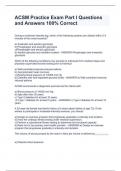
ACSM Certified Exercise Physiologist Exam Questions With 100% Correct Answers
ACSM Certified Exercise Physiologist Exam Questions With 100% Correct Answers Physical Activity - answerAny bodily movement produced by contracting skeletal muscles, with an increase in energy expenditure. Exercise - answerPlanned, purposeful, repetitive Physical Fitness - answerAttributes or characteristics that individuals have achieved that related to their ability to perform physical activity 3 metabolic pathways the body uses to creates ATP - answer1. Creatine Phosphate 2. anaerobic glycolysis 3. 0xidative system Claudication - answerpain in the leg is induced by exercise, usually because of an artery obstruction. Creatine Phosphate system - answerSmall amounts of CP are stored within each cell. Simple one-to-one trade off that allows for the rapid production of ATP. ONLY for use during short bouts of exercise. less that 10 seconds. Anaerobic glycolysis - answerNo oxygen required. NExt most immediate energy source. break down carbs (glucose or glycogen) into pyruvate. Used during medium-duration exercise. no more than about 90 seconds. Aerobic glycolysis (oxidative system) - answerOxygen dependent. As exercise intensity decreases allowing for longer duration activities, use of the oxidative system increases. (Krebs cycle and ETC). Produce ATP in the mitochondria of the cell--requires oxygen. Lasts longer than 1-2 minutes. What is VO2? - answerThe volume of oxygen the body consumes. VO2 max is the highest volume of oxygen the body can consume. Define Stroke Volume - answerthe volume of blood the heart ejects with each beat. How does SV increase with workload? - answerSimilar to HR, it increases as workload increases but only up to ~40% to 60% of VO2max. The percentages can be decreases in sedentary individuals and increased with training. What happens to resting HR as stroke volume increases? - answerit decreases, as more blood being pumped per beat allows the heart to beat less often. What is cardiac output? - answera measure of blood pumped per minute. The product of stroke volume and heart rate. What does Diastolic Blood pressure do during exercise? - answerRemains stable or decreases slightly. What is rate pressure product? - answerserves as an estimate of myocardial oxygen demand. Product of HR and Systolic BP. HR X SBP What is the Fick equation used to determine VO2 max? - answerVO2max = HRmax X SVmax X a-VO2 difference max (arteriovenous oxygen difference) What is the gold standard to measure Cardiorespiratory fitness? - answerVO2 max during open circuit spirometry. How does a submaximal exercise test work? - answerIt estimates VO2 max from the HR response to submaximal single stage or graded exercise. absolute oxygen consumption vs. relative oxygen consumption - answerabsolute is the raw volume of O2 consumed by the body. Relative is the volume of O2 consumed relative to body weight. Useful to compare fitness levels between individuals. What is one of the largest components of PA-related energy expenditure? - answerOccupational Physical Ativity 5 Health related physical fitness components - answerCardiorespiratory endurance, body composition, muscular strength, muscular endurance, and flexibility 6 Skill (performance) related physical fitness components - answerAgility, coordination, balance, power, reaction time, and speed cardiorespiratory endurance - answerability of circulatory system and respiratory system to supply o2 during sustained physical activity Body composition - answerrelative amounts of muscle, fat, bone, and other vital parts of the body Muscular strength - answerAbility of muscle to exert force muscular endurance - answerability of muscle to continue to perform without fatigue flexibility - answerROM at a joint. as per the skeletal muscles and not any external forces. Agility - answerability to change position of the body in space with speed and accuracy coordination - answerability to use the senses together with body parts to perform tasks smoothly and accurately balance - answermaintenance of equilibrium while stationary OR moving reaction time - answertime elapsed between stimulation and the beginning of the reaction to said stimulus speed - answerability to perform a movement within a short period of time ACSM's weekly/daily physical activity recommendations - answer150 minutes Moderate PA per week (30 min or more most days of the week), 75 minutes of vigorous intensity Can most sedentary individuals safely begin a low-to moderate intensity PA Program without the need for baseline testing or medical clearance? - answerYes indeed Most common musculoskeletal injuries occur in what area of the body? - answerlower body- particularly the knee or foot Who is most at risk for sudden cardiac death? - answerSedentary individuals performing infrequent exercise Light PA is defined as - answer3 MET's Moderate PA is defined as - answer3 to 6 MET's Vigorous PA is defined as - answer/=6 MET's What is 1 MET? Why do we use METs? - answer1 MET = the relative oxygen consumption at rest. or, 3.5 mL per kg per minute. It is an easy way for the general public to gauge their exercise intensity. Also used to calculate energy expenditure over time. What is a kilocalorie? what is it also known as? - answerAKA: Calorie. estimate of energy cost that can be directly related to physical activity and exercise. Weight gain, loss and maintenance can be estimated remembering that 3,500kcal =1 lb of fat. Is the ACSM's weekly recommended PA sufficient to prevent weight gain in the typical american lifestyle? - answerHell na! They must go beyond these recommendations. Two types of pre-participation self-guided screenings - answer1. PAR-Q (physical Activity Readiness Questionnaire) 2.Fitness Facility Pre-participation screening questionnaire What is the PAR-Q? Limitation? - answerA minimal standard for entry into Moderate- intensity exercise programs. allows individuals to gauge their own medical readiness to participate . does not screen well for those at low to moderate risk.
Written for
- Institution
- ACSM
- Course
- ACSM
Document information
- Uploaded on
- April 14, 2024
- Number of pages
- 27
- Written in
- 2023/2024
- Type
- Exam (elaborations)
- Contains
- Questions & answers
Subjects
-
acsm certified exercise physiologist exam question