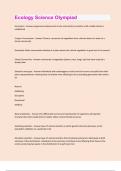
Ecology Science Olympiad Questions With Complete Solutions!!
Succession - Answer-progressive replacement of one community by another until a stable climax is established 2 types of succession - Answer-Primary: succession of vegetation from a barren desert or water to a climax community Secondary: Biotic communities develop in a place where the natural vegetation is gone but soil is present Climax Community - Answer-community of vegetation (plants, trees, fungi, etc) that have reached a steady state Selection and types - Answer-Individuals with advantageous traits tend to be more successful than their peers reproductively--meaning they contribute more offspring to the succeeding generation than others do Natural Stabilizing Disruptive Directional Artificial Natural Selection - Answer-The differential survival and reproduction of organisms with genetic characteristics that enable them to better utilize environmental resources stabilizing selection - Answer-type of natural selection in which genetic diversity decreases as the population stabilizes on a particular trait disruptive selection - Answer-type of natural selection that simultaneously favors individuals at both extremes of the distribution. individuals at the extremes contribute more offspring than those in the center, producing two peaks in the distribution of a particular traitdirectional selection - Answer-when natural selection favors a single allele and therefore allele frequency continuously shift in one direction artificial selection - Answer-The process in which breeders choose the variants to be used to produce succeeding generations limiting factors - Answer-A factor that limits a population's growth; i.e. resources, shelter, food and disease biodiversity - Answer-number and diversity of organisms in a biome/region Acid precipitation - Answer-Includes acid rain, acid fog, acid snow, and any other form of precipitation that is more acidic that normal (i.e., less that pH 5.6). Amensalism - Answer-Two organisms in a symbiotic relationship in which one is unaffected and one is harmed (the black walnut tree secretes juglone which kills the plants living at base of tree, but the lack of competition doesn't help or harm the tree). This is a very rare type of symbiosis. Ammonification - Answer-The process by which decomposers change nitrogen in detritus to ammonium (NH4+) Anaerobic, adj. - Answer-Lacking or seriously depleted of oxygen Assimilation - Answer-The process by which plants absorb nitrate or ammonium through root hairs to be used within the plant Batesian Mimicry - Answer-Resemblance of an unpalatable species by an edible species to deceive predators Biodiversity - Answer-Variety of different species (species diversity), genetic variability among individuals within a species (genetic diversity), variety of ecosystems (ecological diversity), and functions such as energy flow and matter cycling needed for the survival of a species and biological communitiesBiotic - Answer-Living or once living organisms.(Bunny, Dead Bunny) Biotic potential - Answer-Maximum rate at which the population of a given species can increase when there are no limits on its rate of growth Carbon Cycle - Answer-Cyclic movement of carbon in different chemical forms from the environment to organisms then back to the environment Carrying Capacity - Answer-The maximum number of organisms that an environment can support Chemosynthesis - Answer-Process in which certain organisms (mostly specialized bacteria) extract inorganic compounds from their environment and convert them into organic nutrient compounds without the presence of sunlight
Written for
- Institution
- Ecology Science Olympiad
- Course
- Ecology Science Olympiad
Document information
- Uploaded on
- April 13, 2024
- Number of pages
- 7
- Written in
- 2023/2024
- Type
- Exam (elaborations)
- Contains
- Questions & answers
Subjects

Also available in package deal