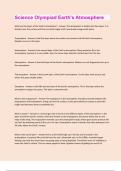
Science Olympiad Earth's Atmosphere Questions and Answers 100% Solved correctly
What are the layers of the Earth's atmosphere? - Answer-The atmosphere is divided into five layers. It is thickest near the surface and thins out with height until it eventually merges with space. Troposphere - Answer-is the first layer above the surface and contains half of Earth's atmosphere. Weather occurs in this layer Stratosphere - Answer-is the second layer of the Earth's atmosphere. Many airplanes fly in the stratosphere, because it is very stable. Also, the ozone layer absorbs harmful rays from the Sun. Mesosphere - Answer-is the third layer of the Earth's atmosphere. Meteors or rock fragments burn up in the mesosphere. Thermosphere - Answer-is the fourth layer of the Earth's atmosphere. It's the layer with auroras and where the space shuttle orbits Exosphere - Answer-is the fifth and last layer of the Earth's atmosphere. This is the layer where the atmosphere merges into space. This layer is extremely thin. What is the tropopause? - Answer-The tropopause is the atmospheric boundary located between the troposphere and stratosphere. Going up from the surface, its the point where air ceases to cool with height and becomes almost completely dry. What is ozone? - Answer-is a natural gas that is found in two different layers of the atmosphere. In the layer around the Earth's surface, otherwise known as the troposphere, bad ozone dirties the air and helps make smog. The troposphere extends up to the stratosphere layer, where good ozone protects life on Earth by absorbing some of the sun's UV rays. Stratospheric ozone is found most often between six to 30 miles above the Earth's surface. What is the ozone layer? - Answer-forms a thin shield high up in the sky and is located in the stratosphere. It protects life on Earth from the sun's ultraviolet rays. In the 1980s, scientists began finding clues that the ozone layer was going away or being depleted. This allows more UV radiation to reach the Earth's surface. This can cause people to have a greater chance of getting too much UVradiation. Too much UV can cause bad health effects like skin cancer, eye damage, and get you sick easier.
Written for
- Institution
- Science Olympiad Earth\'s Atmosphere
- Course
- Science Olympiad Earth\'s Atmosphere
Document information
- Uploaded on
- April 13, 2024
- Number of pages
- 2
- Written in
- 2023/2024
- Type
- Exam (elaborations)
- Contains
- Questions & answers
Subjects
-
science olympiad earths atmosphere

Also available in package deal