Summary AP Physics C: E&M - OpenStax University Physics Volume 2, Chapter 7 Problems 29, 37, 39, 45, 51, 52, 59, 63
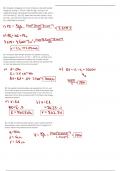
AP Physics C: Electricity and Magnetism. OpenStax University Physics Volume 2, Chapter 7 Problems 29, 37, 39, 45, 51, 52, 59, 63 with Answers and Work. 7.1 Electric Potential Energy 29. Consider a charge Q1(+5.0μC) fixed at a site with another charge Q2 (charge +3.0μC, mass 6.0μg) moving in the neighboring space. (a) Evaluate the potential energy of Q2 when it is 4.0 cm from Q1. (b) If Q2 starts from rest from a point 4.0 cm from Q1, what will be its speed when it is 8.0 cm from Q1? (Note: Q1 is held fixed in its place.) 7.2 Electric Potential and Potential Difference 37. The electric field strength between two parallel conducting plates separated by 4.00 cm is 7.50×10⁴V/m. (a) What is the potential difference between the plates? (b) The plate with the lowest potential is taken to be zero volts. What is the potential 1.00 cm from that plate and 3.00 cm from the other? 39. Two parallel conducting plates are separated by 10.0 cm, and one of them is taken to be at zero volts. (a) What is the electric field strength between them, if the potential 8.00 cm from the zero volt plate (and 2.00 cm from the other) is 450 V? (b) What is the voltage between the plates? 7.3 Calculations of Electric Potential 45. A 0.500-cm-diameter plastic sphere, used in a static electricity demonstration, has a uniformly distributed 40.0-pC charge on its surface. What is the potential near its surface? 51. (a) What is the potential between two points situated 10 cm and 20 cm from a 3.0-μC point charge? (b) To what location should the point at 20 cm be moved to increase this potential difference by a factor of two? 52. Find the potential at points P1,P2,P3, and P4 in the diagram due to the two given charges. 7.5 Equipotential Surfaces and Conductors 59. A very large sheet of insulating material has had an excess of electrons placed on it to a surface charge density of –3.00nC/m2. (a) As the distance from the sheet increases, does the potential increase or decrease? Can you explain why without any calculations? Does the location of your reference point matter? (b) What is the shape of the equipotential surfaces? (c) What is the spacing between surfaces that differ by 1.00 V? 63. Two parallel plates 10 cm on a side are given equal and opposite charges of magnitude 5.0×10⁻⁹C. The plates are 1.5 mm apart. What is the potential difference between the plates?
Connected book
Written for
- Institution
- Senior / 12th grade
- Course
- AP Physics C: Electricity and Magnetism
- School year
- 4
Document information
- Summarized whole book?
- No
- Which chapters are summarized?
- Volume 2, chapter 7
- Uploaded on
- April 12, 2024
- Number of pages
- 2
- Written in
- 2023/2024
- Type
- Summary

Also available in package deal