Chemistry of the d-Block
13 October 2017 19:03
Ground state electronic configuration of copper is [Ar]4s13d10 as it gains extra stability from having a filled 3d shell.
• d-block element and transition metal element do not mean Electronic configurations of the first row Other dn configuration examples:
the same thing. Transition Elements: (can work out by looking at what
• Definition of a transition metal element: an element that • Fill 4s orbital first, then 3d (exceptions are Cr and Cu, group the element is in the periodic
has an incomplete d subshell in either the neutral atom or which gain extra stability from a half-filled or filled d- table, then subtracting positive
its ions. subshell). However, the electronic configuration charge or adding negative charge)
• Therefore, Zn and Cd are d-block elements but not transition must be written in order of increasing principal • Fe2+: d6 [Ar]3d64s0
elements as they do not have any compounds with an quantum number. • Mn (element) d7 [Ar]3d54s2
incomplete d subshell. ○ Ni: [Ar]3d84s2, Cr: [Ar]3d54s1 • Mn(0) d7 [Ar]3d74s0
• The chemistry of the d-block elements is dominated by the Transition Compounds/Transition Complexes: • CuI: d10 [Ar]3d104s0
influence of the d-electrons. • The 3d-orbital is filled before the 4s-orbital • CoIII: d6 [Ar]3d64s0
○ The 1st transition series (elements Sc to Zn) occupy 3d ○ Ni0(CO)4: [Ar]3d104s0 (Ni0 has oxidation state 0)
orbital ○ NiII: [Ar]3d84s0 (NiII has oxidation state +2) Terminology:
○ The 2nd transition series (elements Y to Cd) occupy 4d dn-configuration: • A metal complex contains a metal
orbital The dn-configuration of a transition metal complex is the ion that is directly bonded to a
○ The 3rd transition series (elements La to Hg) occupy number of s+d electrons=n. For example: number of atoms or molecules -
5d orbital. • Ni0 is a d10 metal: these are called ligands
• Ions with no d-electrons e.g. Sc3+, or where the d-orbitals ○ Ni0(CO)4: [Ar]3d104s0 (n=10+0=10) • The number of direct points of
are full e.g. Zn2+, show very different properties more closely • NiII is a d8 metal: attachment to the metal ion, or
related to main group (s- and p-block) cations. (Elements ○ NiII: [Ar]3d84s0 (n=8+0=8) bonds, is called the coordination
with full/empty d-orbitals act like p/s-block elements) • Cr (element) is a d6 metal: number (CN)
○ Cr: [Ar]3d54s1 (n=5+1=6) • The central atom (M) and the
ligands bonded directly to it (L) are
Properties of Transition Metals: indicated in square brackets [ ],
• Physical properties: e.g. [ML6]X3, [Co(NH3)6]Cl3,
hard, ductile (pull in to wires) e.g. copper, malleable [Co(NH3)5Cl]Cl2.
(change its shape), high electrical conductivity, high
thermal conductivity. Characteristic Properties of
• Solid state structure: Transition Metal Complexes
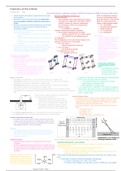
All the transition metals except Mn, Zn, Cd and Hg Colour
adopt one of the three typical metal structures: • e.g. [Co(NH3)6]Cl3 is yellow
○ Hexagonal Close Packed [HCP] e.g. Sc, Ti, Co • In the complexes, the
○ Body Centred Cubic [BCC] e.g. V, Cr, Fe [HCP] [BCC] [FCC] transition metal contain a
○ Face Centred Cubic [FCC] e.g. Ni, Cu partially filled d-orbital
Magnetic Properties • In contrast, ScIII [d0] and ZnII [d10] complexes are colourless (white)
• All substances are affected to a certain degree when placed in a magnetic field. • Source of the colour (all involve the d-orbitals):
• Diamagnetism: Substances that contain only paired electrons are said to be diamagnetic. ○ d-d transitions (electrons moving between d-orbitals)
Diamagnetic substances are repelled from a magnetic field. ○ Ligand-Metal (L=>M) charge transfer
• Paramagnetism: Substances that contain unpaired electrons are said to be paramagnetic. ○ Metal-Ligand (M=>L) charge transfer
Paramagnetic substances are attracted into a magnetic field. • L=>M charge transfer is responsible for the purple permanganate
• Diamagnetic effects are much weaker than paramagnetic effects. If the compound contains colour [MnO4]-. Mn element is d7 but in permanganate it has a +7
unpaired electrons, paramagnetic effects dominate, and the compound is attracted into a magnetic charge so no d-electrons, therefore no d-d electron transition and
field. no M=>L charge transfer
Experimentally, magnetic properties of substances can
be measure using a Guoy Balance. Variable Oxidation States
• Diamagnetic compounds show a decrease in • Transition metals can readily vary their oxidation state. Such properties
weight when placed into an applied magnetic are fundamental to, for example, their catalytic activity e.g. in the
field, as they are repelled from a magnetic field. hydrogenation of alkenes using [RhCl(PPh3)3] (Wilkinson's catalyst)
• Paramagnetic compounds show an increase in which involves a RhI=>RhIII=>RhI redox cycle.
weight when placed into an applied magnetic • The range of oxidation states increases towards the centre of the d-
field, as they are attracted into a magnetic field. block:
○ Sc (left-hand side): +3
○ Cr (middle): -4=>+6
• The effective magnetic moment, µeff, can be predicted from the spin only formula: ○ Mn (middle): -3=>+7
µeff = sqrt(n(n+2)), where n=number of unpaired electrons (in the d-orbitals) ○ Ni (right-hand side): +2 (+4) (mostly +2)
Variable Coordination Number (CN)
• The ability of transition metals to readily vary their CN with little
energy cost is fundamental to, for example, their catalytic activity
e.g. in the hydrogenation of alkenes using [RhCl(PPh3)3] where Rh
intermediated with CN = 3 to 6 are involved.
Catalysis
• The unique properties of transition metal complexes results in
their being excellent catalysts for a wide variety of processes e.g.
Haber process for NH3 synthesis from nitrogen and hydrogen,
using an iron catalyst.
Complex Formation The +2 oxidation state usually arises from the removal of s2 electrons
• Transition metals readily form compounds (transition metal Simplified Bonding Model - Lewis Acid/Base
complexes) In the simplest bonding model of a transition metal complex, the transition metal centre is
• The term complexes historically referred to the complex nature of viewed as a Lewis acid.
the compounds formed by transition metals i.e. early chemists did • A Lewis Acid is an atom or molecule which accepts an electron pair.
not fully understand the bonding found for many transition metal ○ e.g. H+ is a Lewis acid in: H+ + NH3 => [H <= NH3]+
complexes.
○ e.g. Fe2+ is a Lewis acid in [Fe(NH3)6]2+ as it is accepting electron pairs from six ":NH3"
molecules: Fe2+ + :NH3 => [Fe <= NH3]2+
[Fe(NH3)6]2+ adopts a structure which In this simple bonding model the groups (atoms) bound to the metal centre are viewed as Lewis
minimises steric interactions (the bases.
steric effect is an effect in which the • A Lewis Base is an atom or molecule that donates an electron pair.
rate of a chemical reaction depends ○ e.g. :NH3 is a Lewis base in: H+ + :NH3 => [H <= NH3]+
on the size or arrangement of groups ○ In transition metal complexes the Lewis Bases e.g. NH3 in [Fe(NH3)6]2+ are the ligands.
in a molecule, and steric hindrance is The interaction between the ligands and transition metal (L => M) is a dative covalent bond.
Inorganic Chemistry I Page 1
13 October 2017 19:03
Ground state electronic configuration of copper is [Ar]4s13d10 as it gains extra stability from having a filled 3d shell.
• d-block element and transition metal element do not mean Electronic configurations of the first row Other dn configuration examples:
the same thing. Transition Elements: (can work out by looking at what
• Definition of a transition metal element: an element that • Fill 4s orbital first, then 3d (exceptions are Cr and Cu, group the element is in the periodic
has an incomplete d subshell in either the neutral atom or which gain extra stability from a half-filled or filled d- table, then subtracting positive
its ions. subshell). However, the electronic configuration charge or adding negative charge)
• Therefore, Zn and Cd are d-block elements but not transition must be written in order of increasing principal • Fe2+: d6 [Ar]3d64s0
elements as they do not have any compounds with an quantum number. • Mn (element) d7 [Ar]3d54s2
incomplete d subshell. ○ Ni: [Ar]3d84s2, Cr: [Ar]3d54s1 • Mn(0) d7 [Ar]3d74s0
• The chemistry of the d-block elements is dominated by the Transition Compounds/Transition Complexes: • CuI: d10 [Ar]3d104s0
influence of the d-electrons. • The 3d-orbital is filled before the 4s-orbital • CoIII: d6 [Ar]3d64s0
○ The 1st transition series (elements Sc to Zn) occupy 3d ○ Ni0(CO)4: [Ar]3d104s0 (Ni0 has oxidation state 0)
orbital ○ NiII: [Ar]3d84s0 (NiII has oxidation state +2) Terminology:
○ The 2nd transition series (elements Y to Cd) occupy 4d dn-configuration: • A metal complex contains a metal
orbital The dn-configuration of a transition metal complex is the ion that is directly bonded to a
○ The 3rd transition series (elements La to Hg) occupy number of s+d electrons=n. For example: number of atoms or molecules -
5d orbital. • Ni0 is a d10 metal: these are called ligands
• Ions with no d-electrons e.g. Sc3+, or where the d-orbitals ○ Ni0(CO)4: [Ar]3d104s0 (n=10+0=10) • The number of direct points of
are full e.g. Zn2+, show very different properties more closely • NiII is a d8 metal: attachment to the metal ion, or
related to main group (s- and p-block) cations. (Elements ○ NiII: [Ar]3d84s0 (n=8+0=8) bonds, is called the coordination
with full/empty d-orbitals act like p/s-block elements) • Cr (element) is a d6 metal: number (CN)
○ Cr: [Ar]3d54s1 (n=5+1=6) • The central atom (M) and the
ligands bonded directly to it (L) are
Properties of Transition Metals: indicated in square brackets [ ],
• Physical properties: e.g. [ML6]X3, [Co(NH3)6]Cl3,
hard, ductile (pull in to wires) e.g. copper, malleable [Co(NH3)5Cl]Cl2.
(change its shape), high electrical conductivity, high
thermal conductivity. Characteristic Properties of
• Solid state structure: Transition Metal Complexes
All the transition metals except Mn, Zn, Cd and Hg Colour
adopt one of the three typical metal structures: • e.g. [Co(NH3)6]Cl3 is yellow
○ Hexagonal Close Packed [HCP] e.g. Sc, Ti, Co • In the complexes, the
○ Body Centred Cubic [BCC] e.g. V, Cr, Fe [HCP] [BCC] [FCC] transition metal contain a
○ Face Centred Cubic [FCC] e.g. Ni, Cu partially filled d-orbital
Magnetic Properties • In contrast, ScIII [d0] and ZnII [d10] complexes are colourless (white)
• All substances are affected to a certain degree when placed in a magnetic field. • Source of the colour (all involve the d-orbitals):
• Diamagnetism: Substances that contain only paired electrons are said to be diamagnetic. ○ d-d transitions (electrons moving between d-orbitals)
Diamagnetic substances are repelled from a magnetic field. ○ Ligand-Metal (L=>M) charge transfer
• Paramagnetism: Substances that contain unpaired electrons are said to be paramagnetic. ○ Metal-Ligand (M=>L) charge transfer
Paramagnetic substances are attracted into a magnetic field. • L=>M charge transfer is responsible for the purple permanganate
• Diamagnetic effects are much weaker than paramagnetic effects. If the compound contains colour [MnO4]-. Mn element is d7 but in permanganate it has a +7
unpaired electrons, paramagnetic effects dominate, and the compound is attracted into a magnetic charge so no d-electrons, therefore no d-d electron transition and
field. no M=>L charge transfer
Experimentally, magnetic properties of substances can
be measure using a Guoy Balance. Variable Oxidation States
• Diamagnetic compounds show a decrease in • Transition metals can readily vary their oxidation state. Such properties
weight when placed into an applied magnetic are fundamental to, for example, their catalytic activity e.g. in the
field, as they are repelled from a magnetic field. hydrogenation of alkenes using [RhCl(PPh3)3] (Wilkinson's catalyst)
• Paramagnetic compounds show an increase in which involves a RhI=>RhIII=>RhI redox cycle.
weight when placed into an applied magnetic • The range of oxidation states increases towards the centre of the d-
field, as they are attracted into a magnetic field. block:
○ Sc (left-hand side): +3
○ Cr (middle): -4=>+6
• The effective magnetic moment, µeff, can be predicted from the spin only formula: ○ Mn (middle): -3=>+7
µeff = sqrt(n(n+2)), where n=number of unpaired electrons (in the d-orbitals) ○ Ni (right-hand side): +2 (+4) (mostly +2)
Variable Coordination Number (CN)
• The ability of transition metals to readily vary their CN with little
energy cost is fundamental to, for example, their catalytic activity
e.g. in the hydrogenation of alkenes using [RhCl(PPh3)3] where Rh
intermediated with CN = 3 to 6 are involved.
Catalysis
• The unique properties of transition metal complexes results in
their being excellent catalysts for a wide variety of processes e.g.
Haber process for NH3 synthesis from nitrogen and hydrogen,
using an iron catalyst.
Complex Formation The +2 oxidation state usually arises from the removal of s2 electrons
• Transition metals readily form compounds (transition metal Simplified Bonding Model - Lewis Acid/Base
complexes) In the simplest bonding model of a transition metal complex, the transition metal centre is
• The term complexes historically referred to the complex nature of viewed as a Lewis acid.
the compounds formed by transition metals i.e. early chemists did • A Lewis Acid is an atom or molecule which accepts an electron pair.
not fully understand the bonding found for many transition metal ○ e.g. H+ is a Lewis acid in: H+ + NH3 => [H <= NH3]+
complexes.
○ e.g. Fe2+ is a Lewis acid in [Fe(NH3)6]2+ as it is accepting electron pairs from six ":NH3"
molecules: Fe2+ + :NH3 => [Fe <= NH3]2+
[Fe(NH3)6]2+ adopts a structure which In this simple bonding model the groups (atoms) bound to the metal centre are viewed as Lewis
minimises steric interactions (the bases.
steric effect is an effect in which the • A Lewis Base is an atom or molecule that donates an electron pair.
rate of a chemical reaction depends ○ e.g. :NH3 is a Lewis base in: H+ + :NH3 => [H <= NH3]+
on the size or arrangement of groups ○ In transition metal complexes the Lewis Bases e.g. NH3 in [Fe(NH3)6]2+ are the ligands.
in a molecule, and steric hindrance is The interaction between the ligands and transition metal (L => M) is a dative covalent bond.
Inorganic Chemistry I Page 1