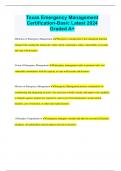
Texas Emergency Management Certification-Basic Latest 2024 Graded A+
Texas Emergency Management Certification-Basic Latest 2024 Graded A+ Definition of Emergency Management Emergency management is the managerial function charged with creating the framework within which communities reduce vulnerability to hazards and cope with disasters. Vision of Emergency Management Emergency management seeks to promote safer, less vulnerable communities with the capacity to cope with hazards and disasters. Mission of Emergency Management Emergency Management protects communities by coordinating and integrating all activi- ties necessary to build, sustain, and improve the capability to mitigate against, prepare for, respond to, and recover from threatened or actual natural disasters, acts of terrorism, or other man-made disasters. 1.Principles Comprehensive emergency managers consider and take into account all hazards, all phases, all stakeholders and all impacts relevant to disasters. 2. Principles Progressive emergency managers anticipate future disasters and take preventive and preparatory measures to build disaster-resistant and disaster-resilient communities. 3.Principles Risk-Driven emergency managers use sound risk management principles (hazard identification, risk analysis, and impact analysis) in assigning priorities and resources. 4. Principles Integrated emergency managers ensure unity of effort among all levels of govern- ment and all elements of a community. 5. Principles Collaborative emergency managers create and sustain broad and sincere relationships among individuals and organizations to encourage trust, advocate a team atmosphere, build consensus, and facilitate communication. 6. Principles Coordinated "emergency managers synchronize the activities of all relevant stakeholders to achieve a common purpose. 7. Principles Flexible emergency managers use creative and innovative approaches in solving disaster challenges. 8. Principles Professional emergency managers value a science and knowledge-based approach based on education, training, experience, ethical practice, public stewardship and continuous improvement. An important feature of Emergency Operation Plans is that they ________________________________. provide a uniform response to all hazards that a community may face. When a more qualified person arrives on scene, which statement best describes what happens? The more qualified person automatically becomes the new Incident Commander and assumes command. The outgoing Incident Commander demobilizes to avoid confusion. Mutual Aid Agreements ________________________________. assist agencies and jurisdictions when existing resources are inadequate. Predicting the resource needs of an incident to determine the appropriate management structure is referred to as (a): Logistical Analysis
Written for
- Institution
- Texas Emergency Management Certificatio
- Course
- Texas Emergency Management Certificatio
Document information
- Uploaded on
- April 12, 2024
- Number of pages
- 50
- Written in
- 2023/2024
- Type
- Exam (elaborations)
- Contains
- Questions & answers
Subjects
-
texas emergency management certification basic lat

Also available in package deal