making responsibilities are delegated by top management to middle and lower -level mangers.

LDR-301S Leading Organizations Questions and Answers Graded A+
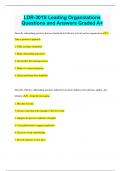
LDR-301S Leading Organizations Questions and Answers Graded A+ Describe onboarding practices that are beneficial to both new arrivals and an organization 1. Take a proactive approach 2. Offer a proper orientation 3. Make onboarding interactive 4. Personalize the training process 5. Make it a social experience 6. Solicit and learn from feedback Describe effective onboarding practices tailored to promote military unit cohesion, agility, and lethality 1. Align the messaging 2. Plan the first day 3. Ensure a meeting with manager in the first week 4. Support the person's authentic strengths 5. Use gamification to engage employees 6. Focus on social relationships 7. Provide mentors to new hires 8. Or provide buddies 9. Use diverse and blended formal practices 10. Gather feedback Describe the differences between the Onboarding Process and Training Onboarding engrosses new employees in the ideals of the organization. While training is in fact a piece of that onboarding, true onboarding is the bigger scope of the first 90 days Identify the various organizational structures Divisional Decentralized Matrix Functional Flat Describe how different organizational structures affect efficiency and communication across the organization 1. A divisional organizational structure usually consists of several parallel teams focusing on a single product or service line 2. Decentralization is a type of organizational structure in which daily operations and decision- making responsibilities are delegated by top management to middle and lower-level mangers. 3. A matrix organizational structure, by contrast, is everything that a hierarchical structure is not. There are separate chains of command and employees are generally accountable to more than one boss. 4. A functional structure is one of the most common organizational structures. Under this structure, the organization groups employees according to a specialized or similar set of roles or tasks. 5. In flat organizational structures, employees are more empowered, operated with a greater degree of managerial independence and are expected to take responsibility for a range of traditionally managerial decisions in their daily routines. Describe the names and age ranges of each of the 4 generations currently in the workforce 1. Baby Boomers- 2. Generation X- 3. Generation Y- Millennials 4. Generation Z- Describe the characteristics of different generations (Baby Boomers, Gen X, Gen Y) 1. Baby Boomers- very focused, value formal education, and may have never heard of crowdsourcing 2. Generation X- extremely independent and self-sufficient, valuing freedom, and shunning micro-management at the workplace 3. Generation Y- Millennials- to work smarter, rather than harder, excellent at multitasking, 4. Generation Z- more money conscious, entrepreneurial, and individualistic Summarize the differences in work values, work motivators and leadership styles among different generations 1. Baby Boomers- Loyal and competitive workaholics, Dedicated towards work, Feeling of entitlement Massey, Value work, team oriented and rule challenging 2. Generation X- Independent, fun loving and self -reliant, Less loyal than baby boomers, They are more concerned about work-life balance and career options, Computer literate and fun loving, Change jobs easily for improving careers. 3. Generation Y- Millennials- Optimistic, realistic,
Written for
- Institution
- LDR-301S Leading Organizations
- Course
- LDR-301S Leading Organizations
Document information
- Uploaded on
- April 10, 2024
- Number of pages
- 7
- Written in
- 2023/2024
- Type
- Exam (elaborations)
- Contains
- Questions & answers
Subjects
-
ldr 301s leading organizations questions and answe
Content preview
making responsibilities are delegated by top management to middle and lower -level mangers.
Also available in package deal