Organization Development Book
Summary
Chapter 1: Organization Development and Reinventing the Organization
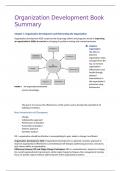
Organization development (OD) comprises the long-range efforts and programs aimed at improving
an organization’s ability to survive by changing its problem-solving and renewal processes
adaptive
organization
the effort is
planned,
organization-wide,
managed from the
top, to increase
organization-
effectiveness and
health through
planned
interventions in
the organization’s
processes using
behavioural
science knowledge.
The goal is to increase the effectiveness of the system and to develop the potential of all
individual members.
Basic characteristics of OD programs:
- Change
- Collaborative approach
- Performance orientation
- Humanistic orientation
- Systems approach
- Scientific method
OD = organization should be effective in accomplishing its goal, adapt to change, be efficient
Organization Development (OD): Organization Development is a planned, systemic approach to
improve organizational effectiveness and individual well-being by addressing processes, structures,
and culture within an organization.
Difference between OD and Single-Change Techniques: OD is a comprehensive, long-term strategy
for overall organizational improvement, while single-change techniques, like management training,
focus on specific aspects without addressing the entire organizational system.
,Uses of the Psychological Contract: The psychological contract guides the employment relationship,
impacting employee motivation, retention, organizational culture, and conflict resolution.
Difference between Pivotal and Peripheral Norms: Pivotal norms are core to an organization's
identity, guiding decision-making, while peripheral norms are less central, varying across subgroups
or departments within the organization. Understanding both is crucial for managing organizational
culture.
Three Basic Responses to Socialization: Individuals may respond to socialization by complying with
organizational norms, identifying with the organization's values, or resisting assimilation.
Identifying Organizational Culture and Norms: To find organizational culture in a book or article,
observe recurring themes, shared values, and common behaviors among characters, reflecting
decision-making processes and communication styles.
Five Stages of Organization Development:
1. anticipating change
2. initiating interventions
3. managing the change process
4. institutionalizing changes into culture
5. evaluating effectiveness for ongoing adjustments.
Chapter 2 : Organization Renewal: The Challenge of Change
In solving a given problem, managers must
analyse the organization, its departmental
subsystem interrelationships, and the
possible effects on the internal
environment. This approach, termed the
systems approach, provides a way of
observing, analysing, and solving
problems in organizations
five areas:
, 1. Organization renewal
= an ongoing process of building innovation and adaptation into the organization.
2. The systems approach
3. The sociotechnical system
4. Future shock
5. Organizational transformation and organization development
Entropy is a principle of physics according to which everything that is organized will break down or
run down unless it is maintained. Organization renewal, then, is an approach to preventing corporate
entropy
Change is ubiquitous, and managers
grapple with future shock, encountering
rapid shifts in technology, environment, and society. Organizations must
continually renew and adapt to navigate these ever-changing conditions.
What is the implication of organization renewal for today’s organizations?
Implication of Organization Renewal: Today's organizations must prioritize continual renewal to
effectively navigate the rapidly changing technological, environmental, and social landscape, ensuring
sustained adaptability.
Contrast between Stable and Hyperturbulent Environment: In a stable environment, gradual change
allows established routines, while a hyperturbulent environment demands agile adaptability,
requiring frequent adjustments to strategies and operations.
Comparison of Management Orientations:
A sluggish orientation suits stable environments.
A reactive orientation responds to change but lacks proactive adaptability.
A satisficing orientation can respond to change but operates in a relatively stable
environment.
A renewing orientation combines adaptability with the necessity to thrive in a rapidly
changing environment.
Summary
Chapter 1: Organization Development and Reinventing the Organization
Organization development (OD) comprises the long-range efforts and programs aimed at improving
an organization’s ability to survive by changing its problem-solving and renewal processes
adaptive
organization
the effort is
planned,
organization-wide,
managed from the
top, to increase
organization-
effectiveness and
health through
planned
interventions in
the organization’s
processes using
behavioural
science knowledge.
The goal is to increase the effectiveness of the system and to develop the potential of all
individual members.
Basic characteristics of OD programs:
- Change
- Collaborative approach
- Performance orientation
- Humanistic orientation
- Systems approach
- Scientific method
OD = organization should be effective in accomplishing its goal, adapt to change, be efficient
Organization Development (OD): Organization Development is a planned, systemic approach to
improve organizational effectiveness and individual well-being by addressing processes, structures,
and culture within an organization.
Difference between OD and Single-Change Techniques: OD is a comprehensive, long-term strategy
for overall organizational improvement, while single-change techniques, like management training,
focus on specific aspects without addressing the entire organizational system.
,Uses of the Psychological Contract: The psychological contract guides the employment relationship,
impacting employee motivation, retention, organizational culture, and conflict resolution.
Difference between Pivotal and Peripheral Norms: Pivotal norms are core to an organization's
identity, guiding decision-making, while peripheral norms are less central, varying across subgroups
or departments within the organization. Understanding both is crucial for managing organizational
culture.
Three Basic Responses to Socialization: Individuals may respond to socialization by complying with
organizational norms, identifying with the organization's values, or resisting assimilation.
Identifying Organizational Culture and Norms: To find organizational culture in a book or article,
observe recurring themes, shared values, and common behaviors among characters, reflecting
decision-making processes and communication styles.
Five Stages of Organization Development:
1. anticipating change
2. initiating interventions
3. managing the change process
4. institutionalizing changes into culture
5. evaluating effectiveness for ongoing adjustments.
Chapter 2 : Organization Renewal: The Challenge of Change
In solving a given problem, managers must
analyse the organization, its departmental
subsystem interrelationships, and the
possible effects on the internal
environment. This approach, termed the
systems approach, provides a way of
observing, analysing, and solving
problems in organizations
five areas:
, 1. Organization renewal
= an ongoing process of building innovation and adaptation into the organization.
2. The systems approach
3. The sociotechnical system
4. Future shock
5. Organizational transformation and organization development
Entropy is a principle of physics according to which everything that is organized will break down or
run down unless it is maintained. Organization renewal, then, is an approach to preventing corporate
entropy
Change is ubiquitous, and managers
grapple with future shock, encountering
rapid shifts in technology, environment, and society. Organizations must
continually renew and adapt to navigate these ever-changing conditions.
What is the implication of organization renewal for today’s organizations?
Implication of Organization Renewal: Today's organizations must prioritize continual renewal to
effectively navigate the rapidly changing technological, environmental, and social landscape, ensuring
sustained adaptability.
Contrast between Stable and Hyperturbulent Environment: In a stable environment, gradual change
allows established routines, while a hyperturbulent environment demands agile adaptability,
requiring frequent adjustments to strategies and operations.
Comparison of Management Orientations:
A sluggish orientation suits stable environments.
A reactive orientation responds to change but lacks proactive adaptability.
A satisficing orientation can respond to change but operates in a relatively stable
environment.
A renewing orientation combines adaptability with the necessity to thrive in a rapidly
changing environment.