Praxis II Math 5017 Latest Version Graded A+
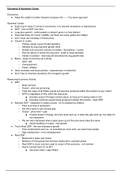
Praxis II Math 5017 Latest Version Graded A+ Deductive reasoning proceeds from general to specific.Teachers present material through lectures and students teach each other through presentations. For Example the teacher would instruct the students how to regroup a two-digit number and then have the students apply the regrouping rules in the examples they practice. Mastery Lecture deductive method by which the teacher presents info. to the students. an advantage to it is teachers can present large amounts of info. in an efficient amount of time. To be most effective mastery lectures should be short, usually no more than 10-15 minutes and interrupted by student questions. The teacher should use lower and higher level thinking questions. inductive reasoning proceeds from specific to general. the teacher first introduces a concept and using inferences from the data the students develop generalizations. What is the difference in deductive and inductive reasoning? with deductive reasoning the teacher gives the students the rule first and then the students practice it. With inductive reasoning the students see many applications of the rule and the determine the rule themselves. Inquiry or discovery lessons are inductive in nature. It starts with a thought provoking question for which students are interested in finding the answer. What is the role of the teacher in inquiry lessons? facilitator who plans outcomes and provides resources for students as they work. What are some advantages of inductive lessons? -they generally require higher-level thinking by both the teacher and students. -they usually result in higher student motivation What are some disadvantages of inductive lessons? -the need for additional preparation by the teacher -access to numerous resources -additional time for students to conduct research. adaptive reasoning refers to logical thinking. in Math adaptive reasoning is the capacity to think logically about the relationships between concepts and situations. An example of adaptive reasoning is after solving a math problem a student would look to see if it is reasonable. If the child solves the problem 7-4 and gets 11 as the answer. The child might think, I only had 7 to start with and I took 4 away. I could not end up with 11 because it is bigger than 7. The key to converting word problems into math probelms is attention to reasonableness, adaptive reasoning, set is a collection of things real, or imagined, related or unrelated. students may manipulate the objects within the set in various ways. classifying objects in a set allows students to sort material according to some specific criteria. for example: a student that is not able to count yet may sort objects according to size or whether it is hard or soft. Patterning objects in a set arranging objects in a set to a duplicate a pattern. for example: red,yellow, red, yellow, or 2,4,6,8... comparing objects in a set students may compare objects in a set to objects in another set as a help in preparing for number skills. example: is there a chair for each toy bear? Does every child in the room a carton of milk? number is a concept that indicates how many. whole numbers are the counting numbers. 0,1,2,3,4,5..... numeral is a symbol used to represent a number. skip counting they may start with 1 and count only the odd numbers. 1,3,5,7,9 odd numbers are those that cannot be equally divided by 2. even numbers are those that can be equally divided by 2. base- 10 place- value scheme as we move to the left of any number, each place value is 10 times the place value to the right. vise versa
Written for
- Institution
- Praxis II Math 5017
- Course
- Praxis II Math 5017
Document information
- Uploaded on
- April 8, 2024
- Number of pages
- 21
- Written in
- 2023/2024
- Type
- Exam (elaborations)
- Contains
- Questions & answers
Subjects
-
praxis ii math 5017 latest version graded a

Also available in package deal