OpenStax Microbiology Test Bank Chapter 15: Microbial Mechanisms of Pathogenicity
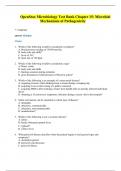
OpenStax Microbiology Test Bank Chapter 15: Microbial Mechanisms of Pathogenicity * = Correct answer Multiple Choice 1. Which of the following would be considered a symptom? A. blood pressure reading of 150/90 mm Hg B. body ache and chills* C. fever of 39 C D. heart rate of 120 bpm 2. Which of the following would be considered a sign? A. blurry vision B. body ache and chills C. burning sensation during urination D. gross hematuria (visible presence of blood in urine)* 3. Which of the following is an example of a nosocomial disease? A. acquiring Giardia while drinking from a stream during a camping trip B. acquiring Listeria after eating at a public restaurant C. acquiring MRSA after touching a locker door handle after an already infected individual did so D. obtaining a Pseudomonas respiratory infection during a recent visit to the hospital* 4. Sickle cell anemia can be classified as which type of disease? A. idiopathic B. infectious, communicable C. infectious, noncommunicable D. noninfectious* 5. Which of the following is not a zoonotic disease? A. rabies B. Rocky Mountain spotted fever C. typhoid* D. yellow fever 6. What period of disease describes when the patient begins to feel general signs and symptoms? A. incubation period B. period of convalescence C. period of illness D. prodromal period* 7. During which period of disease is a patient most susceptible to developing a secondary infection? A. incubation period B. period of convalescence C. period of decline* D. prodromal period Examine the graph shown below and then answer questions 8 and 9. 8. Examine the graph and determine the approximate ID50 of the virus. A. 10 particles B. 5000 particles C. 13,000 particles* D. cannot be determined from the data collected 9. Examine the graph and determine the LD50 of the virus. A. 10 particles B. 5000 particles C. 13,000 particles D. cannot be determined from the data collected* 10. Identify which pathogen is the least virulent on the basis of ID50. A. pathogen A with an ID50 of 1000 cells* B. pathogen B with an ID50 of 50 cells C. pathogen C with an ID50 of 1 cell D. pathogenicity cannot be determined from ID50 values 11. Which of the following is the definition of pathogenicity? A. the ability of a microbial agent to cause disease* B. the ability of a microbial agent to cause infection C. the ability of a microbial agent to prevent disease D. the ability of a microbial agent to produce an antimicrobial compound 12. Which pathogen cannot pass the blood–placenta barrier and infect a fetus? A. Herpes simplex virus 1 B. Listeria monocytogenes C. Salmonella typhi* D. Toxoplasma gondi 13. Which of the following is a common secondary fungal disease? A. giardiasis B. histoplasmosis C. oral thrush* D. syphilis 14. Which statement properly describes how Salmonella typhi enters host cells? A. S. typhi binds to receptors on host cells that cause endocytosis. B. S. typhi is not an intracellular pathogen. C. S. typhi secretes effector proteins that cause membrane ruffling.* D. S. typhi specifically invades phagocytic host cells. 15. Why are Pseudomonas aeruginosa infections difficult to treat? A. Because they are gram-positive bacteria, which are harder to treat. B. Because they form biofilms, which are difficult for antibiotics to penetrate.* C. Because they have a special endotoxin that degrades many antibiotics. D. Because we do not have any antibiotics that target P. aeruginosa. 16. Which describes the condition in which blood contains actively dividing bacteria? A. bacteremia B. septicemia* C. toxemia D. viremia 17. Molecular Koch’s postulates are used to identify which characteristic of pathogens? A. an effective treatment B. the ID50 C. the LD50 D. virulence factor genes* 18. Hyaluronidase is which type of exoenzyme? A. glycohydrolase* B. nuclease C. phospholipase D. protease 19. Intracellular pathogens, like Listeria and Rickettsia, produce which type of exoenzyme to aid in escaping the phagosome? A. glycohydrolases B. nucleases C. phospholipases* D. proteases 20. Which virulence factor, produced by Staphylococcus aureus, allows the bacterium to be coated in fibrin that protects it from phagocytes? A. catalase B. coagulase* C. collagenase D. oxidase 21. What is the toxic component of endotoxin? A. lipid A* B. the core oligosaccharide C. the O-antigen D. the peptidoglycan subunits 22. You are working in a hospital and have been asked to perform the LAL test (Limulus amebocyte lysate). After adding the amebocytes from the horseshoe crab to the serum, coagulation is not observed. What conclusion can you draw from this? A. The patient’s serum contains endotoxin.* B. The patient’s serum contains exotoxin. C. The patient’s serum does not contain endotoxin. D. No conclusion can be reached because the LAL test is not used for detection of toxins. 23. In the A-B toxin, which subunit is necessary for making the initial attachment to the host cell? A. the A subunit B. the B subunit* C. Depending on the toxin, it could be either the A or B subunit. D. Neither, because A-B toxins do not function this way. 24. An enterotoxin targets which type of cell? A. cardiac cells B. hepatic cells C. intestinal cells* D. respiratory cells 25. Which toxin inhibits the release of glycine and GABA at the neuromuscular junction, thus preventing the relaxation of muscles? A. anthrax B. botulinum C. diphtheria D. tetanus* 26. Which is the target for the diphtheria toxin? A. charged tRNA molecules B. elongation factor 2* C. mRNA molecules D. the eukaryotic ribosome
Written for
- Institution
- OpenStax Microbiology
- Course
- OpenStax Microbiology
Document information
- Uploaded on
- April 8, 2024
- Number of pages
- 16
- Written in
- 2023/2024
- Type
- Exam (elaborations)
- Contains
- Questions & answers
Subjects
-
openstax microbiology test bank chapter 15 microb

Also available in package deal