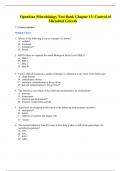
OpenStax Microbiology Test Bank Chapter 13: Control of Microbial Growth
OpenStax Microbiology Test Bank Chapter 13: Control of Microbial Growth * = Correct answer Multiple Choice 1. Which of the following is not an example of a fomite? A. catheter B. doorknob C. mosquitoes* D. towels 2. HEPA filters are required for which Biological Safety Level (BSL)? A. BSL 1 B. BSL 2 C. BSL 3 D. BSL 4* 3. From a clinical perspective, aseptic technique is carried out to do which of the following? A. clean fomites B. contaminate fomites C. introduce contamination in living tissue D. prevent contamination in living tissue* 4. The autoclave uses which of the following mechanism(s) for sterilization? A. pressure B. temperature C. pressure and temperature* D. pressure, temperature, and pH 5. Autoclaves are designed to kill which of the following heat-resistant microbes? A. endospores* B. prions C. vegetative bacterial and fungal cells D. viruses 6. The decimal reduction time (D-value) is how long it takes to kill which percentage of a microbial population? A. 10% B. 50% C. 90%* D. 100% 7. Which of the following actions would be most clearly considered bacteriostatic rather than bactericidal? A. autoclaving bacterial cultures B. placing a bacterial culture in the −80 C freezer* C. spraying 70% alcohol on a laboratory bench D. treating a mattress with ethylene oxide 8. Microbial death follows which type of trend? A. linear B. logarithmic* C. power series D. variable 9. Which of the following are the standard conditions for an autoclave? A. 100 C, 1 psi, 60 minutes B. 121 C, 1 psi, 60 minutes C. 121 C, 15 psi, 20 minutes* D. 212 C, 15 psi, 10 minutes 10. Which of the following is not a milkborne pathogen? A. Escherichia coli O157:H7 B. Listeria monocytogenes C. Salmonella enterica D. Yersinia pestis* 11. To sterilize packaged intravenous tubing, which method would not be acceptable? A. ethylene oxide B. freezing 12. For appropriate food storage in refrigerators, the temperature should be set to no higher than which of the following? A. 5 C B. 7 C* C. 9 C D. 11 C 13. How does pascalization control microbial growth? A. by cross-linking proteins B. by damaging DNA C. by denaturing proteins* D. by disrupting membrane integrity 14. X-rays and gamma rays are examples of which type of radiation? A. beta emission radiation B. ionizing radiation* C. nonionizing radiation D. nonpenetrating radiation 15. Ultraviolet light is an example of which type of radiation? A. beta emission radiation B. ionizing radiation C. nonionizing radiation* D. penetrating radiation 16. Liquid growth media that contain antibiotics should be sterilized using which method? A. autoclaving B. boiling C. HEPA filtration D. membrane filtration* 17. Which method of microbial control introduces double-strand breaks into DNA? A. alcohols B. autoclaving C. ionizing radiation* D. nonionizing radiation 18. Which method of microbial control does not rely on denaturing proteins and/or disrupting the integrity of the cell membrane? A. autoclaving B. lyophilization* C. treatment with alcohols D. treatment with phenolics 19. Phenolic compounds can be found naturally in which group of organisms? A. animals B. bacteria C. fungi D. plants* 20. Which phenolic compound has commonly been added to soap and raises concerns about selection for more antimicrobial-resistant bacteria? A. capsaicin B. carbolic acid C. o-phenylphenol D. triclosan* 21. Which best describes how heavy metals can control microbial growth? A. by binding to sulfur-containing amino acids* B. by cross-linking proteins C. by introducing double-strand breaks into DNA D. by inserting pores in the cell membrane 22. What is argyria? A. a buildup of silver in the body resulting in blue-gray skin* B. a form of skin necrosis due to topical use of phenolics C. inadequate blood supply resulting in chest pain D. microorganisms growing in the blood 23. Which halogen or halogen-containing compound is typically used as a form of topical antisepsis? A. bromine B. chloramine C. fluorine D. iodophor* 24. All but which of the following may be used to disinfect water to make it potable? A. bleach B. chloramine C. fluoride D. sodium dichloroisocyanurate*
Written for
- Institution
- OpenStax Microbiology
- Course
- OpenStax Microbiology
Document information
- Uploaded on
- April 8, 2024
- Number of pages
- 13
- Written in
- 2023/2024
- Type
- Exam (elaborations)
- Contains
- Questions & answers
Subjects
-
openstax microbiology test bank chapter 13 contr

Also available in package deal