OpenStax Microbiology Test Bank Chapter 5: The Eukaryotes of Microbiology
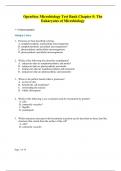
OpenStax Microbiology Test Bank Chapter 5: The Eukaryotes of Microbiology * = Correct answer Multiple Choice 1. Protozoa are best described as being: A. nonphotosynthetic multicellular microorganisms B. nonphotosynthetic unicellular microorganisms* C. photosynthetic multicellular microorganisms D. photosynthetic unicellular microorganisms 2. Which of the following best describes zooplankton? A. eukaryotes that are nonphotosynthetic and motile* B. eukaryotes that are photosynthetic and motile C. prokaryotes that are nonphotosynthetic and nonmotile D. prokaryotes that are photosynthetic and nonmotile 3. Where is the pellicle found within a protozoan? A. as part of cilia B. beneath the cell membrane* C. surrounding the nucleus D. within chloroplasts 4. Which of the following is not a structure used for locomotion by protists? A. cilia B. contractile vacuoles* C. flagella D. pseudopods 5. Which structures associated with locomotion in protists can be described as short, hair-like structures that extend from the surface of the cell? A. cilia* B. contractile vacuoles C. flagella D. pseudopods 6. Pseudopod formation requires which cytoskeletal component? A. actin filaments* B. collagen fibers C. intermediate filaments D. microtubules 7. The organelle in protists that regulates osmolarity is known as which of the following? A. contractile vacuole* B. hydrogenosome C. kinetoplasmid D. plasmalemma 8. Cytoprocts are specialized structures that carry out which cellular process? A. endocytosis B. exocytosis* C. phagocytosis 9. Which organism is best known as the “brain-eating amoeba”? A. Acanthamoeba keratitis B. Entamoeba histolytica C. Giardia lamblia D. Naegleria fowleri* 10. An important slime mold used in research is Dictyostelium discoideum. In this species, individual amoeboid cells that aggregate into multicellular mobile slugs, each forming a fruiting body that produces haploid spores, are known as which of the following? A. cellular slime molds* B. plasmodium slime molds C. pseudohyphae D. sporangia 11. During the asexual life cycle described in the textbook, cellular slime molds produce which of the following? A. gametes B. spores* C. gametes and spores D. neither gametes nor spores 12. Plasmodial slime molds produce which of the following: A. gametes but no spores B. gametes that divide into spores C. spores but no gametes D. spores that divide into gametes* 13. The apical complex of Apicomplexans such as Plasmodium is involved in which cellular process? A. binary fission B. entry into host cells* C. phagocytosis D. photosynthesis 14. Which of the following is a parasitic ciliate? A. Balantidium coli* B. Escherichia coli C. Paramecium caudatum D. Stentor coeruleus 15. The stigma (eyespot) in members of Euglenozoa functions in which of the following? A. chemotaxis B. conjugation C. photosynthesis D. phototaxis* 16. African sleeping sickness is caused by which pathogen? A. Giardia lamblia B. Plasmodium falciparum C. Toxoplasma gondii D. Trypanosoma bruceii* 17. Cestodes are often transmitted via which of the following? A. aerosols B. open wounds in the skin C. undercooked meats* D. water 18. The cell walls of fungi are largely composed of which of the following? A. cellulose B. chitin* C. peptidoglycan D. starch 19. Which of the following includes fungi used as food (such as truffles), bread molds, and pathogenic fungi such as Trichophyton? A. Ascomycota* B. Basidiomycota C. Chytridiomycota D. Zygomycota 20. Most mushrooms and puffballs are members of which fungal phylum? A. Ascomycota B. Basidiomycota* C. Chytridiomycota D. Zygomycota 21. Which of the following include fungi that are obligate intracellular pathogens? A. Ascomycota B. Basidiomycota C. Microsporidia* D. Zygomycota 22. Which fungus is common in the microbiota of a healthy individual? A. Aspergillus aculeatus B. Candida albicans* C. Histoplasma capsulatum D. Rhizopus stolonifera 23. The mode of reproduction for chytrids (Chytridiomycota) uses which of the following? A. asci B. basidia C. motile gametes* D. zygospores 24. To produce spores, some fungi use club-shaped structures called which of the following? A. asci B. basidia* C. plastids D. zygospores 25. Fungi have an important role in nutrient cycling as which of the following? A. decomposers*
Written for
- Institution
- OpenStax Microbiology
- Course
- OpenStax Microbiology
Document information
- Uploaded on
- April 8, 2024
- Number of pages
- 14
- Written in
- 2023/2024
- Type
- Exam (elaborations)
- Contains
- Questions & answers
Subjects
-
openstax microbiology test bank chapter 5 the euk

Also available in package deal