NURS 6640 Week 6 Midterm Exam
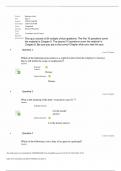
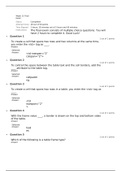
NURS 6640 Week 6 Midterm Exam A PMHNP is treating a 45-year-old female patient who is upset that her brother has not been calling since his divorce. When asked to describe her brother and what prompts him not to call as frequently, she says, “Everything is about him, not me. I think he’s jealous that I have a good marriage and he wants me to be unhappy, too. So he doesn’t call to upset me and ruin my relationships.” Based on this information, the PMHNP can conclude that the patient . Selected Answer: B. has an insistent emphasis on the feelings of others When a PMHNP is seeing a patient for the first time, what is an important step to assure that the patient and provider understand the limits of their discussion? Selected Answer: C. Have a discussion about the confidentiality and its limits You are seeing a 29-year-old widow whose husband recently died overseas while serving his country in the military. She has been mourning the loss of her husband for several months, and continues to grieve. She refuses to go to group grieving sessions, but reports that she is still able to go to work and her fitness classes sometimes, and even makes attempts to stay social. She says, “Sometimes it’s like he’s not even gone. Other times it feels like it’s been an eternity since I’ve seen him. It’s hard to talk about this type of stuff with my girlfriends, especially since all of their husbands are still alive.” The PMHNP understands that it is appropriate to employ which therapeutic principle? Selected Answer: A. Encouraging catharsis The PMHNP is treating a 35-year-old male officer in the military. He discloses that both of his parents are deceased and that he loved them. However, he says that he had feelings of inadequacy because his parents held him to a standard that he could never achieve. He went on to say that nothing he did ever felt good enough. The PMHNP assesses that this patient has perfect creases in his uniform with no strings or tags out of place; she also notices that he has perfect posture and questions him about ritualistic behaviors. She suspects that this patient has maladaptive responses to the expectations placed on him as a teenager and young adult. Which statements made by the patient would verify the PMHNP’s suspicion? Selected Answer: D. “I believe in systems; I have to have order and rules in my everyday life. • Question 1 0 out of 1 points lOMoARcPSD| • Question 6 1 out of 1 points • Question 7 1 out of 1 points If a task must be completed, I will often complete it myself versus depending on someone else.” The PMHNP is working with a patient who experiences anxiety around her parents that later leads to poor impulse control. What will the PMHNP do to employ psychodynamic psychotherapy properly for this patient? Selected Answer: B. Focus on expressions of emotion The PMHNP has been treating a 15-year-old patient with a history of abuse and neglect. Thirty minutes into their therapy session the patient jumps up and begins to pace around the room. Utilizing Socratic dialogue (SD) the PMHNP’s best action would be to: Selected Answer: C. Say, “I noticed a change. Can you tell me what happened?”
Written for
- Institution
- Nurs
- Course
- Nurs
Document information
- Uploaded on
- April 8, 2024
- Number of pages
- 17
- Written in
- 2023/2024
- Type
- Exam (elaborations)
- Contains
- Questions & answers
Subjects
- nurs 6640 week 6
- midterm exam
- nurs
- nursing
-
nurs 6640 week 6 midterm exam