Brooks Biodiversity Exam 1 Questions and Answers (RATED A)
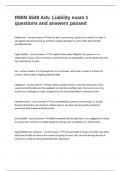
Haldane-Oparin hypothesis - ANSWER-Life arose spontaneously from methane, ammonia, water, and energy sources. Miller-Urey experiment - ANSWER-Created a chemical experiment that simulated the conditions thought at the time to be present on the early Earth, and tested the chemical origin of life under those conditions. Tested Haldane-Oparin hypothesis, thinking that methane and ammonia were likely absent in early atmosphere- more likely CO,CO2,N2, and H2O. Results yielded in organic molecules. SPONCH - ANSWER-Hydrogen was the most abundant. Carbon is the most important. Life is diverse through - ANSWER-meiosis and mutations Cell theory - ANSWER-All organisms are made up of cells and come from cells. Cell membrane defines a cell (composed of phospholipids-hydrophobic) the "RNA" world - ANSWER-earliest cells contained RNA through the discovery of retroviruses (whom could perform reverse transcription RNA>DNA) Pansperania - ANSWER-idea that organic molecules were brought to earth by meteorites/asteroids Heterotrophic anaerobes were the first living cells? - ANSWER-YES Chemotrophs - ANSWER-chemical reactions where no light is involved Phototrophs - ANSWER-chemical reactions where light is involved Cyanobacteria - ANSWER-earliest fossils that have been discovered are cyanobacteria. Not the first organism on the planet, just oldest ones we have evidence of. Not found in extreme conditions. Should not be called blue-green algae because algae is a eukaryote and cyanobacteria is a prokaryote. Not considered bacteria because it has chlorophyll which turns into a chloroplast. Prokaryotes don't have chloroplast. H2S versus H2O - ANSWER-first organisms used H2S, then switched to H2O. By product was oxygen, ever since that switch, O2 has been increasing in atmosphere. Stromatolites - ANSWER-The oldest known fossils, dating from 3.5 billion years ago; layered rock that results from the growth of layer upon layer of cyanobacteria that bind thin films of sediment together. Like corals. 3 geological eras - ANSWER-1. Paleozoic 2. Mesozoic 3. Cenozoic Precambrian - ANSWER-existed from the beginning of Earth to 570 million years ago. It's the timeframe before Paleozoic era. Simple life forms Paleozoic - ANSWER-Began: 570 mil yrs ago. Ended: 250 mil yrs ago. Ancient age of animals. Animal fossils Mesozoic - ANSWER-Began: 250 mill yrs ago. Ended: 65 mil yrs ago. Middle age of animals. Pangea started drifting. Cenozoic - ANSWER-Began: 65 mil yrs ago until NOW. Recent age of animals. Pangea - ANSWER-formed during an end of the Paleozoic era and the beginning of the Mesozoic era. Laurasia - ANSWER-Upper part of Pangea Gondwana - ANSWER-Lower part of Pangea. Flightless birds did not evolve independently. Cretaceous Extinction - ANSWER-Meteor Struck at a low angle and wiped everything out. Happened between Mesozoic and Cenozoic era. Killed the dinosaurs. O2 Crisis - A
Written for
- Institution
- Brooks Biodiversity
- Course
- Brooks Biodiversity
Document information
- Uploaded on
- April 6, 2024
- Number of pages
- 5
- Written in
- 2023/2024
- Type
- Exam (elaborations)
- Contains
- Questions & answers
Subjects
- brooks biodiversity 2024
-
brooks biodiversity exam 1 questions and answers
-
haldane oparin hypothesis answer life arose spon
-
miller urey experiment answer created a chemical

Also available in package deal