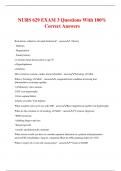
NURS 629 EXAM 3 Questions With 100% Correct Answers 2024/2025
NURS 629 EXAM 3 Questions With 100% Correct Answers 2024/2025 -Differentiate between viral , allergic , and bacterial conjunctivitis . How to diagnose and treat each . -Viral Conjunctivitis Watery discharge ( profuse and clear ) , foreign body sensation , grittiness ) redness URI symptoms are common including sore throat and fever Red , itchy conjunctiva and swollen eye lids Often bilateral Normal visual acuity , PERRLA , EOMI , Fundoscopic exam normal Mucoid - profuse watery discharge Mild , diffuse injection and itching * Preauricular lymphadenopathy Many times too with a sore throat Symptomatic only / supportive Warm ( drainage ) or cool ( itching ) compresses Strict eye hygiene and hand care to prevent spread -Bacterial Conjunctivitis Redness , swelling , purulent discharge , itching No symptoms until eye complaints began ; don't have URI symptoms beforehand Normal visual acuity , PERRLA , EOMI , FUND nl Diffuse injection ; early red eyes No ciliary injection Unilateral at onset Treatment Topical antimicrobials x5-7D Warm compresses qid x10-20min Strict eye hygiene given contagion and hand hygiene. Treatment 1. Trimethoprim / Polymyxin solution ( Polytrim ) 4 gtts q QID x7D 2. Tobramycin 0.3 % 1-2gtts q4H x7D 3. Ciprofloxacin 0.3 % solution 1-2gtts x2D then Q4H x5D 4. Alternate dosing 1gtt Q2H x1D , then 4x / D x5-6D 5 . Depends on what you are seeing in the area , what you suspect for the causative organism for the infection , so getting that good hx on the pt , if anybody has been exposed ; what is being passed around in your area . -Allergic Conjunctivitis Symptoms Bilateral at onset Severe itching Mucoid - stringy - like clear discharge Cobblestone papillary hypertrophy in tarsal conjunctiva Injected conjunctiva ( light pink eye ; not the red you get with bacterial ) Other physical examination findings such as : 1. Allergic shiners ( baggy , blue under the eyes ) 2. Allergic crease ( on their nose ; as if they have been wiping their nose often ) 3. Rhinitis. Prevention Saline solution , artificial tears- help keys eyes moisturized Cool compresses- to help with itching Topical Antihistamines Ketotifen ( zaditor ) , epinastine ( Elestat ) , and azelastine ( Optivar ) Topical decongestants Naphazoline hydrochloride ( AK - con ) Combinations of topical decongestant with topical antihistamine Mast - cell stabilizer Cromolyn , sodium and lodoxamide ( Alomide ) , Olopatadine ( Patanol ) , nedocromil ( Alocril ) Exam techniques used to identify an eye abnormality in an infant or young child. -Red reflex - symmetry From newborn on , every exam -Pupils reactive to light Are they squinting and closing their eyes with bright lights ? Turn room lights off , are they opening their eyes PERRLA -EOM 2mo old- starting to fix and follow objects Take their favorite toy , have mom move and notice are they following -Funduscopic examination- 5y To make sure there is no cataract -Visual acuity Visual acuity is the MOST important vital sign in pts with eye complaints complaints documentation with every eye complaint Visual acuity screening starts at age 4 Make sure to document this at every eye complaint visit and well child exam School physicals Begin visual acuity with Snellen at age 4 Shapes can be tricky for the child if they are not good on their shape recognition ; can use just the E which direction , but then they may have to know Left and Right; check visual acuity with eye glasses on, use pinhole if necessary; record each eye separately and combined If you find an abnormality, what doe sit mean with the eye, and what is normal variations. With an infant, what would be normal things that happen with the eye, the mom and the dad may say this is happening, no that's okay that's normal; certain PE things, let's say you didn't see a red reflex, you are doing a cover/uncover test, what are you testing for and what if it's positive? What are you going to find out? -Amblyopia 1. Seen in early childhood 2. This is why astigmatisms are more common d / t eye shape is more oblong oval - type shape than the concave , circular shape in adulthood -Congenital cataracts 1. Screen for 2 . If red reflex is not normal , then do an ophthalmologic exam 3 . Associated with neurological disorders and cancer 4. Refer early on -Strabismus 1. Normal in the newborn phase . 2. 4mo should be starting to disappear 3. If at 6mo is still present , refer 4. Interventions early on with surgeries -Ptosis 1. Can develop as early as the newborn phase 2. If eyelid is starting to sag , intervene early on -Anisometropia 1. Screen for (asymmetric refraction between the two eyes) -Key is early detection and intervention Good trition such as vitamin - rich foods can help promote good vision New guidelines and recommendations all the time , stay uptodate -Strabismus Can be a normal variation at the newborn stage 4mo- starting to resolve 6mo- still present , refer Misalignment of the eyes Lazy eye or cross - eyed Results in loss of depth perception and double vision . Assessment Red light reflex 1 . Good indication if they are not aligned Cover - uncover test 1. The weaker eye will be deviated Esotropia - focused inward 3-4mo Recognizes parent's smile ( and smile ) , looks from near to far , focuses close again , beginning depth perception , follows 180 degrees , reaches toward toy , few exodeviations , esotropia abnormal Exotropia - focused outward Hypertropia- deviated up or down Findings Intermittent exotropia 1 . Mom or dads might notice when they are trying to focus on something it is evident Squinting 1 Maybe d / double vision , inability to focus Nystagmus 1 . Eye will move ( first few weeks ) Refer to Ophthalmologists Early on ; surgeries are early- depends . -A normal neonate demonstrates disconjugate fixation , but convergence and accommodation normally develop by 3 to 4 months of age with parallel alignment without nystagmus or strabismus by 5 to 6 months of age . Jerky eye movements can be seen until 2 months of age , after which time smooth tracking movements are expected -Know the difference between viral and bacterial respiratory infections . How are they treated ? What are the indications for prescribing antibiotics ? -Upper Respiratory Infection very similar in adult and pediatrics ; but with pediatrics , they get very sick very rapidly Gradual onset , rhinorrhea , sore throat , mild cough , low - grade fever . Pt will have red nasal mucosa , mild throat erythema , possible anterior cervical lymph nodes , chest will be clear Most often viral Supportive treatment for viral URI < 2y : monitor closely for any signs of respiratory distress and get the child a follow - up
Written for
- Institution
- NURS 629
- Course
- NURS 629
Document information
- Uploaded on
- April 6, 2024
- Number of pages
- 33
- Written in
- 2023/2024
- Type
- Exam (elaborations)
- Contains
- Questions & answers
Subjects
-
nurs 629 exam 3 questions with 100 correct answer

Also available in package deal