Unit 8: Physiology of Human Body Systems
A: Understand the impact of disorders of the musculoskeletal system and their associated corrective treatments
Musculoskeletal disorders
I have been employed as a trainee healthcare assistant within the occupational health department of a sports and
fitness company and have been asked to carry out research on the musculoskeletal system in order to produce
information that will be used to educate the employees.
The musculoskeletal system includes bones, joints, muscles, tendons and ligaments [1]. All of these work together to
provide support, movement, protection and to store minerals in the body [1]. The human body has 206 bones and
about 600 muscles, both of which work together to form the musculoskeletal system. Pictured below are labelled
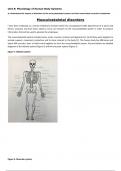
diagrams of the skeletal system (Figure 1) and the muscular system (Figure 2)
Figure 1- Skeletal system
Figure 2- Muscular system
,Unit 8: Physiology of Human Body Systems
A: Understand the impact of disorders of the musculoskeletal system and their associated corrective treatments
Bone classification
Bones can be classified into five categories: long, short, flat, irregular and sesamoid bones.
Long bones are cylindrical in shape and function as levers, they move when muscles contract [2]. Examples of long
bones are the femur, tibia, fibula, metatarsals and phalanges.
Short bones have the same structure as long bones, except they are cube-like in shape [2]. Short bones provide
stability and support as well as some limited motion [2]. Examples of short bones are the carpals and tarsals.
Flat bones are thin and curved. They protect internal organs in the body. Examples of flat bones are cranial bones,
shoulder bones, sternum and the ribs.
Irregular bones tend to have more complex structures, they do not have shapes that can be easily characterised [2].
Examples of irregular bones are the bones of the vertebral column and bones in the pelvis [3].
Sesamoid bones are small, round bones which are formed in tendons where a great deal of pressure is generated in
a joint [3]. They protect tendons by helping them overcome compressive forces [3]. The most common type of
sesamoid bone found in the body is the patella [2].
Composition of bone and the roles of bone in the skeletal system
Bone is composed of fibres, cells and a matrix. The matrix of the bone is mostly made up of osteoblasts and collagen
fibres. Osteoblasts produce bone tissue by combining collagen and calcium phosphate; this allows for new growth
and an increased bone strength.
The skeletal system serves as the main storage system for calcium and phosphorus [4]. Storing these chemicals helps
to regulate mineral balance in the bloodstream [4]. When the fluctuation of minerals is high, minerals are stored in
the bone and when it is low, minerals are withdrawn from the bone [4].
, Unit 8: Physiology of Human Body Systems
A: Understand the impact of disorders of the musculoskeletal system and their associated corrective treatments
The skeleton contains important components of the hematopoietic system [4]. There are two types of bone marrow
that are located in long bones: yellow and red marrow [4]. Yellow marrow is present in the marrow cavity and has
fatty connective tissue [4]. The body utilises the fat in yellow marrow for energy during times of starvation [4]. The
red marrow of some bones is an important site for hematopoiesis (production of blood cells) so that blood cells lost
by the liver can be replaced. All erythrocytes, platelets and most leukocytes are formed in bone marrow and then
move to the circulation. [4]
Bone tissue
There are two types of bone tissue: compact and spongy bone. Both types of bone have different densities, compact
bone is more hard and more dense than spongy bone. The cells that influence bone homeostasis are osteoblasts
(responsible for producing bone tissue), osteoclasts (cells that break down bone tissue), osteocytes (cells that
transmit signals to osteoblasts and osteoclasts in response to pressure on the bones) and osteogenic cells (cells that
control bone remodelling).
Compact bone consists of many Haversian cells which are closely packed together to form a solid mass [5]. These
cells act as channels for nerves, blood vessels and lymphatic vessels. It is also composed of several structural units
known as osteons, which appear as elongated cylinders. Each osteon is a group of hollow tubes of bone matrix and
within each tube, there are collagen fibres present. Compact bone makes up 80% of bones [5].
Spongy bone contains spaces between structures known as trabeculae [5]. These spaces contain osteocytes and
small canals known as canaliculi [5]. Nutrients diffuse from the marrow through these canals to the osteocytes,
which are still living but not secreting bone matrices [5]. Spongy bone makes up 20% of bones [5].
Figure 3- Distribution of compact and cancellous (spongy) bone tissue [6]
Classification of joints
Joints can be grouped into three categories: fibrous joints, cartilaginous joints and synovial joints.
A: Understand the impact of disorders of the musculoskeletal system and their associated corrective treatments
Musculoskeletal disorders
I have been employed as a trainee healthcare assistant within the occupational health department of a sports and
fitness company and have been asked to carry out research on the musculoskeletal system in order to produce
information that will be used to educate the employees.
The musculoskeletal system includes bones, joints, muscles, tendons and ligaments [1]. All of these work together to
provide support, movement, protection and to store minerals in the body [1]. The human body has 206 bones and
about 600 muscles, both of which work together to form the musculoskeletal system. Pictured below are labelled
diagrams of the skeletal system (Figure 1) and the muscular system (Figure 2)
Figure 1- Skeletal system
Figure 2- Muscular system
,Unit 8: Physiology of Human Body Systems
A: Understand the impact of disorders of the musculoskeletal system and their associated corrective treatments
Bone classification
Bones can be classified into five categories: long, short, flat, irregular and sesamoid bones.
Long bones are cylindrical in shape and function as levers, they move when muscles contract [2]. Examples of long
bones are the femur, tibia, fibula, metatarsals and phalanges.
Short bones have the same structure as long bones, except they are cube-like in shape [2]. Short bones provide
stability and support as well as some limited motion [2]. Examples of short bones are the carpals and tarsals.
Flat bones are thin and curved. They protect internal organs in the body. Examples of flat bones are cranial bones,
shoulder bones, sternum and the ribs.
Irregular bones tend to have more complex structures, they do not have shapes that can be easily characterised [2].
Examples of irregular bones are the bones of the vertebral column and bones in the pelvis [3].
Sesamoid bones are small, round bones which are formed in tendons where a great deal of pressure is generated in
a joint [3]. They protect tendons by helping them overcome compressive forces [3]. The most common type of
sesamoid bone found in the body is the patella [2].
Composition of bone and the roles of bone in the skeletal system
Bone is composed of fibres, cells and a matrix. The matrix of the bone is mostly made up of osteoblasts and collagen
fibres. Osteoblasts produce bone tissue by combining collagen and calcium phosphate; this allows for new growth
and an increased bone strength.
The skeletal system serves as the main storage system for calcium and phosphorus [4]. Storing these chemicals helps
to regulate mineral balance in the bloodstream [4]. When the fluctuation of minerals is high, minerals are stored in
the bone and when it is low, minerals are withdrawn from the bone [4].
, Unit 8: Physiology of Human Body Systems
A: Understand the impact of disorders of the musculoskeletal system and their associated corrective treatments
The skeleton contains important components of the hematopoietic system [4]. There are two types of bone marrow
that are located in long bones: yellow and red marrow [4]. Yellow marrow is present in the marrow cavity and has
fatty connective tissue [4]. The body utilises the fat in yellow marrow for energy during times of starvation [4]. The
red marrow of some bones is an important site for hematopoiesis (production of blood cells) so that blood cells lost
by the liver can be replaced. All erythrocytes, platelets and most leukocytes are formed in bone marrow and then
move to the circulation. [4]
Bone tissue
There are two types of bone tissue: compact and spongy bone. Both types of bone have different densities, compact
bone is more hard and more dense than spongy bone. The cells that influence bone homeostasis are osteoblasts
(responsible for producing bone tissue), osteoclasts (cells that break down bone tissue), osteocytes (cells that
transmit signals to osteoblasts and osteoclasts in response to pressure on the bones) and osteogenic cells (cells that
control bone remodelling).
Compact bone consists of many Haversian cells which are closely packed together to form a solid mass [5]. These
cells act as channels for nerves, blood vessels and lymphatic vessels. It is also composed of several structural units
known as osteons, which appear as elongated cylinders. Each osteon is a group of hollow tubes of bone matrix and
within each tube, there are collagen fibres present. Compact bone makes up 80% of bones [5].
Spongy bone contains spaces between structures known as trabeculae [5]. These spaces contain osteocytes and
small canals known as canaliculi [5]. Nutrients diffuse from the marrow through these canals to the osteocytes,
which are still living but not secreting bone matrices [5]. Spongy bone makes up 20% of bones [5].
Figure 3- Distribution of compact and cancellous (spongy) bone tissue [6]
Classification of joints
Joints can be grouped into three categories: fibrous joints, cartilaginous joints and synovial joints.