P&E1: Protein Chemistry review
Learning objectives
• Understand the structures of amino acids and their various unique properties
• Understand the chemistry of the peptide bond
• Understand the basis for regular secondary structure
• Understand the forces that define protein tertiary structure and protein folding
Amino acids (review)
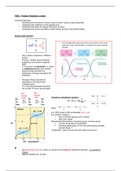
• Key a-carbon: bonded to 4 different
groups
• R group: variable, gives individual
properties; not involved in peptide
bond
• If R is neutral, at neutral pH a.a. exists
as zwitterions/dipolar ions (overall
neutral charge but there is a
distribution of charge throughout the
molecule)
• Changes charge (see above)
depending on environmental
conditions (pH)
• A.a. have dual acid-base character
• Act as both H+ donor and acceptor
Net Net
charge: charge:
+ 0.5 - 0.5 • Henderson-Hasselbalch equation:
A-
pH = pKa1 + log( )=
HA
• When
• (i.e. COO- group is 50% protonated), pKa1 = pH
• E.g. titration of glycine
§ Has 2 ionisable groups as R is neutral
§ Has 2 pKa values
• A • Deprotonation/protonation at carboxyl group; at amino group
r § Low pH: all groups are protonated
o § Continue adding base: all H+ from amino group donated;
m overall charge -1
a • *Ampholytic = able to ionise into both cations and anions
t
i
c
pI
• pH at isoelectric point i.e. where a.a. exists as the zwitterion (electrical neutrality – no overall net
charge)
• Midway between pK1 and pK2
Learning objectives
• Understand the structures of amino acids and their various unique properties
• Understand the chemistry of the peptide bond
• Understand the basis for regular secondary structure
• Understand the forces that define protein tertiary structure and protein folding
Amino acids (review)
• Key a-carbon: bonded to 4 different
groups
• R group: variable, gives individual
properties; not involved in peptide
bond
• If R is neutral, at neutral pH a.a. exists
as zwitterions/dipolar ions (overall
neutral charge but there is a
distribution of charge throughout the
molecule)
• Changes charge (see above)
depending on environmental
conditions (pH)
• A.a. have dual acid-base character
• Act as both H+ donor and acceptor
Net Net
charge: charge:
+ 0.5 - 0.5 • Henderson-Hasselbalch equation:
A-
pH = pKa1 + log( )=
HA
• When
• (i.e. COO- group is 50% protonated), pKa1 = pH
• E.g. titration of glycine
§ Has 2 ionisable groups as R is neutral
§ Has 2 pKa values
• A • Deprotonation/protonation at carboxyl group; at amino group
r § Low pH: all groups are protonated
o § Continue adding base: all H+ from amino group donated;
m overall charge -1
a • *Ampholytic = able to ionise into both cations and anions
t
i
c
pI
• pH at isoelectric point i.e. where a.a. exists as the zwitterion (electrical neutrality – no overall net
charge)
• Midway between pK1 and pK2