QAL - LAWS AND REGULATIONS EXAM | QUESTIONS & ANSWERS (VERIFIED) | LATEST UPDATE | GRADED A+
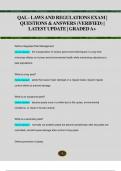
Define Integrated Pest Management Correct Answer: the incorporation of various pest control techniques in a way that minimizes effects on human and environmental health while maximizing reductions to pest populations What is a key pest? Correct Answer: pests that cause major damage on a regular basis; require regular control efforts to prevent damage What is an occasional pest? Correct Answer: become pests once in a while due to life cycles, environmental conditions, or result of human activity What is a secondary pest? Correct Answer: normally not problem pests but become problematic after key pests are controlled; can/will cause damage after control of key pests Define prevention of pests. 2 Correct Answer: Stopping pest populations before damage or treatment thresholds; weed/disease free seeding and mediums, disease/insect resistant genetics, sanitation practices, natural enemies Define suppression of pests. Correct Answer: reduction of pest populations below economic injury threshold/to tolerable levels; can lower pest populations so natural enemies can maintain control; releasing biological agents, cultivation, etc. Define eradication of pests. Correct Answer: total elimination of pest from designated area; very expensive and often limited success; eradication rarely supported unless it is an exotic or introduced pest Define economic injury thresholds. Correct Answer: When damages from pests effect the economic return of the product; pesticide applications often based off of these thresholds Describe monitoring and its importance. Correct Answer: detection and tracking of development of pests; key to building effective management programs; verifies pest presence and helps predict outbreaks; helps observe habits, life cycles, natural enemies, properly time applications, assess effectiveness of control measures 3 Five components of all IPM programs? Correct Answer: Identification, monitoring, use of EIL to determine management, prevention, and combining management tools when needed What are the IPM methods/control options? Correct Answer: biological, chemical, mechanical/physical, cultural Define biological control methods? Correct Answer: use of living control agents/natural enemies to control pest populations; parasites, pathogens, predators, competitors Define chemical control methods Correct Answer: use of naturally occurring or synthetic pesticides; only used when necessary in combination with other methods; use of most selective pesticides to minimize detrimental effects to humans or environment Define mechanical/physical controls Correct Answer: kill pest directly or make the environment unsuitable; ex.) rodent traps, mowing, sterilization, screens for birds Define cultural controls Correct Answer: reduce pest establishment, reproduction, dispersal, and survival; ex.) changing irrigation, crop rotation 4 Explain importance of evaluating pest management results. Correct Answer: monitor after every treatment to learn if control activity was successful; to ensure levels reach tolerable levels and control was successful What IPM method of control is exclusion? Correct Answer: mechanical/physical
Written for
- Institution
- QAC
- Course
- QAC
Document information
- Uploaded on
- April 5, 2024
- Number of pages
- 80
- Written in
- 2023/2024
- Type
- Exam (elaborations)
- Contains
- Questions & answers
Subjects
-
qal laws and regulations exam questions ans

Also available in package deal