JB LEARNING EMT CHAPTER 3 EXAM | QUESTIONS & ANSWERS (VERIFIED) | LATEST UPDATE | GRADED A+
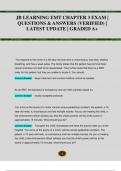
You respond to the home of a 59-year-old man who is unconscious, has slow, shallow breathing, and has a weak pulse. The family states that the patient has terminal brain cancer and does not wish to be resuscitated. They further state that there is a DNR order for this patient, but they are unable to locate it. You should: Correct Answer: begin treatment and contact medical control as needed. As an EMT, the standard of emergency care are often partially based on: Correct Answer: locally accepted protocols. You arrive at the scene of a motor vehicle-versus-pedestrian accident. the patient, a 13- year-old male, is unconscious and has multiple injuries. As you are treating the child, a law enforcement officer advises you that the child's parents will be at the scene in approximately 15 minutes. What should you do? Correct Answer: Transport the child immediately and have the parent meet you at the hospital. You arrive at the scene of a motor vehicle-versus-pedestrian accident. The patient, a 13-year-old-male, is unconscious and has multiple injuries. As you re treating the child, a law enforcement officer advises you that the child's parent will be at the scene in approximately 15 minutes. what should you do? 2 Which aspect of the Health Insurance Portability and Accountability Act (HIPAA) MOST affects EMS personnel? Correct Answer: Protecting patient privacy Maintaining the chain of evidence at the scene of a crime should include: Correct Answer: not cutting through holes in clothing that were caused by weapons. Which of the following statements about the patient care report is correct? Correct Answer: It is difficult to prove actions were performed if they are not included on the report. In which of the following situations does a legal duty to act clearly exist? Correct Answer: A call is received 15 minutes prior to shift change. Which of the following statements regarding consent is correct? Correct Answer: A patient can consent to transport but can legally refuse to be treated. You and your partner arrive at the scene of a major motor vehicle crash. the driver, a young male, is severely entrapped in his car. He has an open head injury and massive facial trauma. He is unresponsive, is not breathing, and does not have a palpable carotid pulse. You should: Correct Answer: Have your partner check for a pulse to confirm that the patient is deceased. 3 Which of the following components are needed to prove negligence? Correct Answer: Duty to act, breach of duty, injury/damages, and causation Putrefaction is defined as: Correct Answer: decomposition of the body's tissues. Where would you MOST likely find information regarding a patient's wishes to be an organ donor? Correct Answer: Driver's licen
Written for
- Institution
- JB LEARNING
- Course
- JB LEARNING
Document information
- Uploaded on
- April 5, 2024
- Number of pages
- 4
- Written in
- 2023/2024
- Type
- Exam (elaborations)
- Contains
- Questions & answers
Subjects
-
jb learning emt chapter 3 exam questions answ

Also available in package deal