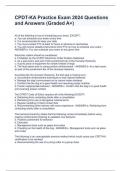
CPDT-KA Practice Exam 2024 Questions and Answers (Graded A+)
All of the following is true of scheduling your exam, EXCEPT: a. You can schedule your exam at any time b. It is recommended to keep your date c. You must contact PTC at least 72 hours in advance to reschedule d. You will receive detailed instructions from PTC on how to schedule your exam - ANSWER-a. You can schedule your exam at any given time Electronic collars should be considered: a. Forbidden by the CCPDT Electronic Collar Position Statement b. As a last resort, and part of the punishment tier of the Humane Hierarchy c. A go-to piece of equipment for certain breeds of dogs d. The final option prior to using positive reinforcement - ANSWER-b. As a last resort, an part of the punishment tier of the Humane Hierarchy According the the Humane Hierarchy, the first step in training is to: a. Use positive reinforcement techniques to train desired behavior b. Manage the dog's environment so he cannot make mistakes c. Confirm that the dog is in good health and receiving proper nutrition d. Punish inappropriate behavior - ANSWER-c. Confirm that the dog is in good health and receiving proper nutrition The CPPDT Code of Ethics requires all of the following EXCEPT: a. Refraining from contacting clients after a consultation b. Refraining from use of derogative cultural terms c. Regular updating of client contact lists d. Recommending other trainers with more experience - ANSWER-a. Refraining from contacting clients after a consultation The Humane Hierarchy states that the following comes immediately before using positive reinforcement training to establish new behavior: a. Positive punishment for behavior b. Extinction c. Management tools such as gates and crates d. Checking on the health of the dog - ANSWER-c. Management tools such as gates and crates The following is an unacceptable aversive method which could cause your CPDT-KA certification to be revoked: a. Recommending the use of a prong collar in a group class b. Ear-pinch method of dumbbell retrieve c. Use of an anti-bark collar d. R
Written for
- Institution
- CPDT-KA
- Course
- CPDT-KA
Document information
- Uploaded on
- April 5, 2024
- Number of pages
- 22
- Written in
- 2023/2024
- Type
- Exam (elaborations)
- Contains
- Questions & answers
Subjects
- electronic colla
-
cpdt ka practice exam 2024 questions and answers
-
cpdt ka practice exam 2024 stuvia
-
all of the following is true of scheduling your ex
-
electronic collars should be considered a forbid

Also available in package deal