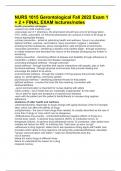
NURS 1015 Gerontological Fall 2022 Exam 1 + 2 + FINAL EXAM lectures/notes
NURS 1015 Gerontological Fall 2022 Exam 1 + 2 + FINAL EXAM lectures/notes health promotion strategies -request non-child medicine cups -encourage use of 1 pharmacy. the pharmacist should have a list of all drugs taken - OTC, herbs, prescribed. An informed pharmacist can conduct a review of all drugs to ensure appropriate therapy. -primary prevention - aimed at optimizing health and wellness. focus is on education: optimal nutrition, exercise, vaccinations, injury prevention, hygiene + sanitation, avoiding harmful substances, stress management, safe living/work environments -secondary prevention ; identifying a disease at its earliest stage - through screening - to initiate treatment and decrease the chance of the disease developing any further or worsening -tertiary prevention - minimizing effects of disease and disability through adherence to medication, nutrition, exercise and disease management -promoting biological wellness - through exercises social wellness - through activities that require interactions with people, pets or both functional wellness - through physical environments that promote healing and encourage the patient to be active environmental wellness - through the creation of living spaces that promote healthy aging. ex: street lighting, community garden psychosocial wellness - identifying potential threats for that patient spiritual wellness - a sense that ones life has meaning; connection with God/world/others - good communication is important for nurses dealing with elders -beers criteria - list of meds that are "potentially inappropriate" for the elder - be on alert for signs and symptoms of autoimmune diseases -work with the patient and the patient's family/friends to increase drug regimen adherence obstacles of elder health and wellness -pharmacodynamic responses to drugs change with aging because of the # of receptor sites, which can affect the affinity of drugs -polypharmacy - the use of more drugs than needed; its usually described as the use of more than 5 drugs or more which can be dangerous -ADE(adverse drug events) - unintended/undesired negative effects of drugs at a normal dose. types: 1) adverse drug reactions (ADR), 2) medication errors, 3) therapeutic failures, 4) adverse drug withdrawal events, 5) overdoses. older adults have multiple risk factors for ADE. to minimize this: "start slow, go slow, but go" -adherence to drug regimen; elders fail to ask questions during appts with health care providers which leads to drug regimens not being fully understood/followed. education +proper communication with elders + help from family/friends fixes this. -list of barriers: taking too many drugs at different times failure to understand the reason for a drug impaired memory decreased mobility/dexterity visual/hearing disturbances high cost of meds side effects of adverse reactions from drugs -elderspeak - patronizing speech; associated with lower levels of communication ability, social isolation, increased dependence and cognitive decline -medication-herb interactions -medication-food interactions -medication-medication interactions -heart disease -chronic lung disease -alcohol abuse -cancer -smoking -pain legal and ethical issues pertaining to elder healthcare -legal --rights: to be fully informed, to participate in their own care, to make independent choices, to expect privacy and confidentiality, to have dignity, respect, and freedom, to have security of their own possessions, to complain, and to have visits -ethical issues --restrictions = safety restrictions/restrictions on cigarettes; restrains require HCP order with proper reason --artificial nutrition and hydration --scheduling activities for staff convenience --provision of care = more care than necessary for time convenience --patient's right to express sexual interest; protection of patient is understandable but they must also be allow to make their own choices nurse's role of advocacy -promote advanced care planning - tell them to always carry their advanced directive -implement their advanced directive -facilitate decisions about care; observe patients competency: ask them to restate their condition/treatment to see if they understand -promote caregiver wellness - some caregivers stress out about what a patient would want types of abuse -physical -physical force; black eyes, welts, burns, broken bones, bruises, withdrawal, agitation -sexual - non-consensual sexual acts; physical acts, exposure to porn, forced voyeurism(Watching ppl), forcing elders to undress -emotional - emotional pain through verbal/non-verbal acts; threats and intimidation, isolation, verbal abuse, and deprivation of needs and affection -financial abuse - individual illegally uses an elder's resources like funds, property, and other assets -domestic abuse in a person home or the home of the caregiver; maltreatment -institutional abuse - maltreatment in a nursing/foster/group home, assisted living; 60.7% of abuse is domestic and 8.3% is institutional -self-neglect - individual may threaten to harm their own health/safety by failing to provide for their basic daily needs -neglect and abandonment - failing to provide an elder with necessities like food, shelter, personal safety, clothing, medicine, and care; failure as a person who has financial responsibility to provide care types of advanced directives -health care proxy - person who communicates the patient's wishes -durable power of attorney - person who is able to make decisions for you when you're unable to -DNR - written order that tells you to what extent of resuscitation efforts is preferred by the patient -AND - allowing of a natural death -living will - states what you want done towards the end of life MOLST - medical orders for life sustaining treatments Define and describe the concept of Cognition -cognition = mental action of acquiring knowledge and understanding through thought, expertise, and the senses; ability to perceive and react, process and understand, store and retrieve info, and make decisions and produce appropriate responses Notice risk factors for cognitive impairment. - risk factors - age, family history, education level, brain injury, toxic substances like lead, diseases like parkinson's disease, heart disease, stroke, and diabetes Identify modifiable and non-modifiable risk factors, specifically related to delirium and dementia. -modifiable --personal behaviors - substance abuse, high-risk activities, accidental injuries, lifestyle choices --environmental exposure to toxic substances like lead --health-related conditions - acute/chronic treatments to prevent further damage -non-modifable --age - elders are at highest risk for cognitive impairment --congenital factors - maternal(substance abuse), birth injuries --genetic conditions like down syndrome Recognize when an individual has cognitive impairment. - neuropsychometric testing = mini mental state exam; neuroimaging works as well -patient experiences amnesia(loss of memory) -either short or long term -language = distorted speech --confabulation may occur = fabrication of events to fill-in timeline; sometimes called "honest lying"; false memories without intent to deceive -lack of visuospatial ability = ability to understand the things we see around us; depth perception; ability to understand the visual and spatial relationships among objects(ex: making a bed; putting furniture together); these skills are needed for movement, depth, vision perception and spatial navigation -calculation problems = not being able to solve math problems -abstract reasoning = lack of flexible thinking, creativity, judgment, and logical problem
Written for
- Institution
- NURS 1015 Gerontological
- Course
- NURS 1015 Gerontological
Document information
- Uploaded on
- April 3, 2024
- Number of pages
- 19
- Written in
- 2023/2024
- Type
- Exam (elaborations)
- Contains
- Questions & answers
Subjects
-
nurs 1015 gerontological fall 2022 exam 1 2 fi