Enrico Tiepolo
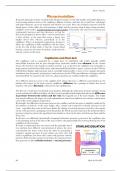
Microcirculation
In its path along the systemic circulation the blood encounters vessels with smaller and smaller diameter,
in increasing number, down to the capillaries (billions of them), and then fewer and fewer with larger
and larger diameter, up to the superior and inferior cava veins. Since the resistance increases with the
fourth power of the radius, the total resistance is high (and the pressure drop is large) along arterioles,
capillaries and venules, notwithstanding their high number. Conversely, the total cross-sectional area
continuously increases and then decreases, so that the
flow in the periphery is slower (flux = cross-sectional area
× flow velocity, so the same flux across a larger area
implies slower flow velocity), particularly so in the
capillaries. This is of paramount importance because it
allows the capillaries to fully equilibrate with the tissue,
in the few mm of their path, so that the venous blood
leaving a tissue has the same electrolyte, small molecule
and gas content as the tissue.
Capillaries and their bed
The capillaries wall is constituted by a single layer of endothelial cells, which typically exhibit
intercellular fenestrae that let pass through freely molecules smaller than albumin. In the various
tissues, the fenestrae may change in number and size (e.g., in the liver the capillaries are permeable to
large proteins and the blood fully mixes with interstitial fluid in Disse’s spaces, whereas in the CNS the
endothelium displays tight junctions and is essentially impermeable), a more or less complex basement
membrane may be present, and pericytes (and astrocytes in the CNS) may influence exchanges with the
interstitial fluid. As a general rule, however, plasma proteins are confined within the capillaries.
Two different processes occur at the capillary bed: solutes that have a different concentration in the
plasma with respect to the tissue tend to equilibrate (diffusion) but a passage of solutes also occurs
together with water (filtration), which favors the equilibration.
The flow in a vessel does not depend on its position; although the hydrostatic pressure changes among
vessels positioned at different heights, the flow across a peripheral bed simply depends on the difference
in pressure between the artery and the vein (that typically are at the same height). The height
may merely influence the degree of vessel replenishment, which may influence its resistance, and in some
cases (if the vessel collapses) impair flow.
In principle, the difference in pressure between the capillary and the interstice is similarly unaffected by
the position, as both are at the same height. Also, a major role is played by valvular structures in the
veins – especially deep veins in the lower limbs: the change in external pressure exerted by the muscles
on the veins generates a pumping action that pushes the blood up and counteracts the positional effect;
pressure is kept low also in the superficial veins thanks to valves in the latter and between them and the
deep veins.
In all cases, an additional (dynamically changing) hydrostatic pressure is present in the capillaries, due
to the pumping action of the heart. One may wonder why plasma fluid does not keep flowing out of the
capillaries in the interstice.
In order to understand this, one must recall the principle that if
two solutions have different concentrations of solutes, the more
concentrated one draws water from the other by generating a
(negative) osmotic pressure; if some solutes can move they will
tend to equilibrate, but those that cannot will generate osmotic
pressure; if the ones that cannot are proteins, the osmotic pressure
they generate is called colloido-osmotic or oncotic pressure.
88 Body At Work II
Microcirculation
In its path along the systemic circulation the blood encounters vessels with smaller and smaller diameter,
in increasing number, down to the capillaries (billions of them), and then fewer and fewer with larger
and larger diameter, up to the superior and inferior cava veins. Since the resistance increases with the
fourth power of the radius, the total resistance is high (and the pressure drop is large) along arterioles,
capillaries and venules, notwithstanding their high number. Conversely, the total cross-sectional area
continuously increases and then decreases, so that the
flow in the periphery is slower (flux = cross-sectional area
× flow velocity, so the same flux across a larger area
implies slower flow velocity), particularly so in the
capillaries. This is of paramount importance because it
allows the capillaries to fully equilibrate with the tissue,
in the few mm of their path, so that the venous blood
leaving a tissue has the same electrolyte, small molecule
and gas content as the tissue.
Capillaries and their bed
The capillaries wall is constituted by a single layer of endothelial cells, which typically exhibit
intercellular fenestrae that let pass through freely molecules smaller than albumin. In the various
tissues, the fenestrae may change in number and size (e.g., in the liver the capillaries are permeable to
large proteins and the blood fully mixes with interstitial fluid in Disse’s spaces, whereas in the CNS the
endothelium displays tight junctions and is essentially impermeable), a more or less complex basement
membrane may be present, and pericytes (and astrocytes in the CNS) may influence exchanges with the
interstitial fluid. As a general rule, however, plasma proteins are confined within the capillaries.
Two different processes occur at the capillary bed: solutes that have a different concentration in the
plasma with respect to the tissue tend to equilibrate (diffusion) but a passage of solutes also occurs
together with water (filtration), which favors the equilibration.
The flow in a vessel does not depend on its position; although the hydrostatic pressure changes among
vessels positioned at different heights, the flow across a peripheral bed simply depends on the difference
in pressure between the artery and the vein (that typically are at the same height). The height
may merely influence the degree of vessel replenishment, which may influence its resistance, and in some
cases (if the vessel collapses) impair flow.
In principle, the difference in pressure between the capillary and the interstice is similarly unaffected by
the position, as both are at the same height. Also, a major role is played by valvular structures in the
veins – especially deep veins in the lower limbs: the change in external pressure exerted by the muscles
on the veins generates a pumping action that pushes the blood up and counteracts the positional effect;
pressure is kept low also in the superficial veins thanks to valves in the latter and between them and the
deep veins.
In all cases, an additional (dynamically changing) hydrostatic pressure is present in the capillaries, due
to the pumping action of the heart. One may wonder why plasma fluid does not keep flowing out of the
capillaries in the interstice.
In order to understand this, one must recall the principle that if
two solutions have different concentrations of solutes, the more
concentrated one draws water from the other by generating a
(negative) osmotic pressure; if some solutes can move they will
tend to equilibrate, but those that cannot will generate osmotic
pressure; if the ones that cannot are proteins, the osmotic pressure
they generate is called colloido-osmotic or oncotic pressure.
88 Body At Work II