HESI VN Module 6 Exam: HESI VN TXGRP 1912COHORT(VNE 39)
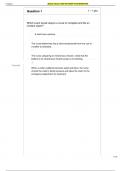
Question 1 1 / 1 pts Which event would require a nurse to complete and file an incident report? A client has a seizure. The nurse determines that a client would benefit from the use of a walker to ambulate. The nurse, preparing an intravenous infusion, notes that the battery of an intravenous infusion pump is not working. Correct! When a visitor suddenly becomes weak and dizzy, the nurse checks the visitor’s blood pressure and takes the visitor to the emergency department for treatment. Rationale: An incident is any event that is not consistent with the routine operation of a health care unit or routine care of a client. Examples of incidents include client falls, needlestick injuries, a visitor having symptoms of illness, medication administration errors, accidental omission of prescribed therapies, and circumstances leading to injury or a risk for injury. An incident report does not need to be filed if a client has a seizure unless the client sustains injury as a result of the seizure. If the nurse determines that a client would benefit from the use of a walker to ambulate, he or she should take the appropriate action to obtain one. If the nurse notes that the battery of an intravenous infusion pump is not working, he or she should obtain a functioning pump and send the nonfunctioning pump to the appropriate department for repair. Test-Taking Strategy: Use knowledge of the subject, reasons for filing an incident report, to assist you with the process of elimination. Read each option carefully. Recalling that an incident is any event that is not consistent with the routine operation of a health care unit or routine care of a client will direct you to the correct option. Review the reasons for filing an incident report if you had difficulty with this question. Cognitive Ability: Applying Client Needs: Safe and Effective Care Environment Integrated Process: Nursing Process/Implementation Content Area: Ethical/Legal Notifying the nursing supervisor Tearing up and discarding the incident report Correct! Telling the health care provider that the error warrants the completion of an incident report Telling the nursing supervisor that the health care provider did not want an incident report completed and filed Rationale: Incident reports are an important part of a health care agency’s quality improvement program. An incident is any event that is not consistent with the routine operation of a health care unit or routine care of a client. An example of an incident is administering a medication at a time at which it is not prescribed to be given. Whenever an incident occurs, an incident report is completed and filed in accordance with agency guidelines. The nursing supervisor would be notified of the incident; however, on the basis of the data in the question, the nurse should tell the health care provider that the error warrants completion and follow-through with an incident report. Therefore, the other options are incorrect. Test-Taking Strategy: Focus on the subject of the question, the health care provider’s telling the nurse that an incident report is not needed. Eliminate the comparable or alike options that involve notifying the nursing supervisor. To select from the remaining options, recall the purpose of an incident report to select the correct option. Review the procedures involved in completing and filing incident reports if you had difficulty with this question. Cognitive Ability: Applying Client Needs: Safe and Effective Care Environment Integrated Process: Nursing Process/Implementation Content Area: Ethical/Legal Contact precautions are initiated for a client with methicillin- resistant Staphylococcus aureus (MRSA) infection. The nurse, providing instructions to a nursing assistant about caring for the client, tells the assistant to take which action? To transfer the client to a semiprivate room That gloves only are needed to care for the client Correct! To wear gloves and a gown when changing the client’s bed linen To wear a gown when caring for the client and remove the gown immediately after leaving the client s room Rationale: Contact precautions require the use of gloves, gown, and goggles if direct client contact is anticipated. The client should be placed in a private room or, if a private room is not available, in a semiprivate room with another client who has active infection with the same microorganism but no other infection. The nursing assistant would remove the protective gear before leaving the client’s room. Test-Taking Strategy: Use the process of elimination. Eliminate the option that includes the closed-ended word “only.” Next eliminate the option that involves removal of the gown after leaving the client’s room. To select from the remaining options, read each carefully and visualize the procedure instituted for contact precautions, which will direct you to the correct option. If you had difficulty with this question, review contact precautions. Cognitive Ability: Applying Client Needs: Safe and Effective Care Environment Integrated Process: Teaching and Learning Content Area: Leadership/Management The mother of a 3-year-old calls a neighbor who is a nurse and reports that her child just drank some window cleaner that had been stored in a cabinet. The nurse should instruct the mother to immediately take which action? Correct! Call a poison control center. Administer an excessive amount of fluids to induce vomiting. Call an ambulance to bring the child to the emergency department. Leave a message at the health care provider answering service about the incident. Rationale: When a poisoning occurs, a poison center should be called immediately. Vomiting should not be induced if the victim is unconscious or if the substance ingested was a strong corrosive or petroleum product. Also, vomiting should not be induced unless a health care provider has given specific instructions to induce vomiting. Neither calling an ambulance nor calling the health care provider’s answering service is the immediate action, because either would delay treatment. Additionally, the health care provider would immediately make a referral to the poison control center. The poison control center may advise the mother to bring the child to the emergency department; if this is the case, the mother should then call an ambulance. Test-Taking Strategy: Note the strategic word “immediately” in the query of the question. First, recalling that vomiting should not be induced without appropriate advice to do so will help you eliminate the option that involves inducing vomiting. Next eliminate the comparable or alike options that will delay treatment (i.e., calling an ambulance and leaving a message with the answering service). Review immediate poison control measures if you had difficulty with this question. Cognitive Ability: Applying Client Needs: Safe and Effective Care Environment Integrated Process: Nursing Process/Implementation Content Area: Safety
Written for
- Institution
-
Concorde Career College
- Course
-
HESI 101
Document information
- Uploaded on
- April 1, 2024
- Number of pages
- 137
- Written in
- 2023/2024
- Type
- Exam (elaborations)
- Contains
- Questions & answers
Subjects
-
question 1 1 1 pts which event would re

Also available in package deal