
TECTONIC PROCESSES AND HAZARDS
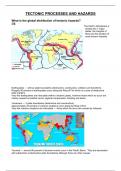
What is the global distribution of tectonic hazards?
21§
The Earth’s lithosphere is
divided into 7 major
plates; the margins of
these are the location of
most tectonic hazards.
Earthquakes — all four plate boundaries (destructive, constructive, collision and transform).
Roughly 90 percent of earthquakes occur along the Ring of Fire which is a zone of destructive
plate margins.
Very few earthquakes are intra-plate (within a tectonic plate), however those which do occur are
mainly caused by isostatic recoil, regional compression, fracking and dams.
Volcanoes — 2 plate boundaries (destructive and constructive).
Approximately 75 percent of volcanic eruptions occur along the Ring of Fire.
Very few volcanic eruptions are intra-plate — those which do occur are caused by hotspots.
Tsunami — around 90 percent of tsunami events occur in the Pacific Basin. They are associated
with subduction at destructive plate boundaries although there are other causes.
,PLATE TECTONIC THEORY:
Inside the earth, heat from the Earth’s core drives convection cells (see below) in the mantle, which in
turn move the tectonic plates.
The crust, the outermost layer, is rigid and very thin compared to mantle or core.
There are two types oceanic or continental, oceanic is denser than the continental crust and therefore
subducts (sinks) if the two types of crust converge.
Palaeomagnetism and sea floor spreading
Palaeomagnetism is the study of the Earth’s magnetic field in rocks.
A research vessel performed a detailed study of the magnetism of the
sea floor in the Pacific Ocean; when the results were plotted,
alternating rows of low and high magnetism emerged.
Frederick Vine and Drummond Matthews, two Cambridge University
researchers, surmised that the stripes of alternating magnetic
intensity represented periods of normal and reversed magnetic
polarity.
When basaltic lava and magma cools iron particles align themselves in
the direction of the magnetic pole.
The Earth’s magnetic pole is in the north for a period of time (normal magnetic polarity) and then in the
south for a further period (reversed magnetic polarity) and so on (171 reversals over 76 million years).
, If formed when the magnetic pole was in the north, new basalt would be aligned to the north.
However, after a reversal in the magnetic poles, newer basalt would be oriented to the south.
This proves than new oceanic crust is created by the process of sea-floor spreading at mid-ocean ridges.
Harry Hess, an American geologist, became interested in the
oceans while serving in the US Navy during the Second World
War.
He published a theory known as ‘Sea Floor Spreading’. He
argued that oceans grew from their centre, with magma
creating new sea floor which then spread away from the mid-
ocean ridge in both directions.
The mid-ocean ridge was thermally expanded and consequently
higher than ocean further away. Hess also believed that deep-
sea trenches were the location where sea floor was destroyed
and recycled.
DIFFERENT TYPES OF PLATE MARGIN:
Destructive plate margins:
The denser oceanic crust subducts beneath the overlying continental
crust.
The subducting plate partially melts generating magma which rises
as it is less dense than its surroundings. As the magma rises through
the overlying continental crust, it becomes richer in silica and
therefore more viscous. If the magma reaches the earth’s surface, a
potentially explosive volcano is created.
Earthquakes may occur at a range of depths along the Benioff zone (area where friction is
created between the colliding plates), the boundary between the subducting oceanic crust and
the overlying continental crust. This is because stress may build up where the plates converge.
The dense oceanic plate is also pulled into the mantle under the influence of gravity; this is
known as slab pull.
If oceanic crust converges with oceanic crust, one of the plates will be colder/denser and
therefore subduct.
Collision plate margins:
Two continenal plates converge however, subduction does not occur
because they both have the same low density.
Shallow, high magnitude earthquakes such as in Nepal in 2015 may
occur although volcanic eruptions are very rare.
Constructive plate margins:
Where two oceanic or continental plates diverge, tensional forces open
faults and fissures, therefore creating pathways for magma to move
towards the surface.
What is the global distribution of tectonic hazards?
21§
The Earth’s lithosphere is
divided into 7 major
plates; the margins of
these are the location of
most tectonic hazards.
Earthquakes — all four plate boundaries (destructive, constructive, collision and transform).
Roughly 90 percent of earthquakes occur along the Ring of Fire which is a zone of destructive
plate margins.
Very few earthquakes are intra-plate (within a tectonic plate), however those which do occur are
mainly caused by isostatic recoil, regional compression, fracking and dams.
Volcanoes — 2 plate boundaries (destructive and constructive).
Approximately 75 percent of volcanic eruptions occur along the Ring of Fire.
Very few volcanic eruptions are intra-plate — those which do occur are caused by hotspots.
Tsunami — around 90 percent of tsunami events occur in the Pacific Basin. They are associated
with subduction at destructive plate boundaries although there are other causes.
,PLATE TECTONIC THEORY:
Inside the earth, heat from the Earth’s core drives convection cells (see below) in the mantle, which in
turn move the tectonic plates.
The crust, the outermost layer, is rigid and very thin compared to mantle or core.
There are two types oceanic or continental, oceanic is denser than the continental crust and therefore
subducts (sinks) if the two types of crust converge.
Palaeomagnetism and sea floor spreading
Palaeomagnetism is the study of the Earth’s magnetic field in rocks.
A research vessel performed a detailed study of the magnetism of the
sea floor in the Pacific Ocean; when the results were plotted,
alternating rows of low and high magnetism emerged.
Frederick Vine and Drummond Matthews, two Cambridge University
researchers, surmised that the stripes of alternating magnetic
intensity represented periods of normal and reversed magnetic
polarity.
When basaltic lava and magma cools iron particles align themselves in
the direction of the magnetic pole.
The Earth’s magnetic pole is in the north for a period of time (normal magnetic polarity) and then in the
south for a further period (reversed magnetic polarity) and so on (171 reversals over 76 million years).
, If formed when the magnetic pole was in the north, new basalt would be aligned to the north.
However, after a reversal in the magnetic poles, newer basalt would be oriented to the south.
This proves than new oceanic crust is created by the process of sea-floor spreading at mid-ocean ridges.
Harry Hess, an American geologist, became interested in the
oceans while serving in the US Navy during the Second World
War.
He published a theory known as ‘Sea Floor Spreading’. He
argued that oceans grew from their centre, with magma
creating new sea floor which then spread away from the mid-
ocean ridge in both directions.
The mid-ocean ridge was thermally expanded and consequently
higher than ocean further away. Hess also believed that deep-
sea trenches were the location where sea floor was destroyed
and recycled.
DIFFERENT TYPES OF PLATE MARGIN:
Destructive plate margins:
The denser oceanic crust subducts beneath the overlying continental
crust.
The subducting plate partially melts generating magma which rises
as it is less dense than its surroundings. As the magma rises through
the overlying continental crust, it becomes richer in silica and
therefore more viscous. If the magma reaches the earth’s surface, a
potentially explosive volcano is created.
Earthquakes may occur at a range of depths along the Benioff zone (area where friction is
created between the colliding plates), the boundary between the subducting oceanic crust and
the overlying continental crust. This is because stress may build up where the plates converge.
The dense oceanic plate is also pulled into the mantle under the influence of gravity; this is
known as slab pull.
If oceanic crust converges with oceanic crust, one of the plates will be colder/denser and
therefore subduct.
Collision plate margins:
Two continenal plates converge however, subduction does not occur
because they both have the same low density.
Shallow, high magnitude earthquakes such as in Nepal in 2015 may
occur although volcanic eruptions are very rare.
Constructive plate margins:
Where two oceanic or continental plates diverge, tensional forces open
faults and fissures, therefore creating pathways for magma to move
towards the surface.


