
COASTAL LANDSCAPES AND CHANGE
What is the littoral zone and why is it dynamic?
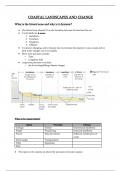
● The littoral zone (beach) 🡪 it is the boundary between the land and the sea.
● It is divided into 4 zones:
1. Backshore
2. Foreshore
3. Nearshore
4. Offshore
● It is always changing, and is dynamic due to processes that operate in seas, oceans and on
land. Some changes can occur rapidly.
● Short-term processes include:
▪ Tides
▪ Longshore drift
● Long-term processes in include:
▪ Sea level rising/falling (climate change)
What is the coastal system?
Inputs Processes Outputs
Geology Erosion Depositional landforms
People Weathering Erosional landforms
Waves Mass movement Different classification of
coasts
Storm surges Transportation
Tides Deposition
Solar
● The inputs to the systems are altered by processes to become outputs.
,How are coasts classified?
According to the geology:
Rocky coasts, for example Bedruthan Steps, Cornwall. Older resistant rock such as slates and
sandstones can withstand winter storms without suffering from rapid erosion.
Sandy coasts, for example Holkham Beach, Norfolk. Low-lying beaches are inundated at high tide
but the vegetated dunes are not and prevent erosion. Sediment is supplied from different
terrestrial and offshore sources.
Estuarine coasts, for example Lymington in Hampshire. Extensive mud flats are exposed at low
tide but inundated at high tide with a salt marsh behind. Sediment is supplied from different
terrestrial and offshore sources.
,Cliffed coasts, for example Flamborough Head, Yorkshire. The transition from land to sea is
abrupt and a wave-cut platform is exposed at low tide.
Concordant coasts, for example Lulworth Cove, Dorset. Different rock bands run parallel to the
coast.
, Discordant coasts, for example Studland Bay, Dorset. Different rock bands run at right angles to
the coast.
According to the level of energy:
High-energy coasts, for example Cornwall. The waves are powerful for much of the year.
What is the littoral zone and why is it dynamic?
● The littoral zone (beach) 🡪 it is the boundary between the land and the sea.
● It is divided into 4 zones:
1. Backshore
2. Foreshore
3. Nearshore
4. Offshore
● It is always changing, and is dynamic due to processes that operate in seas, oceans and on
land. Some changes can occur rapidly.
● Short-term processes include:
▪ Tides
▪ Longshore drift
● Long-term processes in include:
▪ Sea level rising/falling (climate change)
What is the coastal system?
Inputs Processes Outputs
Geology Erosion Depositional landforms
People Weathering Erosional landforms
Waves Mass movement Different classification of
coasts
Storm surges Transportation
Tides Deposition
Solar
● The inputs to the systems are altered by processes to become outputs.
,How are coasts classified?
According to the geology:
Rocky coasts, for example Bedruthan Steps, Cornwall. Older resistant rock such as slates and
sandstones can withstand winter storms without suffering from rapid erosion.
Sandy coasts, for example Holkham Beach, Norfolk. Low-lying beaches are inundated at high tide
but the vegetated dunes are not and prevent erosion. Sediment is supplied from different
terrestrial and offshore sources.
Estuarine coasts, for example Lymington in Hampshire. Extensive mud flats are exposed at low
tide but inundated at high tide with a salt marsh behind. Sediment is supplied from different
terrestrial and offshore sources.
,Cliffed coasts, for example Flamborough Head, Yorkshire. The transition from land to sea is
abrupt and a wave-cut platform is exposed at low tide.
Concordant coasts, for example Lulworth Cove, Dorset. Different rock bands run parallel to the
coast.
, Discordant coasts, for example Studland Bay, Dorset. Different rock bands run at right angles to
the coast.
According to the level of energy:
High-energy coasts, for example Cornwall. The waves are powerful for much of the year.


