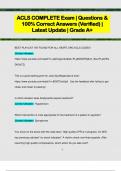
ACLS COMPLETE Exam | Questions & 100% Correct Answers (Verified) | Latest Update | Grade A+
BEST PLAYLIST I'VE FOUND FOR ALL HEART.ORG ACLS CODES! Correct Answer: DKOkTZj This is a good starting point for Jose (big Megacode at end): closer and closer to passing! In which situation does bradycardia require treatment? Correct Answer: Hypotension Which intervention is most appropriate for the treatment of a patient in asystole? Correct Answer: Epinephrine You arrive on the scene with the code team. High-quality CPR is in progress. An AED has previousy advised "no shock indicated." A rhythm check now finds asystole. After resuming high-quality compressions, which action do you take next? 2 Correct Answer: Establish IV or IO access A monitored patient in the ICU developed a sudden onset of narrow-complex tachycardia at a rate of 220/min. The patient's blood pressure is 128/58 mm Hg, the PETCO2 is 38mm Hg, and the pulse oximetry reading is 98%. There is vascular access in the left arm, and the patient has not been given any vasoactive drugs. A 12-lead ECG confirm a supraventricular tachycardia with no evidence of ischemia or infarction. The heart rate has not responded to vagal maneuvers. what is your next action? Correct Answer: Administer adenosine 6mg IV push A patient has sinus bradycardia with a heart rate of 36/min. Atropine has been administered to a toal does of 3 mg. A transcutaneous pacemaker has failed to capture. The patient is confused, and her blood pressure is 88/56 mm Hg. Which therapy is now indicated? Correct Answer: Epinephrine 2 to 10 mcg/min A patient is in cardiac arrest. Ventricular fibrillation has been refractory to a second shock. Which drug should be administered first? Correct Answer: Epinephrine 1 mg IV/IO A 62-year-old man suddenly experienced difficulty speaking and left-sided weakness. He meets initial criteria for fibrinolytic therapy, and a CT scan of the brain si ordered. Which best describes the guidelines for antiplatelet and fibrinolytic therapy? 3 Correct Answer: Hold aspirin for at least 24 hours if rtPA is administered A patient is in refractory ventricular fibrillation and has received multiple appropriate defribillation shocks, epinephrine 1 mg IV twice, and an initial dose of amiodarone 300mg IV. The patient is intubated. Which best describe the recommended second does of amiodarone for this patient? Correct Answer: 150 mg IV push A patient with sinus bradycardia and a heart rate of 42/min has diaphoresis and a blood pressure of 80/60mm Hg. What is the initial does of atropine? Correct Answer: 0.5mg A 35-year-old woman has palpitations, light-headedness, and a stable tachycardia. The monitor shows a regular narrow-complex QRS at a rate of 180/min. Vagal maneuvers have not been effective in terminating the rhythm. An IV has been established. Which drug should be administered? Correct Answer: Adenosine 6mg A patient is in cardiac arrest. Ventricular fibrillation has been refractory to an initial shock. If no pathway for medication administration is in place, which method is preferred? Correct Answer: IV or I
Written for
- Institution
- ACLS
- Course
- ACLS
Document information
- Uploaded on
- March 30, 2024
- Number of pages
- 69
- Written in
- 2023/2024
- Type
- Exam (elaborations)
- Contains
- Questions & answers
Subjects
-
acls complete exam questions 100 correct ans

Also available in package deal