JIBC Emergency Medical Responder Exam (Questions & Answers) Passed!!
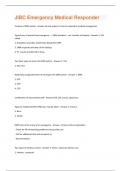
Purpose of EMS system - Answer-Formal system of care to respond to medical emergencies Typical seq. of events from emergency --> EMS activated --> pt. transfer to hospital - Answer-1. 911 called 2. Dispatcher provides verbal help, dispatches EMR 3. EMR responds and may call for backup 4. Pt. may be transferred to hosp Two basic ways to access the EMS system - Answer-1. 911 2. Non-911 Nationally recognized levels of training in the EMS system - Answer-1. EMR 2. PCP 3. ACP 4. CCP Certification of aeromedical staff - Answer-ACP, CCP, nurses, physicians Types of medical facilities EMS pts. may be taken - Answer-1. Trauma 2. Burn 3. Stroke EMR roles at the scene of an emergency - Answer-- Protect self, pt, bystanders - Check for life threatening problems and provide care - Call for additional help and transport pt - Documentation Two types of medical control - Answer-1. Direct - physician directs care 2. Indirect - protocolsFive stages of grieving - Answer-1. Denial 2. Anger 3. Bargaining 4. Depression 5. Acceptance Critical incident stress debriefing (CISD) - Answer-Help team cope and share after a stressful critical incident, typically 24-72 hours after the event Debriefing vs. defusing - Answer-Defusing is shorter and more informal Ways an infectious disease can spread from person to person - Answer-- Blood - Bodily fluids - Objects - Resp. droplets Cleaning vs. disinfecting vs. sterilizing - Answer-Cleaning: Wash w/ soap and water Disinfecting: Wash w/ chemical to kill infectious material Sterilizing: All microorganisms killed Equipment needed for BSI precautions - Answer-- Gloves - Gown - Eye protection - Mask Cross contamination - Answer-Disease or infection transferred through exposed equipment/surfaces Five immunizations that should be up to date - Answer-- Tetanus - Hep B - Influenza- Polio - MMR EMR's scope of practice - Answer-Legally allowed actions Expressed vs. implied consent - Answer-Expressed: Directly from the pt, verbally or physically Implied: Assumes that an unconscious pt would agree to care Advanced care plan - Answer-Outlines what tx a pt wants, signed by the pt Do Not Resuscitate (DNR) order - Answer-Written order signed by a physician re: CPR and life-saving measures allowed for a chronically/terminally ill pt Handling refusal of care - Answer-- Try to persuade pt to get tx - Ensure pt can make a decision - Pt signs refusal form - Give pt instructions for care and when to seek help again Abandonment and negligence - Answer-Abandonment: Stopped providing care Negligence: Care deviates from standard of care Duty to act - Answer-Contractual or legal obligation to provide care while on duty How to preserve evidence at a crime scene - Answer-- Don't wash blood or move objects - Don't cut through holes or ropes - Document scene Anatomical position - AnswerLateral recumbent position - AnswerSupine vs. prone position - AnswerAnterior vs. posterior - Answer-Anterior: Towards the front Posterior: Towards the back Medial vs. lateral - Answer-Medical: Towards the midline of the body Lateral: Away from the midline of the body Proximal vs. distal - Answer-Proximal: Situated nearer to the point of reference or torso Distal: Situated away from the point of reference or torso Superior vs. inferior - Answer-Superior: Closer to head Inferior: Closer to feet Superficial vs. deep - Answer-Superficial: Near surface Deep: Remote, far from surface Anatomy and function of the musculoskeletal system - Answer-- Skeleton and muscles - Shape, protection, movement Anatomy and function of the respiratory system - Answer-- Lungs, nose - Oxygen delivery, carbon dioxide removal Anatomy and function of the circulatory system - Answer-- Heart, blood vessels, blood - Oxygen and nutrient delivery, removal of waste products Anatomy and function of the nervous system - Answer-- Brain, spinal cord, nerves - Communication and control - Central nervous system: Brain and spinal cord - Peripheral nervous system: Nerves (carry info back and forth) - Autonomic nervous system: Controls involuntary componentsAnatomy and function of the integumentary system - Answer-- Skin - Protection, prevent dehydration, temp regulation, receptor Anatomy and function of the digestive system - Answer-- Alimentary tract, stomach, intestines - Ingest and digest food and remove waste Anatomy and function of the urinary system - Answer-- Kidneys, bladder, urethra - Filter blood and excrete waste Anatomy and function of the endocrine system - Answer-- Endocrine glands - Regulate body through hormone secretion Main body cavities - Answer-- Thoracic (heart and lungs) - Abdominal (digestion and excretion) - Pelvic (protects lower abdomen) Ligaments vs. tendons - Answer-Ligaments: Bone to bone Tendons: Muscle to bone Three types of muscles - Answer-- Skeletal/voluntary - Smooth/involuntary - Cardiac Basic heart anatomy and function - Answer-- Divided into four chambers - Upper = atria - Lower = ventricles - Right side: Receives deoxygenated blood from the body and pumps to lungs - Left side: Receives oxygenated blood from lungs and pumps to body via arteries - Arteries: Take blood away from heart - Veins: Bring blood back to heartLocations of pulse points - Answer-- Carotid: Either side of neck - Brachial: Inside of arm between elbow and shoulder - Radial: Inside of wrist - Femoral: Groin crease between abdomen and thigh Brand vs. generic name of medications - Answer-Brand: Proprietary name given by manufacturer, most familiar to consumers (capitalized) Generic: Non-proprietary name (lowercase) Most common drug administered by EMRs/PCPs - Answer-Oxygen Examples of opioids (narcotics) - Answer-- Fentanyl - Morphine Typical use for "water pills" - Answer-Diuretics, anti-hypertensive medication Five rights of drug administration - Answer-TRAMPD 1. Time 2. Route 3. Amount 4. Medication 5. Patient 6. Documentation
Written for
- Institution
- JIBC Emergency Medical Responder
- Course
- JIBC Emergency Medical Responder
Document information
- Uploaded on
- March 30, 2024
- Number of pages
- 56
- Written in
- 2023/2024
- Type
- Exam (elaborations)
- Contains
- Questions & answers
Subjects
-
jibc emergency medical responder

Also available in package deal